
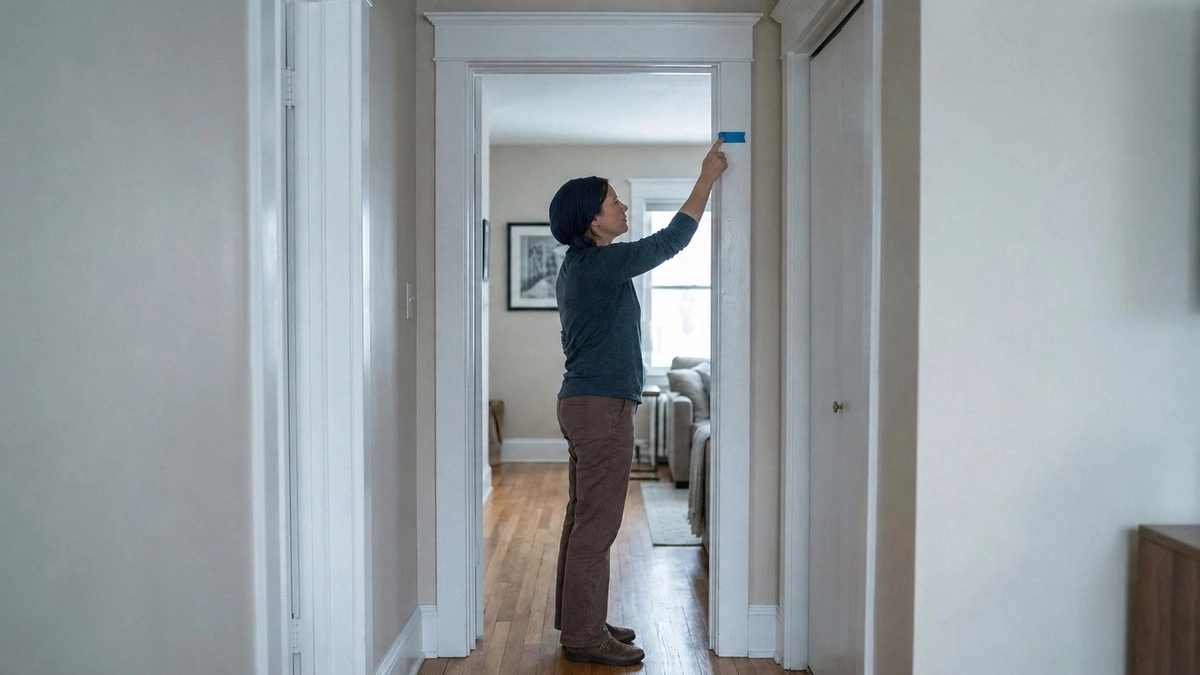
Where to Place a Mezuzah: Complete Doorpost Rules (Height, Side, and Angle)
The Torah commands us to write these words “on the doorposts of your house and on your gates” (Devarim 6:9). The Gemara derives that the mezuzah is placed on the right side of the entrance as one enters, and Rambam (Hilchot Mezuzah 6:12) rules that if it is placed on the left, it is invalid.
Where to Place a Mezuzah: The Short Answer
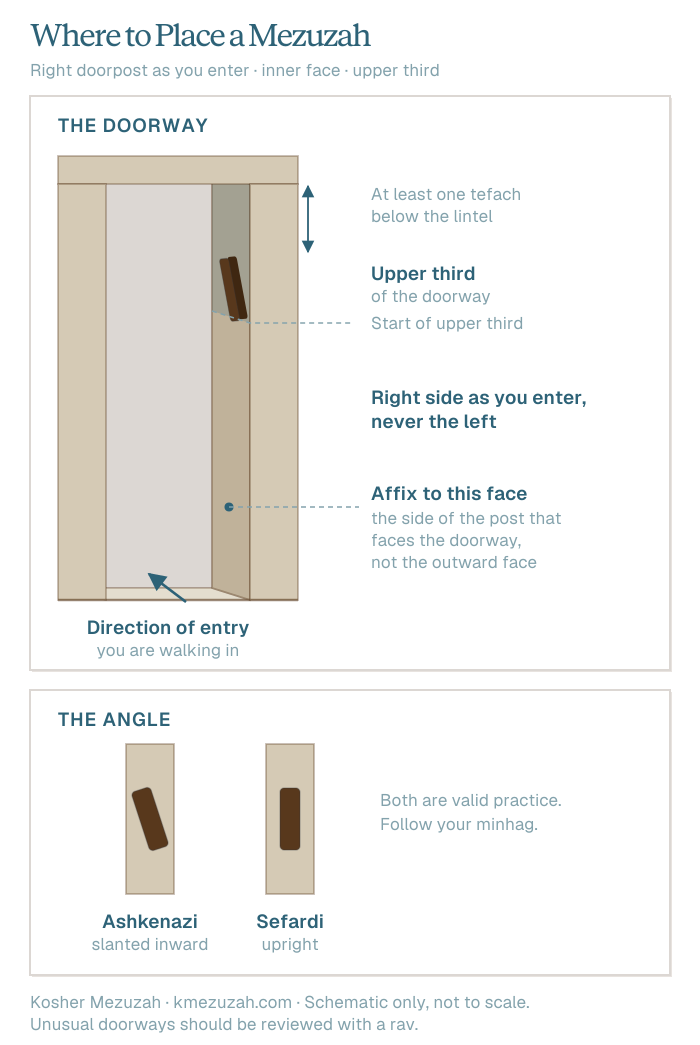
- Side: the right doorpost as you enter the room or the house (Menachot 34a; Shulchan Aruch, Yoreh Deah 289:2).
- Face: the inner face of the doorpost, the surface that looks across the doorway, not the face pointing outward.
- Height: the bottom of the mezuzah at the start of the upper third of the doorway, and at least a tefach below the lintel.
- Depth: within the outer tefach of the doorpost, closest to the outside of the entrance (Menachot 33b).
- Angle: Ashkenazim slant it with the top tilted inward. Sefardim affix it upright.
- Attachment: fixed firmly to the doorpost. A mezuzah that hangs loose or merely rests in place is not validly affixed.
Each of these is explained in full below.
Side: The Right Doorpost as You Enter
The mezuzah goes on the right side of the doorway from the perspective of a person entering, not leaving. Stand where someone normally walks into the room, and the doorpost on your right is the correct one. Rambam rules that a mezuzah affixed on the left is invalid, so this is a binding requirement rather than a custom. Where a doorway is used in both directions, or where it is not obvious which room is being entered, the determination takes more care, and our guide to which side of the door a mezuzah goes on works through those cases.
Which Face of the Doorpost?
A doorpost has more than one surface, and the mezuzah belongs on the inner one: the face that looks across the doorway toward the opposite post, within the thickness of the door frame. It does not go on the flat outward face of the frame that faces along the wall, which is where people most often put it by mistake.
On a deep frame this distinction is obvious once you see it. On a shallow frame the two surfaces are close together and the error is easy to make. If your doorway has an unusually deep reveal, our guide to mezuzah placement on a deep door frame works through where the scroll should sit.
Height: Upper Third of the Doorpost
The Shulchan Aruch (Yoreh Deah 289:2) rules that the mezuzah must be placed in the upper third of the doorpost. The upper third begins at the point two-thirds of the way up and extends to the top. The ideal placement is at the beginning of that upper third. Placing the mezuzah too low, in the middle or lower third of the doorpost, is a common mistake that affects proper fulfillment of the mitzvah and should be corrected. Our guide to mezuzah height covers how to measure the upper third on doorways of unusual proportions.
Depth: Within the First Tefach
The mezuzah must be placed within the first tefach (handsbreadth) of the doorpost closest to the outside. This is derived from the Gemara in Menachot 33b and codified by the Shulchan Aruch. Practically, this means the mezuzah should be fixed close to the exterior side of the doorway, while still being securely attached in the proper place.
Angle: Diagonal or Vertical?
This is the most well-known point of practical disagreement in mezuzah placement.
The Rambam rules that the mezuzah should be placed upright along the length of the doorpost.
The Rama writes that because there are differing opinions about the proper orientation, the Ashkenazi custom is to place the mezuzah at a diagonal, tilted with the top angling toward the inside of the room.
Ashkenazim follow this ruling.
Sefardim follow the Shulchan Aruch and place the mezuzah vertically upright.
How to Affix It
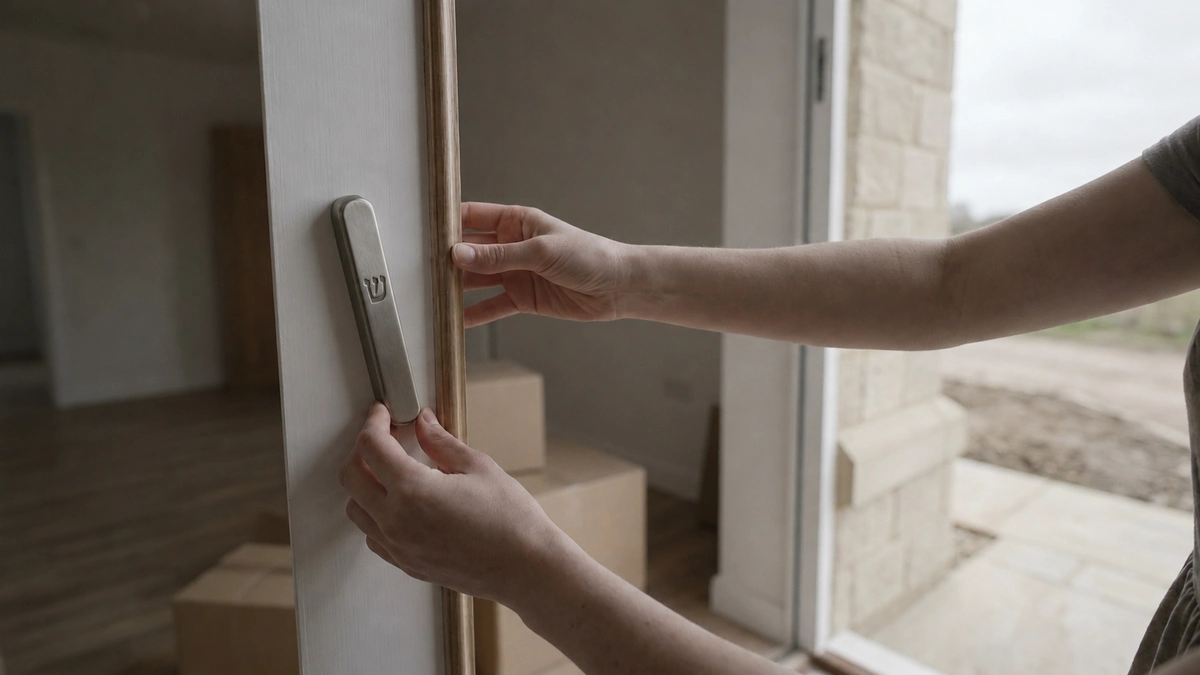
The mezuzah must be affixed securely to the doorpost. A mezuzah case attached firmly to the doorpost satisfies this requirement. A mezuzah that is merely propped in place, resting loosely, or otherwise not properly fixed does not constitute a valid placement.
At the same time, the mezuzah should not be set into a carved-out cavity within the doorpost itself in a way that treats the groove as its placement, since the classic sources treat that as invalid. In unusual architectural situations, such as marble, metal, or glass framing, practical placement should be reviewed with a competent halachic authority.
The mezuzah blessing is recited immediately before the scroll is fixed in place, never after. If you are affixing mezuzot on several doorways in one session, a single blessing covers all of them.
Which Doorways Require a Mezuzah?
These placement rules only apply to a doorway that is obligated in the first place. In brief, a doorway generally requires a mezuzah when it has two doorposts and a lintel and serves a room used for living. Bathrooms are exempt, and rooms smaller than four amos by four amos are usually exempt. For the room-by-room detail, see which doors need a mezuzah and how many mezuzahs a home needs.
The Most Common Placement Errors
Three errors account for most of what goes wrong: the wrong side of the doorway, mounting at eye level rather than in the upper third, and a correct installation built around a scroll that is not kosher. Any of the three means the mitzvah is not being fulfilled as it should be. A printed or invalid scroll in a correctly mounted case is the one people notice least, because nothing about the doorway looks wrong. Our full breakdown of mezuzah placement mistakes covers each one and how to correct it.
About Kosher Mezuzah
At Kosher Mezuzah, every scroll we carry is written by a vetted sofer, checked by a trained magiah, and documented with the sofer's name, the writing date, and an image of your scroll. Placement matters, and so does what is inside the case. If you have questions about a specific doorway, shared entrance, or unusual architectural situation, we're happy to help you think through the halachic considerations.
Conclusion
Mezuzah placement is precise: right side of the doorway as you enter, on the inner face of the doorpost, upper third of its height, near the outer side of the entrance, affixed securely, and angled according to your community's custom. Get the placement right, verify the scroll is kosher, and check it on schedule. That's the complete fulfillment of this mitzvah.


.svg)
Bring a true Kosher Mezuzah into your home
Fulfill the mitzvah with confidence, beauty, and meaning.
Buy a Mezuzah