

Buy a Mezuzah in Philadelphia: Your Guide to Authentic Kosher Scrolls
Looking to buy a mezuzah in Philadelphia? This guide explains what makes a mezuzah truly kosher, how to verify the sofer and certification, and where families can find mezuzos locally or online. Learn how to fulfill the mitzvah according to proper halachic standards.
When you buy a mezuzah in Philadelphia, you are on your way to fulfilling one of the Torah's daily mitzvos with precision and reverence. The mitzvah of affixing a mezuzah to your doorposts brings kedushah (holiness) into your home, ensuring that every detail of the scroll, from the parchment to the letters, meets the halachic requirements outlined in Shulchan Aruch. For a related question, see Buy a Mezuzah in New York City.
Many families assume that if a mezuzah is sold in a Jewish store, it must be kosher. But the mezuzah market today operates without centralized oversight, and not all scrolls are written, checked, or verified to the same standard.
Our mission at Kosher Mezuzah is to help you understand what makes a mezuzah truly kosher and how to make an informed choice rooted in halacha, not guesswork. If you have questions about which mezuzah is right for your home, we are here to guide you with transparency and clarity.
What to Look for When Buying a Mezuzah
The Scroll: Handwritten on Kosher Klaf by a Qualified Sofer
Every kosher mezuzah begins with a scroll that is handwritten by a trained sofer using parchment and ink that must meet stringent halachic requirements. The sofer must write each of the 713 letters of the mezuzah text with kavanah (intent) and yiras Shamayim (fear of Heaven), knowing that what he writes will be placed on a Jewish doorpost to fulfill a mitzvah d'Oraysa (Torah commandment). The parchment must come from a kosher animal and be prepared in a way that ensures durability and halachic validity. The ink must be formulated according to traditional standards and must not fade or flake over time. If any of these elements are compromised, if the scroll is printed, if the klaf is not kosher, or if the sofer lacks proper training, the mezuzah is pasul (invalid), and the mitzvah is not fulfilled.
Verification and Certification You Can Trust
Even a scroll that is handwritten by a qualified sofer must be checked by a trained magiah (inspector) before it can be considered kosher. The halachos of STaM (Sifrei Torah, Tefillin, and Mezuzos) are intricate and interdependent, covering not only letter formation and spacing but also the order of writing, proper intent, and the structural integrity of the klaf. A magiah examines each letter for form, proportion, and spacing, ensuring that no two letters touch, and that no required element, such as a crown on certain letters, is missing or malformed.
This process requires extensive training and a deep understanding of halachic texts. Without rigorous checking, even small, invisible errors can render a mezuzah invalid. Because the halachos (laws) of mezuzah are so intricate and complex, it's important to have oversight and a rigorous approval process to offer consumers transparency and reliability when purchasing a mezuzah.
Understanding Halachic Standards for Your Mezuzah Purchase
Who Wrote and Checked Your Scroll?
One of the most fundamental questions to ask before purchasing a mezuzah is this: Who wrote the scroll, and who checked it? These are not incidental details. The halachic validity of a mezuzah depends entirely on the integrity, training, and intent of the sofer who wrote it and the magiah who inspected it. A sofer must be a shomer Shabbos, halachically observant Jew who has studied the laws of STaM and has trained under a recognized authority. He must write each letter with the proper form, proportion, and spacing, and he must do so lishmah, with the specific intent to create a kosher mezuzah scroll. The magiah must then verify that every letter meets the exacting standards set forth in halacha, checking for negiyos (letters touching), missing tagin (crowns), improper spacing, and other invalidating errors. If you cannot verify who wrote and checked your mezuzah, you cannot verify its kashrus. At Kosher Mezuzah, every scroll includes this documentation, along with a QR code that links to a digital record of the scroll's production and checking history.
Where to Find a Mezuzah Store in Philadelphia
Local Judaica Shops and Community Resources
Philadelphia is home to a vibrant Jewish community with several local Judaica stores that serve families across the region. These stores provide an important resource for ritual items, Shabbos supplies, and Jewish books, and many families have longstanding relationships with the proprietors. The table below lists local Judaica stores in Philadelphia for informational purposes only. Inclusion in this list does not constitute endorsement or evaluation of any kind. We acknowledge the role these businesses play in supporting Jewish life in Philadelphia, while also emphasizing that regardless of where you purchase a mezuzah, verifying its kashrus and documentation remains your responsibility.
| Store | Area | What they carry |
|---|---|---|
| Jerusalem Israeli Gift Shop | Northeast Philadelphia (Castor Ave) | Judaica, mezuzos, cases |
| Bala Judaica & Gifts | Bala Cynwyd | Judaica, mezuzos, accessories |
These stores are listed for informational purposes only. Inclusion does not imply endorsement or evaluation of the kashrus of any mezuzos they carry. Ask each store who wrote the scroll, who checked it, and what documentation is available.
Local Judaica stores typically sell mezuzahs that have been written and checked by sofrim and magihim elsewhere in the supply chain. As a result, the store may not always have immediate access to documentation about who wrote a given scroll, who checked it, or when it was produced. This is not a reflection of the store's integrity or professionalism. It is simply the structural reality of retail distribution in an industry that lacks uniform oversight.
Questions to Ask Before You Buy
Before purchasing a mezuzah, whether in a Philadelphia PA mezuzah store or online, ask the seller:
- Who wrote this scroll, and can you provide the sofer's certification?
- Who checked this scroll, and can you provide the magiah's credentials?
- Does the mezuzah include documentation or traceability?
If these questions cannot be answered clearly, that is a sign the mezuzah may lack proper verification. A mezuzah is an embodiment of a mitzvah d'Oraysa and deserves rigorous accountability.
Understanding the Importance of a Mezuzah Certification Process
The OU's kosher mezuzah certification program introduces a standard of traceability and accountability to mezuzah production just as it does to food kashrus, ensuring every verified scroll is written to the highest standards and checked by verified individuals.
When you purchase an OU-approved mezuzah, you receive full transparency about its origin and halachic integrity. Each mezuzah arrives in a tamper-proof sleeve detailing who the sofer and magihim were, when it was written, what materials were used, and when it should next be checked. It also includes a unique QR code for certification verification, a high-quality image of the actual scroll, and, if unrolled, a video guide demonstrating how to roll it properly to prevent damage.
Why Many Philadelphia Families Order Online
In a market without standardized oversight, many Philadelphia families have found that ordering a mezuzah online from a trusted, OU Endorsed source offers a level of halachic assurance and transparency that may be difficult to obtain through traditional retail channels.
Kosher Mezuzah is one of the few merchants that have earned the OU's mezuzah program, thanks to their high standards and compliance with the standards the OU has set. When you order from Kosher Mezuzah, you receive a scroll that was handwritten in Israel by a vetted sofer, checked by trained magihim, and packaged with tamper-evident seals and QR-based verification. You also receive documentation that clearly identifies the individuals responsible for writing and checking your mezuzah, as well as guidance on when it should be inspected in the future.
Ordering online does not mean abandoning community or convenience. It means prioritizing the verifiable fulfillment of a mitzvah d'Oraysa in a market where trust must be earned through process, not proximity. Even families who deeply value supporting local Jewish businesses recognize that halachic responsibility sometimes requires choosing the option that offers the clearest path to certainty. If you are preparing to affix mezuzahs in your Philadelphia home and want to ensure every scroll meets the highest halachic standards, we invite you to explore our collection or contact us with your questions.
How Many Mezuzahs Does Your Philadelphia Home Need?
The Torah commands us to place a mezuzah on "the doorposts of your house and upon your gates," and Chazal (our Sages) have clarified that this obligation applies to most doorways within the home, not only the front entrance. A typical Philadelphia home, whether a rowhouse in South Philly, a twin in the Northeast, or a single-family home in the suburbs, will require multiple mezuzahs. Every doorway that leads into a room used for living purposes and that meets the minimum size requirement (a room of at least four amos by four amos, roughly six feet by six feet) is obligated in mezuzah. This includes bedrooms, living rooms, kitchens, dining rooms, and hallways. Bathrooms, closets smaller than the minimum size, and certain utility rooms may be exempt, but the general rule is that if a room is part of the home's functional living space and has a proper doorway, it requires a mezuzah. A three-bedroom home might need six to twelve mezuzahs depending on its layout. When you move into a new home or apartment in Philadelphia, take the time to walk through each room with a halachic checklist in mind, and consult with a rav if you are uncertain about any particular doorway. Planning ahead allows you to fulfill the mitzvah properly from the outset.
| Doorway | Mezuzah required? | Notes |
|---|---|---|
| Front entrance | Yes | Right side as you enter, upper third of the doorpost |
| Bedrooms | Yes | Includes children's rooms and guest rooms |
| Kitchen and dining room | Yes | If the room has a proper doorway |
| Living room and family room | Yes | Including archways without doors, ask your rav about width |
| Home office and study | Yes | Any room used for living purposes |
| Hallways and interior arches | Usually | Depends on structure, confirm with your rav |
| Garage | Depends | Based on use and connection to the house, ask your rav |
| Porch, deck, or balcony | Depends | Ask your rav |
| Bathrooms | No | Exempt |
| Small closets and pantries | Usually no | Exempt if under the minimum size, ask your rav |
Mehudar Versus Standard: What the Difference Means
Within the category of kosher mezuzahs, there exists a distinction between those that are simply kosher and those that are mehudar (beautified or enhanced). A mehudar mezuzah is written with extra care, often by a more experienced sofer, with extra attention and craftsmanship given to the writing. The letters may be more uniform, the spacing more balanced, and the overall appearance more refined. Some families seek mehudar mezuzahs out of a desire to fulfill the mitzvah in the most beautiful way possible, a concept known as hiddur mitzvah.
Navigating Script Styles and Community Minhag
Mezuzah scrolls are written in a variety of traditional scripts, including Beis Yosef (Sephardic), Ari (Chassidic), and Velish (Litvish). Each script reflects the mesorah (tradition) of a particular community and follows slightly different conventions in letter formation and style.
When choosing a script for your mezuzah, the primary consideration should be your family's minhag or the guidance of your rav. If you are Ashkenazi and your community follows Litvish customs, a Velish script may be most appropriate. If your family has Sephardic roots, a Beis Yosef script may be the best choice. If you are a baal teshuvah or a convert and do not yet have an established minhag, consult with your rav to determine which script is appropriate for you. The key is not to choose based on appearance or price, but based on mesorah and halachic guidance. Every script, when written properly, produces a fully kosher mezuzah.
The Mezuzah Case: Protection and Beauty for Your Doorpost
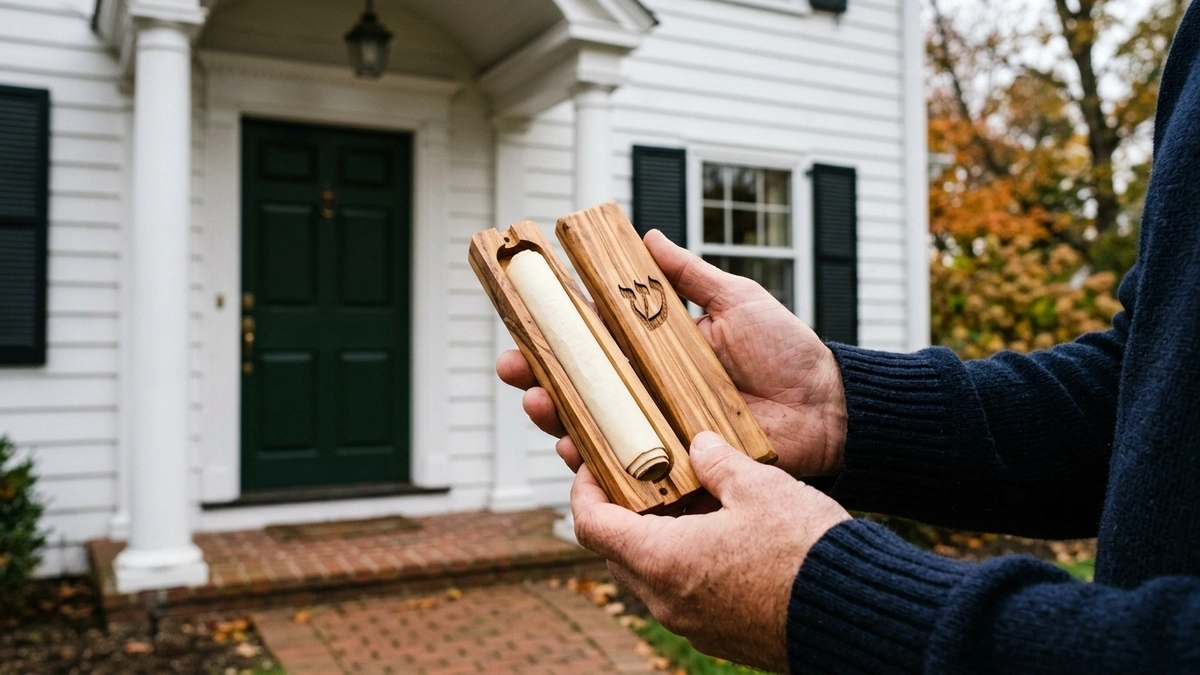
Once you have ensured that your scroll is kosher, you will need a protective case that shields the parchment from moisture, sunlight, and handling while also reflecting the dignity of the mitzvah. The case should be durable, appropriately sized for the scroll, and constructed in a way that allows secure attachment to the doorpost. Many families choose cases that reflect their aesthetic preferences, from simple plastic to hand-carved wood or silver, but the primary purpose of the case is protection, not decoration. The scroll inside is what fulfills the mitzvah. A beautiful case that houses an invalid scroll does not fulfill the Torah's command, while a modest case that protects a kosher scroll does. When selecting a case, ensure that it can be securely fastened and that it provides adequate coverage of the scroll without trapping moisture.
Rowhouses, Older Doorframes, and Philadelphia Placement Questions
Philadelphia's housing stock is among the oldest in the country, and the classic rowhouses of Northeast Philadelphia and the older homes of Bala Cynwyd bring doorway questions that newer construction rarely raises. Deep-set frames, angled vestibule entrances, shared entry doors, and doorways without a conventional post on the right side all appear regularly in Philadelphia homes, and each affects where and whether a mezuzah belongs.
The principles are well established in halacha, but applying them to a nineteenth-century doorframe is exactly the kind of question to bring to your rav, ideally with a photo in hand. Our article on mezuzah placement in deep door frames addresses one of the most common older-home situations in detail.
What does not change with the age of the house is the scroll itself. Whether it will hang in a new Main Line build or a rowhouse that has seen a century of Jewish families, the mezuzah must be written, checked, and maintained to the same halachic standard. Kosher Mezuzah documents that standard for every scroll, so the only questions left for your Philadelphia home are the placement ones.
Which Mezuzah Scroll Is Right for Your Philadelphia Home?
Kosher Mezuzah writes three scroll styles, and each ships to Philadelphia with full documentation from an OU Endorsed writing and checking process. The Sefardi mezuzah scroll follows the ksav used in Sephardic and Mizrachi communities. The Ashkenaz Beis Yosef mezuzah scroll is the standard for most Ashkenazi homes. The Arizal mezuzah scroll follows the script favored in Chassidic communities. Each is available in 4.7 inch and 5.9 inch sizes across several quality tiers. If you are unsure which script matches your family's minhag, ask your rav, or contact us and we will help you choose.
Conclusion
The mitzvah of mezuzah is one of the Torah's most visible and enduring commandments, marking our homes as places of kedushah and reminding us daily of our connection to Hashem.
When you buy a mezuzah in Philadelphia, you are making a halachic decision that will affect your family's fulfillment of this mitzvah for years to come. The mezuzah market today presents real challenges. Without uniform oversight or standardized verification, it can be difficult for even well-intentioned buyers to assess the kashrus of a given scroll. That is why OU endorsement exists, to provide transparency, traceability, and confidence in a market where trust must be earned through documentation and process, not assumptions. Whether you choose to purchase locally or online, the key is to prioritize halachic integrity, ask the right questions, and seek out sellers who can provide clear answers.
At Kosher Mezuzah, we are dedicated to ensuring that every scroll we offer meets the highest standards of kashrus and is accompanied by the documentation you need to fulfill the mitzvah with certainty. If you are ready to affix mezuzahs in your home or have questions about what to look for, please contact us or call us at +1 848-356-9471. May the mitzvah of mezuzah bring blessings, protection, and the presence of the Shechinah into your home and the homes of all Klal Yisrael.



.svg)
Bring a true Kosher Mezuzah into your home
Fulfill the mitzvah with confidence, beauty, and meaning.
Buy a Mezuzah