

The Pittsburgh Mezuzah Guide: Finding Authentic Kosher Scrolls and Cases in the Steel City
When you set out to buy a mezuzah in Pittsburgh, you are fulfilling a sacred mitzvah, one that sanctifies the doorways of your home and marks it as a place where Hashem's presence dwells. Every Jewish household is commanded to affix a kosher mezuzah on every doorpost, and that requirement carries real halachic weight. It means that the scroll inside must be handwritten by a qualified sofer, checked by a trained magiah, and written on properly prepared klaf with kosher dio. The mitzvah cannot be fulfilled unless all the intricate laws pertaining to the mitzvah are met.
Pittsburgh's Jewish community has access to local Judaica stores, online options, and rabbinic guidance, but navigating the mezuzah market requires knowledge. At Kosher Mezuzah, we are dedicated to ensuring the proper fulfillment of the mitzvah of mezuzah. Our mission is to bring transparency and halachic integrity to every scroll we provide. If you want to learn more about what makes a mezuzah truly kosher, explore our documented collection and see the documentation that accompanies each one.
Why Local Shopping for Mezuzahs Matters
Pittsburgh has a long and vibrant Jewish history, with synagogues, schools, and institutions that have served the community for generations. Many families naturally turn to local Judaica stores when they need a mezuzah, and there is something deeply meaningful about walking into a shop where the staff knows your name and your family. Local stores are often trusted fixtures in the community, and they carry not only mezuzahs but also Shabbos candlesticks, Havdalah sets, and other items that bring kedushah into the home. For families who want to support local Jewish businesses and maintain a personal connection with the people who serve them, shopping locally is a valued option.
At the same time, it is important to recognize that purchasing a mezuzah is not the same as purchasing a menorah or a tallis bag. Many of the requirements for a kosher mezuzah are not immediately visible, such as the precise formation of each letter, the proper spacing between words, the quality and preparation of the klaf (parchment), and the correct composition of the ink. Even subtle deviations in any of these areas can invalidate the scroll, which is why verification by knowledgeable authorities is essential.
This means that the question of where to buy a mezuzah in Pittsburgh is not only about convenience or community connection. It is also about verification, transparency, and confidence that the mitzvah is being properly fulfilled.
Many buyers assume that if a mezuzah is sold in a reputable store, it must be kosher. That assumption is understandable, but it does not always reflect the realities of the mezuzah market. Local stores are often not the original writers or checkers of the scrolls they sell. They purchase mezuzahs from suppliers, and those suppliers may or may not provide full documentation of who wrote the scroll, who checked it, and when it was written. This does not mean that local stores are acting in bad faith. It simply reflects the structure of retail distribution, where distance from the source often means limited visibility into the process. Buyers who want to fulfill the mitzvah with confidence need to understand what questions to ask and what kind of documentation to look for, regardless of where they choose to purchase.
Mezuzah Stores in Pittsburgh: Where to Find Authentic Scrolls
Judaica Shops and Synagogue Gift Shops
Pittsburgh is home to several Judaica retailers and synagogue gift shops that carry mezuzah scrolls and cases. These stores play an important role in making Jewish ritual items accessible to the local community. Below is a reference list of some local options for informational purposes only. Inclusion on this list does not imply endorsement or evaluation of any kind.
the heart of Squirrel Hill, Pinsker's Judaica Center offers a wide selection of mezuzah scrolls, decorative housings, and a variety of Judaica essentials. Also located in the same neighborhood, the Temple Sinai Judaica Shop carries mezuzos alongside ritual objects and gift items commonly used for Jewish practice and celebrations.
A short distance away in Shadyside, Gift Corner Judaica serves the local community with mezuzah scrolls, cases, and a range of Jewish gifts and household ritual pieces, making it another option for families looking to obtain items connected to daily observance and tradition.
These shops are community resources, and many families have relationships with them that span years or even decades. They serve an important function in making ritual items available locally, and the people who run them are often deeply committed to serving the Jewish community with integrity and care.
What to Ask When Shopping Locally
When you enter a Judaica store to buy a mezuzah in Pittsburgh, it is important to ask the right questions. Begin by asking who wrote the mezuzah. A kosher mezuzah must be handwritten by a qualified sofer, and the name of that sofer should be available. Ask who checked the mezuzah after it was written. Every mezuzah must be inspected by a trained magiah, and ideally that person's name should also be documented. Ask when the mezuzah was written and when it should be checked again, because mezuzahs can deteriorate over time and must be inspected periodically.
If the store cannot provide this information, it does not necessarily mean the mezuzah is pasul. It means that you do not have the documentation needed to verify its kashrus independently. In a market without standardized oversight, documentation becomes the primary tool a buyer has to ensure that the mitzvah is being properly fulfilled. Without it, the buyer is left to trust the store, the supplier, and the chain of custody, none of which are required by halacha to maintain records. This is not a criticism of any individual store. It is simply a structural limitation of the retail process.
The Benefits of Buying Online: Transparency and Verification
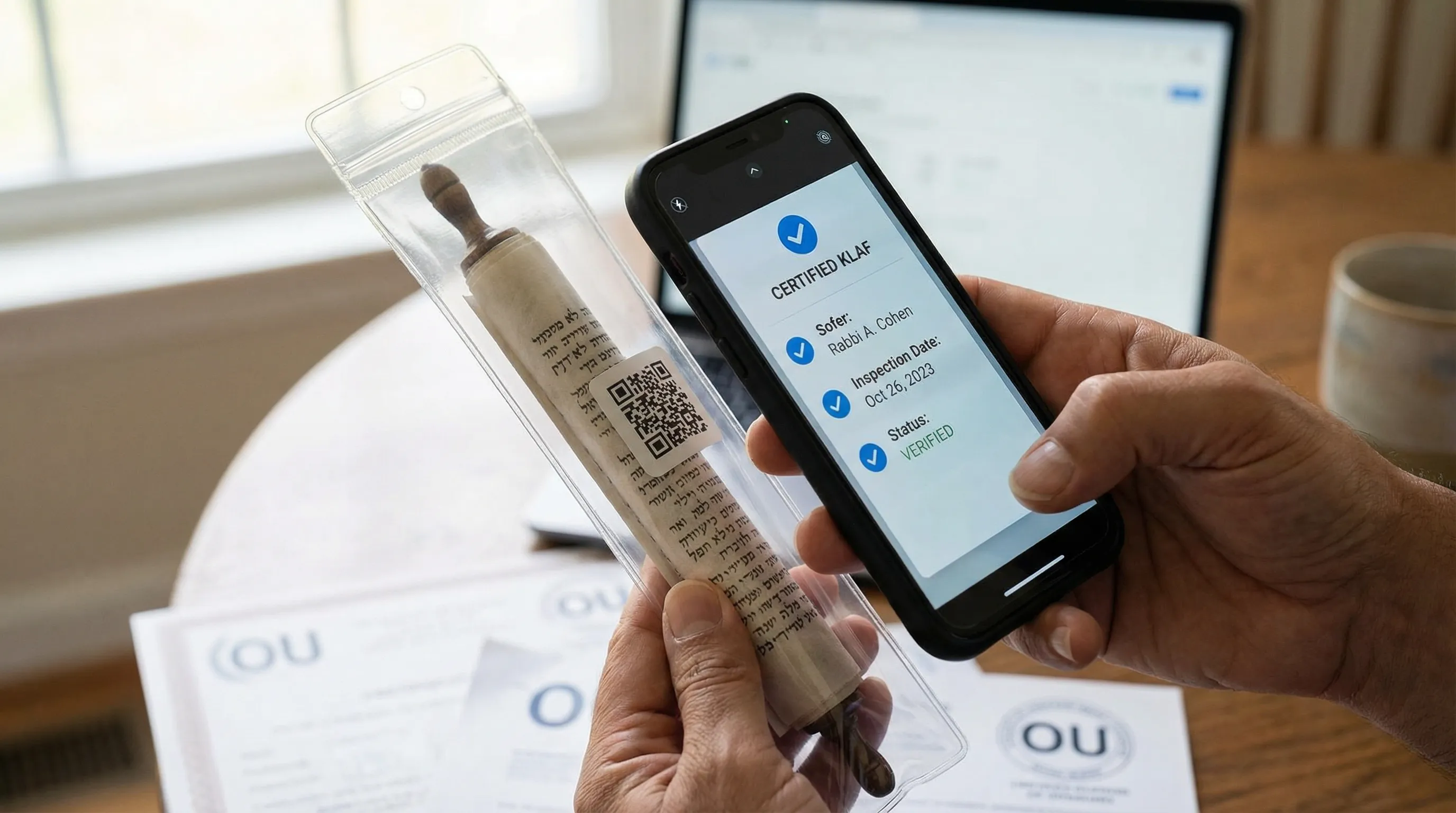
Buying a mezuzah online is less personal or less trustworthy than purchasing locally, as online buying introduces an additional layer of complexity that requires careful consideration. Since you cannot inspect the scroll in person before it arrives, there is naturally more uncertainty about its authenticity and quality. Without proper verification, buyers must rely heavily on trust, which increases the risk of receiving a mezuzah that does not fully meet halachic requirements.
| Consideration | Local Judaica store | Kosher Mezuzah (online) |
|---|---|---|
| Named sofer and magiah | Sometimes available on request | Included with every scroll |
| Date of writing and checking | Rarely documented | Included with every scroll |
| Image of your actual scroll | Not usually provided | Linked by QR code |
| Tamper-evident packaging | Varies by store | Standard |
| OU Endorsed process | Depends on supplier | Yes, company-wide |
| See the scroll in person before buying | Yes | No, image and documentation instead |
| Same-day pickup | Often | No, ships in 3 to 5 business days |
| Supports a local Jewish business | Yes | No |
However, the opposite is often true when it comes to halachic verification through documented online sources like Kosher Mezuzah that can provide a level of transparency and documentation that is difficult to replicate in a traditional retail setting. Each mezuzah we provide is handwritten in Israel by a vetted sofer, checked by trained magihim, and accompanied by full documentation that includes the name of the sofer, the name of the magiah, the date of writing, and the materials used. We also provide tamper-evident packaging and QR-based verification, so you can confirm the kashrus of your mezuzah at any time.
This is not a matter of convenience or speed. It is a matter of halachic responsibility. When you purchase a verified mezuzah online, you receive a scroll that has been vetted through a process supervised by the Orthodox Union, one of the most trusted names in kosher certification. You know exactly who wrote it, who checked it, and when it was produced. You have access to the documentation that proves it meets the highest halachic standards. This level of accountability that Kosher Mezuzah provides is not always available through local retail channels, not because local stores are negligent, but because the structure of the market does not require them to maintain such records.
How Online Verification Systems Work
When you purchase a mezuzah from our OU Endorsed process from Kosher Mezuzah, the scroll arrives in a tamper-evident sleeve with a QR code. Scanning that code gives you access to the full history of the mezuzah. You can see the name of the sofer who wrote it, the magiah who inspected it, and the date it was completed. With this certification, buyers can be assured that every aspect of the mezuzah preparation and writing complies with the intricate halachos involved, from letter formation and spacing to the checking process and final verification.
Verification systems like this address a core problem in the mezuzah market, which is that most buyers have no way to independently assess whether a scroll is kosher. The halachos of STaM are deeply technical, and even small errors in letter formation, spacing, or intent can render a mezuzah pasul. A trained sofer spends years learning these halachos, and a trained magiah spends years learning how to inspect for them. A consumer walking into a store does not have that training, and cannot be expected to evaluate kashrus based on appearance alone. Certification from a Rabbinic authority provides the transparency that allows a buyer to fulfill the mitzvah with confidence.
Avoiding Common Pitfalls in the Mezuzah Market
The mezuzah market is largely unregulated, and that lack of oversight has created opportunities for problems to persist. Some mezuzahs are printed rather than handwritten, which renders them completely invalid. Some are written by individuals who lack proper training or certification. Some are checked only briefly or not at all. These issues are not unique to any one city or region. They reflect a systemic challenge that exists across the market, and they affect buyers who purchase locally as well as those who purchase online.
Certification exists to address these challenges. When you purchase a mezuzah from our OU Endorsed process, you are buying a scroll that has been produced and inspected according to a consistent standard. The sofer is vetted, the materials are verified, and the checking process is rigorous. The certification is not a marketing claim. It is a documented process that provides accountability at every stage. For buyers in Pittsburgh who want to fulfill the mitzvah properly and avoid the pitfalls of an unregulated market, purchasing a verified mezuzah online is often the wiser hishtadlus. If you are ready to bring a kosher mezuzah into your home, contact us for guidance and we will help you choose the right scroll for your needs.
What to Look for in Any Mezuzah Purchase
The Sofer, the Magiah, and Halachic Standards
The sofer is the individual who writes the mezuzah, and not every scribe is qualified to do so. A kosher sofer must be a yarei Shamayim, a G-d-fearing Jew who understands the halachos of writing STaM and who writes with the proper intent. He must declare before writing that he is doing so for the sake of the mitzvah, and he must maintain that kavanah throughout the entire process. The sofer must also be trained in the precise formation of every letter, the proper spacing between words and columns, and the many other details that determine whether a mezuzah is kosher.
After the sofer completes the mezuzah, it must be checked by a magiah. The magiah is a trained inspector who examines every letter and every word to ensure that no errors were made. Even a single letter that is malformed, touching another letter, or written without proper intent can render the entire mezuzah pasul. The magiah's role is to catch those errors before the mezuzah is sold. A mezuzah that has not been properly checked cannot be considered reliably kosher, no matter how beautiful it appears or how reputable the store that sells it.
Materials: Klaf, Dio, and Proper Preparation
The materials used to write a mezuzah are just as important as the writing itself. The parchment, known as klaf, must come from the skin of a kosher animal and must be prepared in a way that is suitable for writing holy texts. The ink, known as dio, must be black, durable, and made according to halachic specifications. If the klaf or dio are not kosher, the mezuzah is not kosher, regardless of how skillfully it was written. These details are not visible to the untrained eye, which is why documentation and certification are so important.
Buyers who want to ensure that their mezuzah meets these standards should ask for documentation of the materials used. A reputable seller should be able to tell you whether the mezuzahs were produced according to halachic requirements. If that information is not available, the buyer is left to trust without verification, and trust alone is not a substitute for halachic diligence.
Choosing the Right Mezuzah Case for Your Pittsburgh Home
Once you have a kosher mezuzah scroll, you will need a case to protect it. Mezuzah cases come in a wide variety of styles, materials, and price points, and the choice is largely a matter of personal preference. Some families prefer simple plastic cases that are durable and inexpensive. Others choose decorative cases made of wood, metal, or ceramic that reflect the beauty of the mitzvah and the character of their home. There is no halachic requirement to use an expensive or ornate case. The essential function of the case is to protect the scroll from moisture, dirt, and damage.
That said, the case you choose should be appropriate for the location where it will be affixed. Mezuzahs placed outdoors or in areas exposed to weather should be housed in waterproof cases, because moisture can damage the klaf and render the mezuzah pasul. Mezuzahs placed indoors can use a wider variety of materials, but even indoor cases should be checked periodically to ensure that the scroll inside remains in good condition. Pittsburgh's climate includes cold winters and humid summers, and both can affect the condition of a mezuzah over time. A case that seals well and keeps moisture out is an important part of protecting the scroll.
At Kosher Mezuzah, we offer a range of cases designed to meet both halachic and aesthetic needs. Each case is selected with care to ensure that it protects the scroll while enhancing the beauty of your home. Whether you are affixing a mezuzah on a new home, replacing an old one, or adding mezuzahs to additional doorways, we are here to help you choose the right case for your needs.
When to Consult Your Local Pittsburgh Rabbi
While this guide provides an overview of what to look for when you buy a mezuzah in Pittsburgh, there are many situations where it is appropriate to consult your local rav. Questions about which doorways require a mezuzah, how to affix a mezuzah in an unusual architectural situation, or whether a particular scroll is still kosher after being exposed to moisture or damage are all questions that should be directed to a halachic authority. Your rabbi knows the specific minhagim of your community and can provide guidance that is tailored to your family's circumstances.
It is also a good practice to have your mezuzahs checked periodically by a trained magiah. Over time, letters can fade, crack, or become damaged, and a mezuzah that was once kosher may no longer be valid. The general recommendation is to check mezuzahs every three and a half years for scrolls in a private home, and more frequently for scrolls in public or commercial spaces. Your rabbi can help you arrange for this checking, or you can work directly with a trained magiah. Regular checking is an act of diligence that ensures the mitzvah continues to be fulfilled properly.
If you have questions about the kashrus of a mezuzah you already own, or if you are uncertain about which mezuzah to purchase, do not hesitate to reach out to us. Kosher Mezuzah ensures each mezuzah scroll meets the highest halachic standards, and we are available to provide guidance and support. You can call us at +1848-356-9471 or reach out with your questions, and we will be happy to help.
How Many Mezuzahs Does Your Pittsburgh Home Need?
Every doorway with two doorposts and a lintel that leads into a room used for living purposes requires a mezuzah, provided the room is at least four amos by four amos, roughly six to seven feet square. Bedrooms, living and dining rooms, kitchens, and home offices are obligated. Bathrooms and small closets are exempt. A typical single-family home needs six to twelve mezuzahs and an apartment three to eight. Walk through your home and count each qualifying doorway, and ask your rav about any you are unsure of.
| Doorway | Mezuzah required? | Notes |
|---|---|---|
| Front entrance | Yes | Right side as you enter, upper third of the doorpost |
| Bedrooms | Yes | Includes children's rooms and guest rooms |
| Kitchen and dining room | Yes | If the room has a proper doorway |
| Living room and family room | Yes | Including archways without doors, ask your rav about width |
| Home office and study | Yes | Any room used for living purposes |
| Hallways and interior arches | Usually | Depends on structure, confirm with your rav |
| Garage | Depends | Based on use and connection to the house, ask your rav |
| Porch, deck, or balcony | Depends | Ask your rav |
| Bathrooms | No | Exempt |
| Small closets and pantries | Usually no | Exempt if under the minimum size, ask your rav |
Generational Homes and Mezuzah Checking in Squirrel Hill
Squirrel Hill is unusual among American Jewish neighborhoods: families stay, homes pass between generations, and it is common for a house to have carried mezuzos for decades. That continuity is a blessing, and it comes with a responsibility that is easy to overlook. A mezuzah that has hung faithfully since a previous generation affixed it may not have been checked in many years, and ink and klaf age even in a well-kept home.
If you have inherited or purchased a home with mezuzos already on the doorposts, the sound course is to have those scrolls examined by a qualified sofer before relying on them for the mitzvah. Some will be perfectly kosher; others may have faded or cracked in ways only a trained eye catches. Our guide on mezuzahs in an inherited home walks through the halachic and practical steps, and your rav can advise on the family dimensions that often accompany them.
For scrolls that need replacement, Kosher Mezuzah provides documented, checked mezuzos in all three script traditions, so the next generation in your home begins with certainty.
Which Mezuzah Scroll Is Right for Your Pittsburgh Home?
Kosher Mezuzah writes three scroll styles, and each ships to Pittsburgh with full documentation from an OU Endorsed writing and checking process. The Sefardi mezuzah scroll follows the ksav used in Sephardic and Mizrachi communities. The Ashkenaz Beis Yosef mezuzah scroll is the standard for most Ashkenazi homes. The Arizal mezuzah scroll follows the script favored in Chassidic communities. Each is available in 4.7 inch and 5.9 inch sizes across several quality tiers. If you are unsure which script matches your family's minhag, ask your rav, or contact us and we will help you choose.
Conclusion
The mitzvah of mezuzah is one that accompanies us every day, marking the doorways of our homes and reminding us of Hashem's presence in our lives. When you set out to buy a mezuzah in Pittsburgh, you are taking on a sacred responsibility, and that responsibility includes ensuring that the scroll you purchase is truly kosher. Local Judaica stores serve an important role in the community, but in a market without standardized oversight, certification and documentation provide the transparency needed to fulfill the mitzvah with confidence. Whether you choose to purchase locally or from a documented online source, the key is to ask the right questions and to seek out mezuzahs that come with verifiable proof of their kashrus.
At Kosher Mezuzah, we are dedicated to ensuring the proper fulfillment of the mitzvah of mezuzah. Every scroll we provide is handwritten by a vetted sofer, checked by trained magihim, and accompanied by full documentation that includes the name of the sofer, the magiah, and the date of writing. We offer Our OU Endorsed writing and checking process and QR-based verification, so you can be confident that your mezuzah meets the highest halachic standards. If you are ready to bring a kosher mezuzah into your home, visit our shop and explore the scrolls and cases we have available.
Your mezuzah should be a reminder of holiness and protection for your home. It should connect you to a chain of tradition that stretches back to Sinai, and it should be written and checked according to the standards that Chazal set down for us. May the mitzvah of mezuzah bring blessings and protection to your home, and may you merit to fulfill it with joy and with confidence that you are doing so properly.



.svg)
Bring a true Kosher Mezuzah into your home
Fulfill the mitzvah with confidence, beauty, and meaning.
Buy a Mezuzah