

Does a Glass Door or Frameless Doorway Need a Mezuzah? The Halachic Answer
As with any doorway, a glass door requires a mezuzah whenever the opening meets the halachic definition of a doorway. The determining factor is not the material, but the structure. A doorway without a physical door may still require a mezuzah according to many authorities, but that point is disputed.
In halacha, a doorway generally requires two sideposts (mezuzot) and a lintel (mashkof). When those structural features are present, the opening may be obligated in mezuzah.
When people ask about glass door mezuzah or frameless door mezuzah, they are usually trying to figure out where the mezuzah should go on a modern doorway that does not look like a classic wood frame.
This is why many questions about glass doorway mezuzah rules come down to structure rather than design. If the glass panel sits within a defined frame with clear sides and a top, the obligation is usually straightforward. When the structure is less obvious—as in frameless or highly modern designs—the question becomes primarily about identifying the doorway and modern door mezuzah placement. For the full discussion, read Do Decorative Doorways Need a Mezuzah? When Design Changes the Rule.
A doorway may be made of glass, metal, narrow trim, or minimalist architectural lines, yet still raise the same practical question: Where is the correct place to mount the mezuzah?
The Real Question Behind Modern Door Mezuzah Placement
Most people asking about a frameless door mezuzah or glass entryway are not really asking if a mezuzah is required—they are asking where it goes.
Modern architecture often removes the visual cues we are used to. Narrow metal frames, minimal trim, or seamless transitions between rooms can make it difficult to tell where the “doorpost” actually is.
But the halachic approach remains consistent: first determine whether the opening qualifies as a doorway, and then identify the correct side and placement area within that structure. This is the foundation of proper modern door mezuzah placement.
Basic Placement Principles
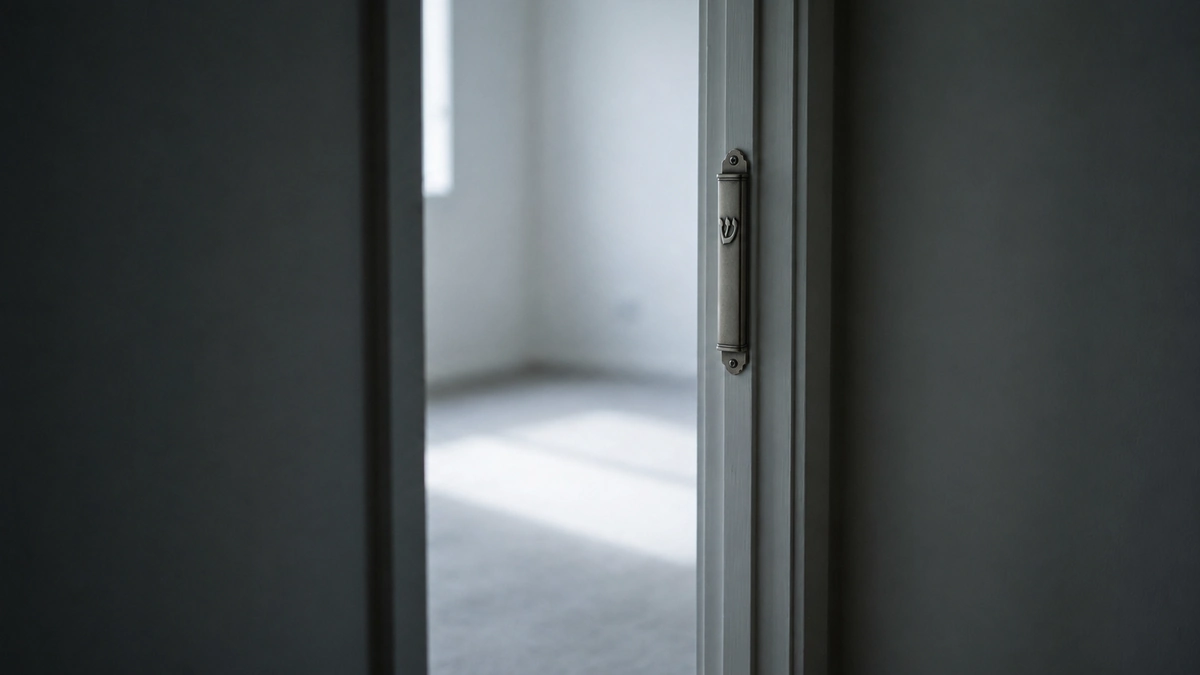
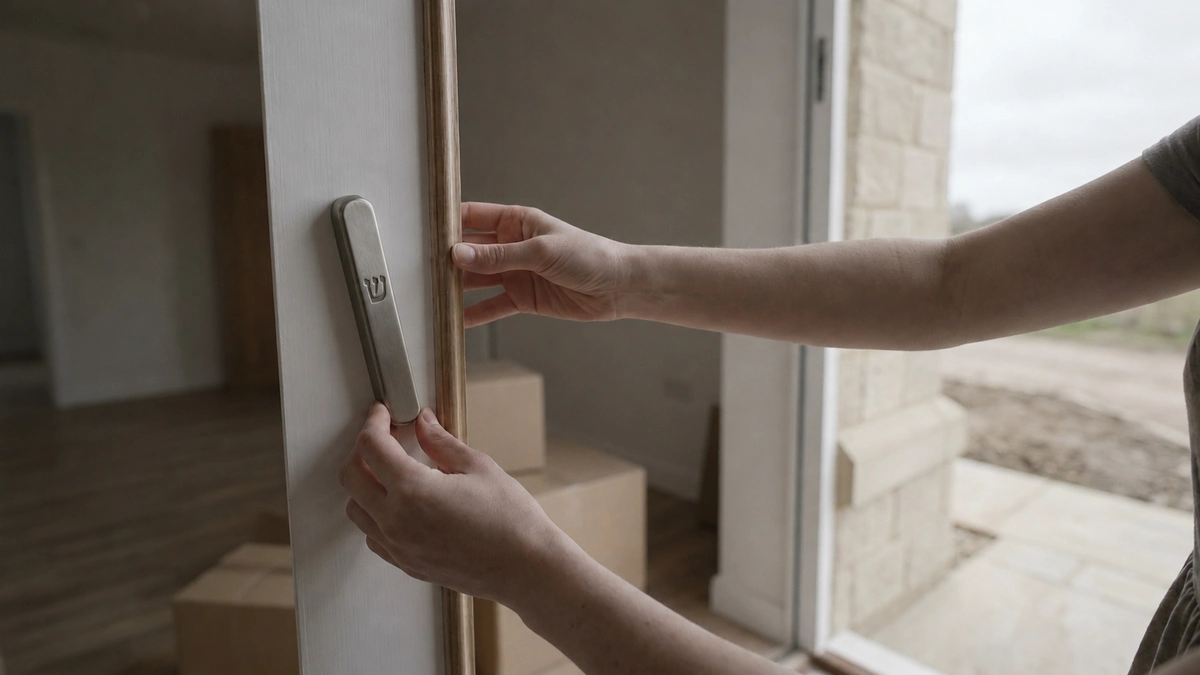
If a doorway needs a mezuzah, place it on the right side when entering. It should be attached inside the doorway opening, near the outer edge of the doorpost. Put it at the lower portion of the upper third of the doorpost’s height.
That rule does not change for modern or glass designs. What does change is how easy it is to identify the correct surface. In many contemporary homes, the challenge is figuring out which part of the opening halachically counts as the sidepost and where the mezuzah belongs within that opening.
Glass Doors: Focus on the Frame, Not the Glass
So when thinking about a glass door mezuzah, the practical answer is usually found by examining the frame and structure—not the transparent center. In many cases, a glass door is set within some kind of frame—even if it is subtle. The mezuzah is generally placed on the structural side of the opening that halachically functions as the doorpost, rather than on the glass panel itself. If there is no clear usable surface on that side, the mezuzah should not be placed arbitrarily; the placement may need rabbinic review to determine whether there is a valid adjacent mounting area.
Frameless Doorways: Defining the Structure
“Frameless” can mean different things, which is why frameless door mezuzah questions can be more nuanced.
Sometimes the door appears frameless, but the opening still has a built-in structure within the wall. In those cases, placement may still be relatively straightforward.
Other times, the design minimizes or conceals the side boundaries to the point that they are hard to identify. When there is no clearly defined surface functioning as a doorpost—or no practical place on that surface to mount the mezuzah—the placement question becomes less obvious and may require rabbinic evaluation before installation.
Modern Design Doesn’t Change the Halacha
Contemporary doorways—pivot doors, slim-profile frames, flush openings—can look very different from traditional ones. But the underlying principles remain the same.
What matters is identifying the right-side boundary of the entrance and the correct mounting zone on that side. Labels like “modern,” “minimalist,” or “all glass” do not determine placement; the actual structure does.
That is why modern door mezuzah placement often comes down to careful observation rather than assumptions.
Archways and Open Entrances
Open-plan layouts often include archways or transitions without standard doors, sometimes combined with glass panels or decorative elements.
An archway glass mezuzah question typically depends on whether the opening has recognizable side boundaries and a top. If it does, there may be a clear placement point. If it is more decorative or lacks defined structure, the situation becomes less certain.
These openings often require more careful consideration than a standard doorway.
Common Placement Mistakes
Many errors come from focusing on appearance rather than halachic structure. For example:
- Placing the mezuzah directly on the glass because it is the most visible surface
- Centering it at eye level for visual symmetry
- Choosing the more convenient side instead of the correct one
- Treating the doorway as a design feature rather than a halachic entrance
A mezuzah is not placed based on aesthetics—it is placed based on the definition of the doorway.
Real-World Examples
- Glass front door with a metal frame:
The relevant placement is usually on the frame or structural side. - Frameless-looking interior opening:
The correct location depends on which part of the wall or opening functions as the sidepost. - Sliding glass door:
These can be more complex due to their structure and usage. - Archway with minimal trim:
The main question is whether it qualifies as an archway glass mezuzah case with a defined structure. - Minimalist pivot door:
The hardware and layout can affect which side is considered the entrance boundary.
In each case, the determining factor is the actual structure—not the design label.
When the Placement Isn’t Clear
If you are unsure where the mezuzah should go, that usually means the doorway needs closer halachic evaluation before installation.
This is especially common with:
- hidden or minimal framing
- extra-wide openings
- curved or partial sides
- unusual entry directions
- glass-heavy or custom designs
A clear photo or short video is often the fastest way to clarify the correct placement. In some modern glass or frameless designs, a rav may need to determine whether there is a halachically valid surface next to the opening for the mezuzah, or whether the case is too uncertain to treat like a standard doorway without further review.
Final Takeaway
With glass doors and modern designs, the mezuzah question is rarely about whether there is an obligation in theory. It is about identifying the correct placement in practice.
In most cases, the answer comes down to locating the true side of the doorway, understanding the structure of the entrance, and placing the mezuzah in the proper position on that side. If you are unsure where to place a mezuzah on a glass door, frameless doorway, or archway, reviewing the structure carefully—or asking for halachic guidance—can help ensure it is placed correctly.
About Kosher Mezuzah
At Kosher Mezuzah, we believe that fulfilling the mitzvah of mezuzah properly begins with having a mezuzah that is genuinely kosher. Every mezuzah scroll we offer is written by a qualified sofer (Torah scribe) and checked by a trained magiah (halachic mezuzah examiner). We carry OU endorsement, one of the most rigorous and trusted kosher certification standards, so you can place each mezuzah on your doorpost with full confidence in its validity.
Beyond the scroll itself, we understand that questions about which doorways require a mezuzah and how to affix it correctly are part of fulfilling the mitzvah fully. Whether your home has glass doors, unusual archways, or modern frameless openings, we are here to help you navigate those questions with halachic clarity. We encourage you to consult your rav for any edge cases specific to your community's custom (minhag) or your particular doorway structure. Our role is to support that process, by providing verified, reliable scrolls and by making the halachic information you need as clear and accessible as possible.
If you have questions about a specific glass door or frameless doorway in your home, reach out to us at Kosher Mezuzah, we are here to help you fulfill this precious mitzvah with clarity and confidence. May the mezuzot on your doorposts be a source of bracha and shmirah for your home and all who enter it.


.svg)
Bring a true Kosher Mezuzah into your home
Fulfill the mitzvah with confidence, beauty, and meaning.
Buy a Mezuzah