

Entering a Home Without a Mezuzah: What Halacha Expects in Each Scenario
You walk up to a doorway and notice there is no mezuzah. Is something wrong? Are you allowed to stay there? Does someone need to act right away? Halacha gives clear guidance — but the answer depends very much on who lives there, where the home is, and why the mezuzah is missing.
The mitzvah of mezuzah is not a decorative extra. It is a constant presence of Hashem at the threshold of a Jewish home. The Rambam writes that when a person encounters the mezuzah each time he goes in and out, he is reminded of the unity of Hashem and is pulled back to the straight path in life (Hilchos Mezuzah 6:13). When the mezuzah is missing where it should be, that reminder is missing too — and halacha treats that absence seriously.
This article walks through the main real‑life scenarios where you come to a doorway with no mezuzah and explains what halacha expects in each case.
Key Takeaways
- Every qualifying Jewish dwelling needs a kosher mezuzah. Owner or renter, man or woman — anyone who dwells in a home that meets the halachic criteria is obligated in mezuzah. The obligation is about who lives there, not just who owns the walls.
- Timing can differ for renters. Outside Eretz Yisrael, a Jewish renter’s full obligation generally begins after thirty days of living there. In Eretz Yisrael, a Jewish renter is obligated as soon as he moves in. A Jewish homeowner is considered obligated once he lives in the home.
- Temporary lack is treated differently from neglect. When a mezuzah cannot be affixed at that moment — for example, it is Shabbos, or a kosher scroll is not currently available — halacha recognizes that reality. At the same time, the situation should be corrected as soon as it becomes possible.
- Guests are not the same as residents. A visitor in someone else’s home without a mezuzah does not take over the obligation. The responsibility rests on the one who dwells there. Still, ahavas Yisrael may call for a gentle, respectful suggestion at the right time.
- Only a kosher, properly written scroll fulfills the mitzvah. A mezuzah that is faded, cracked, improperly written, or otherwise invalid does not count halachically, no matter how beautiful the case may be. The mitzvah is fulfilled only with a kosher scroll written and checked according to halacha.
This article provides general guidance, not personal psak (halachic ruling). Every specific case has details, especially when other people’s homes are involved. Practical questions should be brought to a competent rav who knows the situation.
Kosher Mezuzah exists to help you put this into practice with handwritten mezuzah scrolls from Eretz Yisrael prepared to the highest standards. With OU endorsement, you can fulfill the mitzvah of mezuzah with confidence.
Scenario 1: You Are Preparing to Move Into Your Own New Home
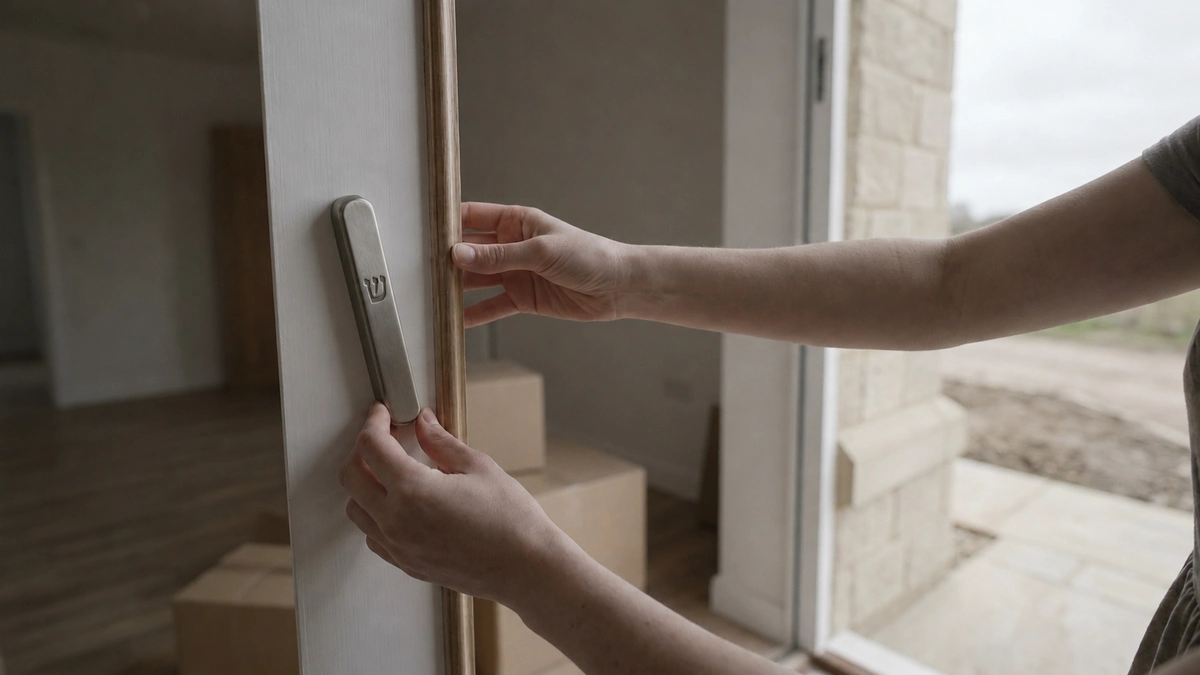
You are getting ready to move into your own new home. Before the boxes arrive and before you sleep there even one night, it is important to think about mezuzos. From a halachic standpoint, a Jewish homeowner is obligated to affix mezuzos to the qualifying doorways of his home once he is actually living there. The classic sources do not give the homeowner the thirty‑day waiting period that can apply to renters outside Eretz Yisrael, so the obligation effectively takes hold as soon as the home becomes your place of dwelling.
Because the chiyuv begins right away, arrange kosher mezuzos in advance of the move, so that from the very beginning your new home is entered and exited under the sign of this mitzvah.
From a practical side, that preparation often means planning a few steps ahead: consulting with a posek or knowledgeable rav about which doorways in the new home are obligated, ordering or checking the mezuzos with a qualified sofer, and scheduling a time close to moving day to put them up in the correct places. When this is done before you bring your family and belongings into the house, you avoid the halachic question of living there without mezuzos altogether.
Sometimes, despite the best planning, delays still happen. In such cases, a rav should be consulted about whether to delay moving in, to sleep elsewhere until at least the main entrance can have a mezuzah, or to move in and correct the situation at the first opportunity. The key point is that once you are truly dwelling there, the obligation is real, and any gap in affixing mezuzos should be as short as possible and guided by clear halachic advice.
Scenario 2: You Are a Renter Outside Eretz Yisrael and the Doorway Has No Mezuzah
You sign a lease and move into a rented apartment or house outside Eretz Yisrael, and there is no mezuzah on the front door.
In this case, halacha recognizes a difference between an owner and a renter in the Diaspora. Many authorities rule that the renter’s full obligation begins after thirty days of dwelling in the home. Until that point, the obligation to affix a mezuzah is not yet fully in force. Once thirty days have passed, the renter is obligated to affix mezuzos on the qualifying doorways, with a brachah (blessing) where appropriate, just as a homeowner would.
Because of this, some renters wait until that point to put up mezuzos. Others choose to put them up right away out of love for the mitzvah, even before the technical obligation date. Many contemporary poskim advise putting up the mezuzos immediately if you expect to stay more than thirty days, and consulting a rav about when to make the brachah. In all cases, the scrolls should be kosher and properly written. If the previous tenant left mezuzos and they are of uncertain status, they should be checked so that you are truly fulfilling the mitzvah.
If a renter passes through those first thirty days without having prepared mezuzos, he should not stretch the delay further. Once the obligation begins, the mezuzos should be affixed promptly. Where there is uncertainty about the timing, the status of the building, or shared spaces, a rav should be consulted.
Scenario 3: You Are a Renter in Eretz Yisrael and There Is No Mezuzah
A Jewish renter in Eretz Yisrael is in a different halachic position. Here, many authorities understand that the obligation of mezuzah begins immediately when a Jew moves into a rental home. There is no thirty‑day delay as outside Eretz Yisrael.
That means a renter in Eretz Yisrael should ideally have mezuzos ready to go when moving in. Entering a new rental with no mezuzah on the front door is a mitzvah obligation waiting to be fulfilled.
Where circumstances make it impossible to put up mezuzos at once, the person should act under the guidance of a rav. Sometimes the reality of moving and timing cannot be fully avoided, but the expectation is that the mezuzos be affixed as soon as it becomes feasible.
Scenario 4: You Are Visiting a Friend Whose Home Has No Mezuzah
You arrive as a guest at someone else’s home, perhaps for a meal or to stay overnight, and you notice there is no mezuzah on the doorway.
Halachically, the obligation of mezuzah rests on the dweller, not the visitor. A guest is not required to put up mezuzos in someone else’s home and is not considered to be violating the mitzvah by entering a doorway that lacks a mezuzah. The responsibility lies with the person who lives there.
At the same time, the principle of ahavas Yisrael — genuine care for other Jews — may, at the right moment and in the right way, call for a gentle word. If you have a close relationship and you know that the homeowner is open to religious growth, you can offer to help them understand the mitzvah and arrange proper mezuzos. Often this is best done later and privately, not at the door in front of others.
If, on the other hand, you are a distant acquaintance or the conversation is likely to embarrass or push them away, it may be better to remain silent and focus on building the relationship. In all such questions, a rav who knows you and the homeowners can help you decide the right approach.
Scenario 5: The Mezuzah Fell or Is Found to Be Invalid
Sometimes the doorway did have a mezuzah, but the case falls off, the scroll is damaged, or a sofer checks it and rules that it is invalid.
In such a case, the doorway is once again without a kosher mezuzah, and the mitzvah is not being fulfilled. During the week, the expectation is straightforward: the mezuzah should be repaired or replaced without delay. The same doorway that was once obligated remains obligated, and the absence of a kosher scroll should not be allowed to continue when you can fix it.
On Shabbos or Yom Tov (a festival day), however, actually affixing a new mezuzah may not be possible because of the laws of muktzah (restricted items) and melachah (forbidden creative work). In those cases, the person cannot repair or replace the mezuzah immediately, even if he wishes to. Some authorities are stringent about continuing to dwell there if another viable place to stay exists, while others frame the situation as one where the person is not actively transgressing but must correct things as soon as Shabbos ends. The core idea is that the lack of a mezuzah is taken seriously, and should be dealt with promptly.
From a practical standpoint, regular checking of mezuzos by a qualified sofer reduces the chance of discovering a long‑standing invalid scroll. When problems are found, a reliable source for kosher replacements ensures that the mitzvah can be restored quickly.
Scenario 6: Selling or Renting a Home to a Non‑Jew
Another common situation is when a Jew sells his home to a non‑Jew or rents it to a non‑Jewish tenant. The question arises: should the mezuzos be left on the doorways, or removed before the transfer?
Classic halachic sources indicate that leaving a mezuzah in a home that will now be occupied by a non‑Jew can expose the scroll to disrespect or misuse. For that reason, the poskim rule that, in many such cases, the mezuzos should in fact be removed before the non‑Jew takes possession. The goal is to protect the sanctity of the scroll itself, which bears Names of Hashem and must not be treated as an ordinary object.
Where the next resident is a Jew, the situation is different, and there are rules about when it is and is not appropriate to remove mezuzos. Those laws depend on factors such as whether new mezuzos are realistically available and whether removing them would leave the next Jewish resident without any mezuzah at all. Since these questions touch both on mezuzah and on bein adam lachaveiro, they should be brought to a rav.
Common Misunderstandings About a Home Without a Mezuzah
A frequent misunderstanding is that a renter is somehow exempt from mezuzah because he does not own the building. In truth, halacha places the mitzvah on the person who lives there. A renter is obligated just as a homeowner is, with the specific timing depending on whether he is in Eretz Yisrael or outside it.
Another misconception is that visiting a mezuzah‑less home is itself forbidden for the guest. As we have seen, the obligation belongs to the dweller, not the occasional visitor. A guest may enter and stay there. The mitzvah‑question for the guest is not “Am I allowed to go in?” but rather “Is there a way, with true sensitivity, to help this Jew fulfill the mitzvah when the time is right?”
A third error is assuming that any scroll, in any condition, is good enough. A mezuzah that is worn, cracked, poorly written, or produced without proper halachic oversight simply does not fulfill the mitzvah. The requirements for a kosher mezuzah — including the quality of the parchment, the accuracy and form of the letters, and the qualifications of the sofer and magiah — are precise. Without meeting them, the doorway is halachically bare, even if a case is on the wall.
The Meaning of the Mezuzah’s Presence — and Its Absence
The Rambam describes a person encountering the mezuzah on his doorway and being reminded of Hashem’s Oneness and the eternal truth of the Creator. Every entry and every exit can become a moment of awareness. Later sources connect mezuzah with the verse “Hashem will guard your going out and your coming in” (Tehillim 121:8), and many have the custom to touch the mezuzah and think of that protection when leaving and entering.
Seen in this light, the mitzvah of mezuzah is a form of Krias Shema written into the structure of the home. It anchors emunah and bitachon at the doorway itself. Fulfilling it properly means ensuring that the scroll is genuinely kosher, that it has been written and checked by those qualified to do so, and that it is affixed on every doorway that halacha obligates.
What to Remember When You Face a Doorway Without a Mezuzah
When you find yourself at a doorway with no mezuzah, the first questions to ask are: Who lives here? Where is this home? And why is the mezuzah missing? A Jewish homeowner or renter has a real obligation to put up kosher mezuzos on the qualifying doorways of his home. Temporary impossibility may sometimes excuse delay, but it does not erase the mitzvah. A guest, for his part, is allowed to enter but may have an opportunity, handled with care, to help another Jew fulfill this mitzvah.
Kosher Mezuzah is dedicated to helping you fulfill this mitzvah with confidence and clarity — from selecting properly certified, kosher scrolls to providing guidance on how to place them correctly on your doorposts. If you are unsure about the status of your home’s mezuzos, or you are entering a new home and want to set it up right from the beginning, you can reach out and get guidance at every step.



.svg)
Bring a true Kosher Mezuzah into your home
Fulfill the mitzvah with confidence, beauty, and meaning.
Buy a Mezuzah