

What If a Mezuzah Falls and You Didn't Notice? The Halacha You Need to Know
A mezuzah can fall quietly. The case slips, the scroll drops, and days pass before anyone realizes the doorpost is bare. It happens in busy homes, in rental apartments, in houses where the wind catches a loosely mounted case. And when it does, many people are left wondering: was the house unprotected? Is there a din (halachic ruling) about this? What do we do now? This article answers those questions directly, drawing on classical halachic sources, so you can move from uncertainty to clarity and fulfill the mitzvah properly.
What If a Mezuzah Falls and You Didn't Notice?
When a mezuzah falls off the doorpost, whether you noticed immediately or only discovered it days later, the practical halacha is clear: you should restore a kosher mezuzah to the doorway as soon as you become aware. Classical sources focus on the present obligation to have the mezuzah properly affixed, rather than on framing the earlier unknowing absence as a separate retroactive penalty. The practical step is simple: as soon as you notice the mezuzah has fallen, replace it or have it checked and re-affixed as soon as possible. If you are unsure whether your mezuzos are properly mounted and secure right now, reach out to us at Kosher Mezuzah for guidance on proper affixing and reliable scrolls.
The Halachic Basis: Why Proper Affixing Is Essential
The Gemara in Menachos (32b) records a ruling from Rav Yehuda in the name of Shmuel: if a mezuzah was hung on a staff rather than fixed to the doorpost, it is invalid. Rashi explains that the Torah's command to place the mezuzah on the doorposts requires it to be firmly fixed in place, not left dangling. The Rambam codifies this as well: the mezuzah must be genuinely attached to the doorpost, not merely resting or hanging. This requirement of kevius (fixedness) is not a minor technical point. It reflects the fundamental nature of the mitzvah, which is that these portions of Torah should be a permanent part of the doorpost of the Jewish home. A scroll that has fallen is no longer fulfilling the mitzvah at all, regardless of how beautiful or kosher the klaf (parchment scroll) may be.
The core practical point is straightforward: once the mezuzah is no longer properly affixed to the doorway, that doorway is no longer fulfilling the mitzvah of mezuzah. That is why prompt action matters. The longer the mezuzah remains off the doorpost, the longer the mitzvah remains unfulfilled in that entrance. For those concerned about whether a mezuzah can become invalid even before it falls, our article on mezuzah becoming pasul explains how internal defects can develop over time. And our discussion of what makes a mezuzah invalid addresses many of the practical scenarios families encounter.
What to Do When a Mezuzah Falls: Practical Steps
When you discover that a mezuzah has fallen, the practical response involves more than just re-hanging the case. There are several things to consider, and acting on them carefully ensures the mitzvah is fulfilled properly.
First, examine the scroll. A scroll that has fallen, especially outdoors, may have been exposed to moisture, impact, or other damage. Even a scroll that looks fine from the outside may have cracking, fading, or letters that have become pasul (invalid). A fall is exactly the kind of event that should make a person cautious about relying on the scroll without further thought. If the mezuzah was outdoors, outdoor mezuzah care presents specific concerns: heat, moisture, and physical stress can compromise the klaf and the dio (ink) more quickly than people expect.
Second, it is often advisable to have the scroll inspected by a qualified magiah (halachic mezuzah examiner) before re-affixing it, especially if there is any concern about impact, moisture, age, or exposure. A pasul scroll re-hung on a doorpost is not a fulfilled mitzvah, even if it looks identical to a kosher one. Our article on a pasul mezuzah scroll explains how even a single cracked or missing letter renders the entire scroll invalid.
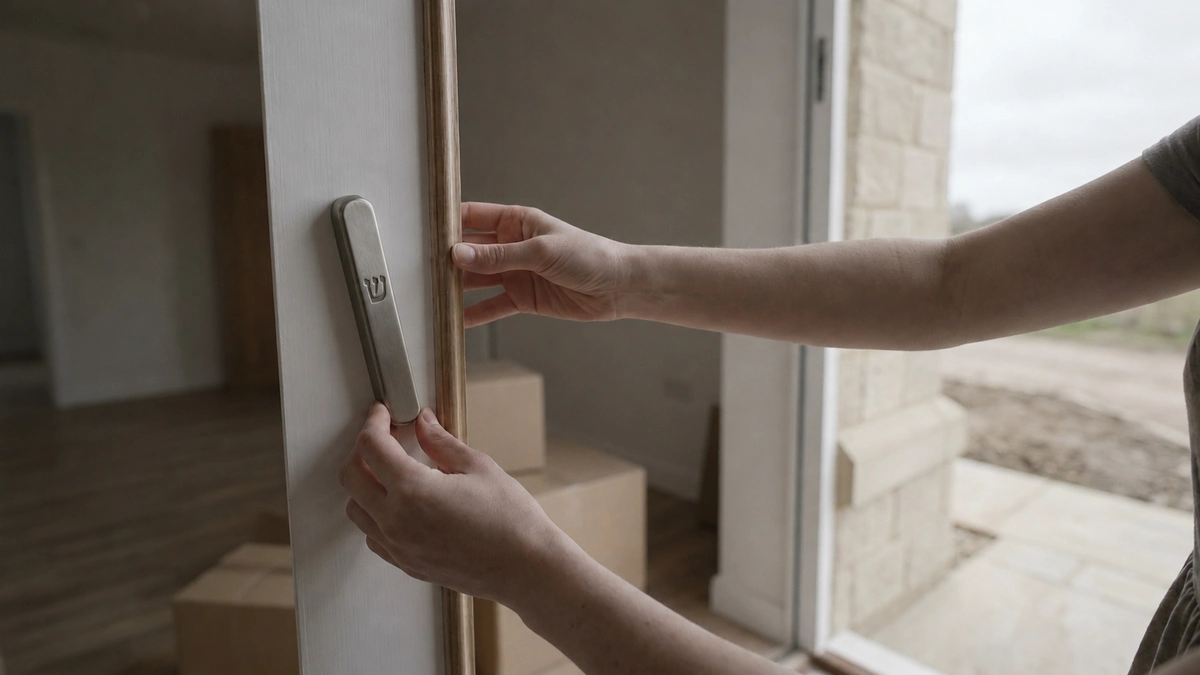
Third, re-affix the mezuzah securely. The requirement of fixedness means the case and scroll must be genuinely attached to the doorpost, not balanced or loosely clipped. If the same mounting failed once, it will likely fail again. Use proper screws or adhesive appropriate for the surface, and confirm the angle and position are correct, in the upper third of the doorpost, on the right side as you enter, tilted inward (according to the Ashkenazic minhag, custom) or straight (according to the Sephardic minhag).
Once the mezuzah is properly re-affixed with a checked, kosher scroll, the bracha question should be handled carefully. The standard bracha for affixing a mezuzah is: Baruch Atah Hashem Elokeinu Melech haolam, asher kideshanu b'mitzvosav v'tzivanu likboa mezuzah. Whether to recite that bracha when re-affixing a mezuzah that fell can depend on the circumstances, so a rav should be consulted if there is any doubt. If you have multiple doorposts and are unsure which mezuzos are secure and properly checked, we encourage you to connect with our team for a full assessment of your home's mezuzah situation.
One of the most frequent mistakes after a mezuzah falls is simply picking it up, placing it back in the case, and re-hanging it without any inspection. This is understandable, we are busy, and the scroll looks the same as before. But a scroll that has been dropped, especially one that was unnoticed for days or weeks, deserves careful attention. Overlooking this step is one of the forms of mezuzah neglect that can leave a household without a valid mezuzah even while thinking one is in place.
Another common error is re-affixing a mezuzah without confirming it is mounted correctly. Classical sources treat improper placement seriously: a mezuzah placed behind the door or in an improper manner does not fulfill the mitzvah properly. A mezuzah tucked too far back, placed at the wrong height, or mounted incorrectly should be corrected when it is re-affixed after a fall. This is worth verifying, especially after the mezuzah has already come loose once.
A third error involves ignoring the question of how often mezuzos should be checked. The Shulchan Aruch (YD 291:1) rules that mezuzos in private homes should be checked twice in seven years. When a mezuzah falls and must be removed anyway, that moment is an ideal opportunity to have it inspected, and to have the other mezuzos in the home checked as well. Delaying this step is a missed opportunity to ensure the entire home's mezuzos are kosher.
The Deeper Meaning Behind Fixedness
The requirement that a mezuzah be genuinely fixed to the doorpost is not only a technical rule, it reflects something profound about the nature of the mitzvah. The Rambam explains that the mezuzah creates a moment of awareness every time a person enters or leaves their home: an encounter with the unity of Hashem, a reminder to walk in upright paths, a waking from the distractions of the world. This awareness depends on the mezuzah being truly present, truly part of the doorpost, not resting loosely or temporarily.
In a broad sense, the mezuzah parallels the recitation of Shema. Just as Shema is a declaration of Hashem's oneness spoken in words, the mezuzah is that declaration written into the physical structure of the home. A scroll lying on the floor, or stored in a drawer, cannot fulfill this function. The mitzvah is specifically the act of affixing, kevi'us, and the ongoing presence of the mezuzah in its proper place. When a mezuzah falls, it is not a minor inconvenience. It is an interruption of something genuinely important, and restoring it properly is an act of care for the home and for the mitzvah itself.
For scrolls that become invalid through internal changes rather than physical falls, our explanation of a mezuzah becoming pasul without visible damage offers important background. And when a scroll is no longer usable, it must be handled with respect, our guide on mezuzah geniza explains the proper way to dispose of a pasul scroll following halacha.
Key Takeaways
When a mezuzah falls, whether noticed immediately or after some time, the halacha requires that it be restored as soon as it is discovered. Before re-affixing, the scroll should be evaluated carefully, and in many cases inspected by a qualified magiah, especially after a fall that may have caused physical damage. The mezuzah must be re-affixed securely, in the correct position and orientation, and the question of a bracha at the time of re-affixing should be handled according to the circumstances. A fall is also an ideal time to check the other mezuzos in the home, in keeping with the halachic obligation to inspect them regularly. Fallen mezuzah halacha ultimately reflects the principle that the mitzvah requires genuine, lasting presence, not just placement.
About Kosher Mezuzah
At Kosher Mezuzah, we understand that fulfilling the mitzvah of mezuzah properly requires more than purchasing a scroll, it requires confidence that the scroll is genuinely kosher, that it has been written by a qualified sofer (scribe) and checked by a trained magiah (halachic examiner), and that it is mounted correctly. Our scrolls are produced through a process endorsed by the Orthodox Union, which provides a layer of independent halachic oversight that goes beyond standard certification. Every scroll we offer is traceable, you can know who wrote it, who checked it, and what materials were used.
We also recognize that questions about a fallen mezuzah, a scroll that needs checking, or a doorpost that was left bare are real concerns for real families. If you have any uncertainty about the status of your mezuzos, whether after a fall or simply as part of regular maintenance, our team is here to help you navigate those questions with halachic care.
Reach out to us at Kosher Mezuzah today to have your mezuzos checked or replaced with a scroll you can trust. May the mitzvah of mezuzah be a source of zechus and protection for your home and family. Yehi ratzon milifnei Avinu shebashamayim sheyishmor tzeitcha uvo'echa mei'atah v'ad olam, may Hashem guard your going and your coming, from now and forever.

.svg)
Bring a true Kosher Mezuzah into your home
Fulfill the mitzvah with confidence, beauty, and meaning.
Buy a Mezuzah