
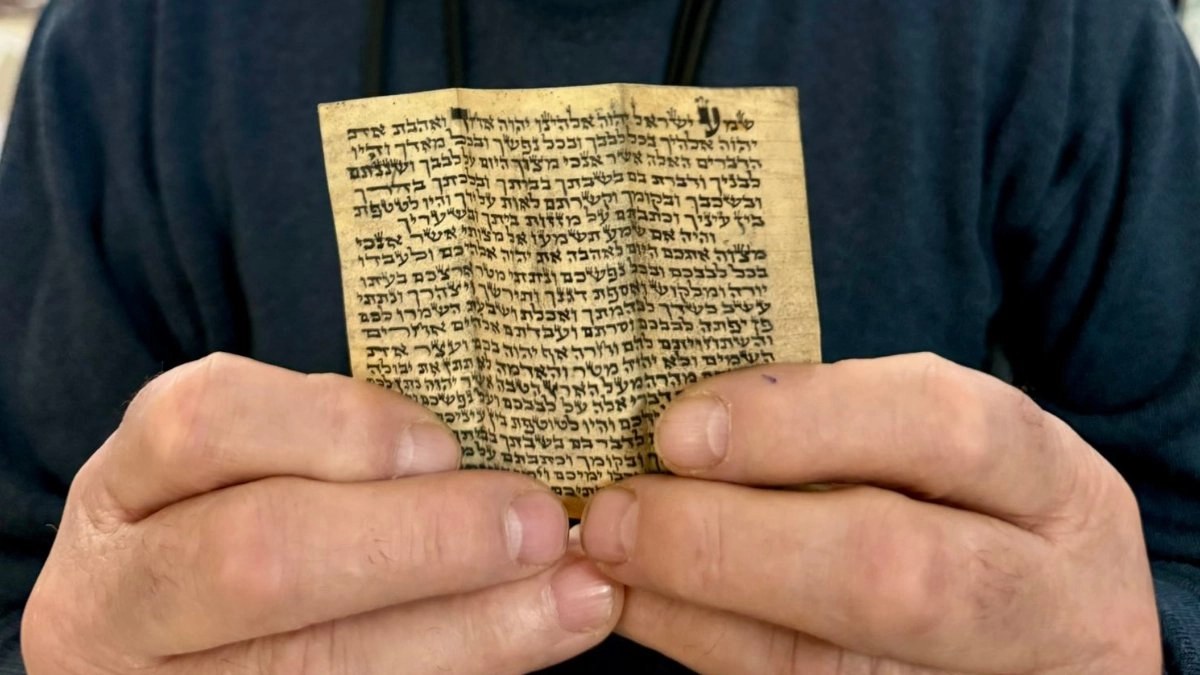
The Mezuzah in His Wallet: A Soviet-Era Scroll That Never Left His Side
After reading the Megillah to a group of elderly Jews in Rostov-on-Don, Russia, Rabbi Chaim Danzinger received an unexpected response. An older man named Eduard reached into his wallet and carefully unfolded a tiny, yellowed piece of parchment. "Rabbi," he said. "I also have a scroll."
It was a mezuzah. And it had been there for decades.
You can read Rabbi Danzinger's original post on X here.
“Rabbi. I also have a scroll.”
— Chaim Danzinger | Rostov Rabbi (@RostovRabbi) March 15, 2026
Eduard reached into his wallet and unfolded a tiny, yellowed parchment.
I had just finished reading the Megillah to the elderly. He had just shown me something older.
A mezuzah. Carried in his wallet for decades.
“My mother left it when she… pic.twitter.com/yfdtM5GJ0Y
How a Mezuzah Survived the Soviet Union, Carried in One Man's Wallet in Rostov-on-Don
Eduard's mezuzah didn't come from a Judaica store. It came from his mother, who received it from her mother, from before the Revolution. Through decades of Soviet rule that banned religious practice, outlawed Hebrew, closed Jewish schools, and systematically dismantled every visible expression of Jewish life, this small piece of parchment traveled from grandmother to daughter to son, folded inside a wallet.
Eduard told Rabbi Danzinger he didn't know exactly what it said. But he knew what it did. "It protects me," he said.
Rabbi Danzinger is no stranger to moments like this. A Chabad emissary who moved from California to Rostov-on-Don in 2008, he has spent nearly two decades rebuilding Jewish life in a city with approximately 15,000 Jews, many of them elderly, many of them carrying fragments of a Jewish identity that survived not because it was practiced openly, but because it was quietly kept alive. The Soviet regime spent nearly 80 years attempting to uproot religious freedom, leaving what Rabbi Danzinger describes as only embers.
Eduard's mezuzah is one of those embers.
What a Mezuzah Means When It Cannot Be on the Door
The mitzvah of mezuzah is to affix the scroll to the doorpost, but for Jews living under Soviet rule, a mezuzah on the door was an act that could invite persecution. So some kept them hidden. In wallets. In coat pockets. Close to the body, out of sight, but never discarded.
The words inside a mezuzah are the Shema, the declaration of Hashem's unity that sits at the very center of Jewish faith. Eduard may not have known exactly what his parchment said, but his instinct to keep it, to carry it, to call it protection: that is the neshama (soul) remembering what the mind was never allowed to learn. The Jewish soul does not forget, even when the knowledge is gone.
Why a Kosher Scroll Matters, and What to Do When You Don't Know What You Have
Eduard's story also raises a quiet halachic question that many Jews in similar situations face: a scroll that has been folded in a wallet for decades, passed through generations without a sofer's oversight, may no longer be kosher. Parchment cracks. Ink fades. Letters that once formed the Shema correctly may no longer be legible or complete.
This is not a reason to discard such a scroll. It is a reason to have it checked by someone qualified to assess it. And for those placing a new mezuzah on their doorpost, the starting point must be a scroll that is written correctly from the outset.
Kosher Mezuzah offers scrolls written by vetted sofrim, double-checked by expert magihim, and backed by OU endorsement, with each one traceable through a unique QR code so you know exactly who wrote it and when it was last inspected.
The Neshama Never Forgets
Rostov-on-Don has its own deep Jewish history. In 1942, the Nazis murdered 27,000 Jews in a single massacre at Zmiyovskaya Balka, the single largest mass killing by the Nazis in Russia, virtually obliterating what had been a vibrant Jewish community. What remained of Jewish life was then systematically suppressed for another fifty years.
And yet: Eduard still had his mezuzah.
They banned the practice. They erased the language. They destroyed the books. But a small, yellowed parchment, folded inside a wallet, crossed every one of those borders intact. That is what the mezuzah has always carried: not just words, but testimony.
There are Jews all over the world carrying Judaism in their pockets the way Eduard did, quietly, without a doorpost, waiting for the moment when they can live it openly. If that moment is now, Kosher Mezuzah is here to make sure the scroll that goes up on your doorpost is everything it needs to be. Explore our mezuzah scrolls, written and checked through our OU Endorsed process, and bring that quiet faith into the open, where it belongs.



.svg)
Bring a true Kosher Mezuzah into your home
Fulfill the mitzvah with confidence, beauty, and meaning.
Buy a Mezuzah