
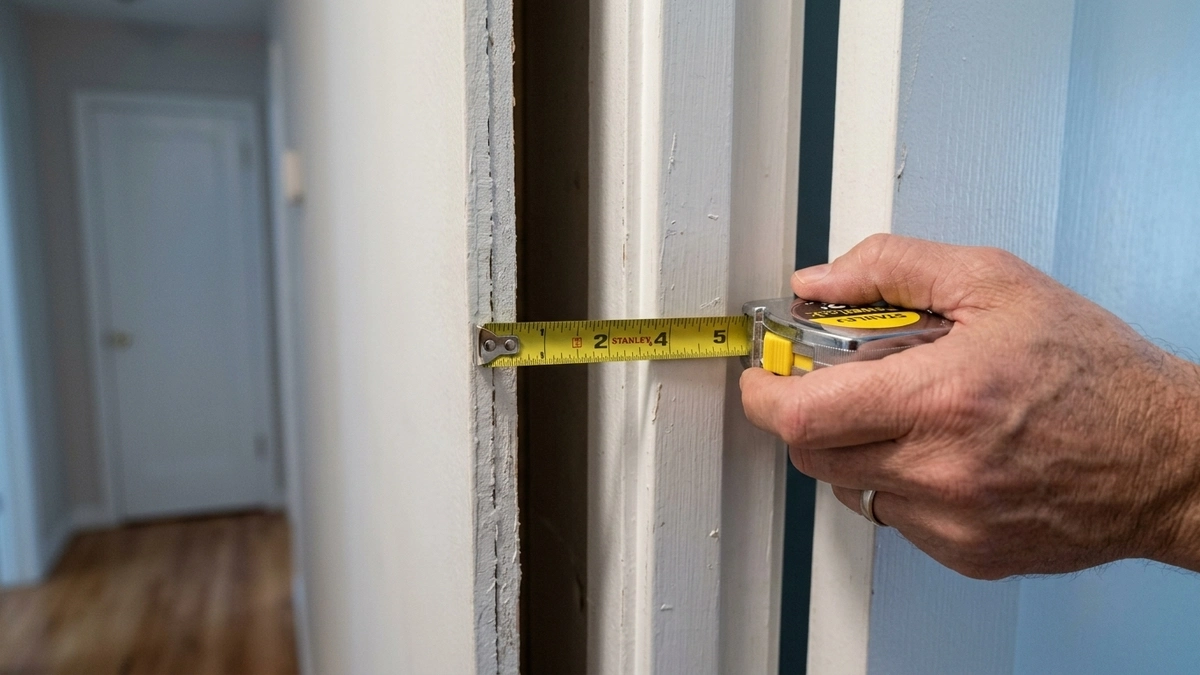
Mezuzah on an Extended Doorpost: What the Halacha Actually Requires
When a doorframe is unusually narrow, shallow, or structurally irregular, many people wonder whether they can extend or modify the doorpost to create a valid place for affixing a mezuzah. The question of placing a mezuzah on an extended doorpost is more common than you might expect, it comes up in apartments with aluminum sliding doors, doorways with recessed frames, and entrances where the original post simply does not offer enough surface.
Before attempting any workaround, it is essential to understand what the halacha actually requires. If you have a doorway that poses a real structural challenge and are unsure how to proceed, reach out to us at Kosher Mezuzah and we can help you determine the right approach.
Key Takeaways
- A mezuzah must be placed on the actual doorway area, not just on a nearby wall.
- If an extended piece is being used, it only works if that piece is truly considered part of the doorway.
- The mezuzah should be placed on the doorway, within the first tefach (handsbreath) of the entrance.
- Putting the mezuzah on a surface that is outside the doorway area or deep inside a recessed frame does not fulfill the mitzvah.
- An extended doorpost is not automatically valid just because it is close to the doorway.
- The key question is whether the extension is really treated as part of the doorpost.
- Whenever there is an unusual doorway or any uncertainty, the case should be shown to a qualified rav
Can You Put a Mezuzah on an Extended Doorpost or Frame?
The short answer is: sometimes, but only if the mezuzah is still being affixed to what is considered the actual doorpost of the entrance. Halacha requires the mezuzah to be placed on Mezuzot beitecha—the actual doorposts of the house, and not on any other surface. If an added strip, extension, or piece of material genuinely becomes part of the doorway itself, there may be room to use it. But if it merely creates a mounting surface on the wall beside the entrance, that is highly problematic and may not fulfill the mitzvah at all.
Because unusual frames vary from case to case, a non-standard doorway should not be judged by rule of thumb. The practical question is always whether the mezuzah is still being attached to the entrance’s actual halachic doorpost.
What Makes a Doorpost Valid?
The Torah says: “U’khetavtam al mezuzot beitecha u’vish’arecha”—“And you shall write them on the doorposts of your house and on your gates” (Devarim 6:9). That language is the basis of the mitzvah. The mezuzah must be fixed to something that is halachically treated as the entrance’s actual Mezuzah—its real doorpost.
That is why the basic question is not whether the added piece is physically close to the doorway, but whether it is still considered part of the doorway itself. If the mezuzah is no longer on the doorpost, but on a side wall, a bracket, or an added surface outside the doorway’s halachic boundaries, the placement is deeply questionable.
The Rambam is very sharp on this point. In Hilchot Mezuzah he writes that if one placed the mezuzah behind the door, he has not accomplished anything. The mitzvah is not just to place a mezuzah near an entrance. It must be affixed in the right place in order to function as a mezuzah of the doorway.
The Ideal Mezuzah Placement Within the Doorway
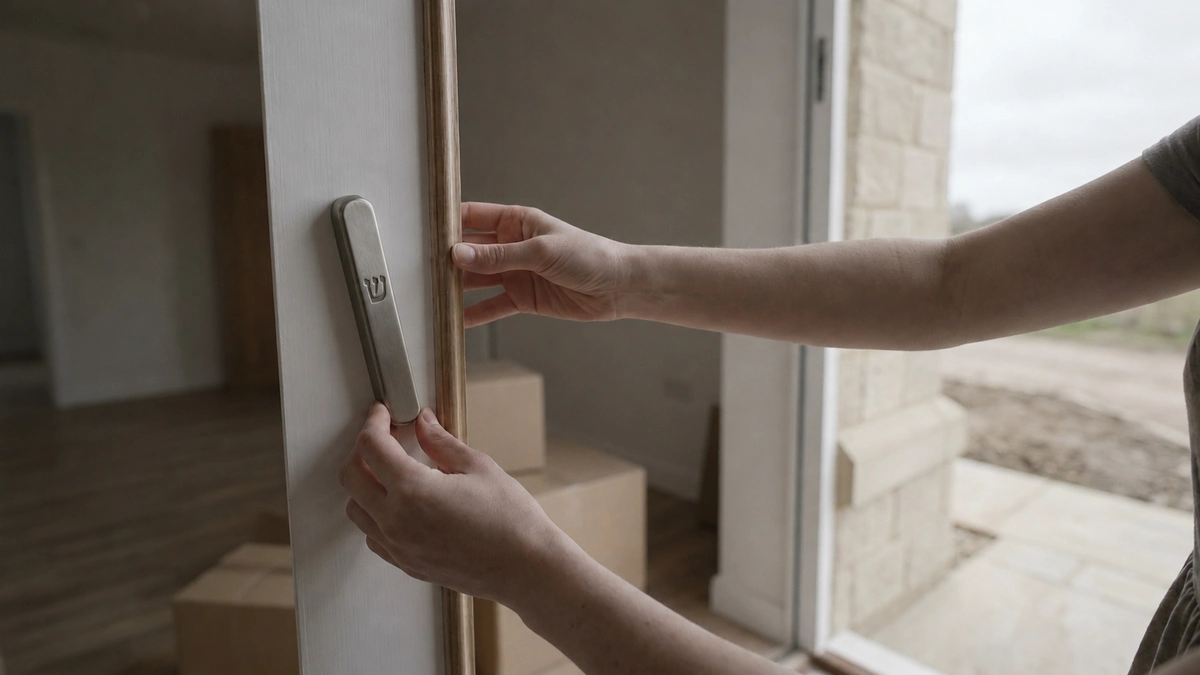
Chazal state that the mezuzah should be placed within the tefach closest to the outside, so that a person encounters it immediately upon entering. (A tefach is 4 fingerbreadths and is commonly measured as about 3.15–3.79 in / 8–9.6 cm, depending on the halachic opinion followed.) Shulchan Aruch rules that the mezuzah should ideally be placed within the doorway space, in the outer handbreadth nearest the outside.
The outer tefach is the preferred location. If the mezuzah is affixed elsewhere on the actual doorpost, many read the Rema as treating that as valid bedi'eved (acceptable after the fact). A separate invalidating case is where the mezuzah is recessed deeply into the post or wall ("העמיק לה טפח פסולה"), or placed in a way that is no longer considered fixed on the doorway itself.
How This Applies When You Modify or Extend a Doorframe
In practice, homeowners consider extending a doorframe for several reasons. A sliding aluminum frame may be very narrow. A recessed doorway may make ordinary placement difficult. A damaged post may leave too little usable surface. The halachic issue is not whether one can invent a place for the mezuzah, but whether the final placement still counts as being on the doorway’s actual Mezuzah.
When an Extension May Be Permitted
If the added material is attached flush to the doorpost and is treated as a real continuation of that post, there may be room to consider it valid. But this should not be presented as a blanket heter (leniency). The geometry matters: where the doorway begins, where the doorpost ends, whether the added piece is still within the entrance framework, and whether the mezuzah remains on what halacha would call the actual doorpost.
In other words, some extensions may be usable, but only when they truly function as part of the doorway itself—not merely as a convenient workaround. That determination is visual and case-specific, which is why unusual frames should be reviewed by a rav rather than treated by rule of thumb.
When an Extension Is Not Valid
If the added piece shifts the mezuzah off the actual doorpost and onto the wall beside the doorway, the placement is highly problematic. Shulchan Aruch’s language—provided that one places it on the doorpost itself—points in exactly the opposite direction: even when one does not place the mezuzah in the ideal outer tefach, it still must be on the doorpost itself.
Likewise, if the placement effectively becomes behind the door, Rambam’s language is severe: it is as if one has done nothing. And if the mezuzah is set back a full tefach into the depth of the frame, Rambam rules that it is invalid.
There is also a separate concern when someone tries to “build” a kosher location only after the mezuzah is already attached. The Rambam writes that if one inserted the mezuzah into a reed and only afterward attached that reed so that it became part of the doorway, the mezuzah is invalid, because the affixing of the mezuzah came before the making of the doorpost. So a makeshift extension is not automatically acceptable merely because it was later incorporated into the frame.
Practical conclusion: first determine whether the added material is still halachically part of the doorpost. If it is not, the placement is defective regardless of whether its placed in the outermost tefach of the doorway. If it is a valid placement, one can then discuss the secondary question of whether the mezuzah has also been placed in the preferred outer section of the doorway.
Common Mistakes People Make With Non-Standard Doorposts
One common mistake is placing the mezuzah on the wall beside the frame instead of on the frame itself. This often happens with very narrow metal or aluminum doorframes, where the wall seems like the only practical option. But physical closeness is not enough. If the mezuzah is on the adjacent wall rather than on the doorway’s actual Mezuzah, that is a serious halachic problem.
Another mistake is treating any attached strip or board as a valid “doorpost extension.” It is not enough that the piece is now physically attached. The question is whether halacha would regard it as part of the doorway itself. If not, it cannot simply be used as a substitute mezuzah-post.
Finally, people sometimes focus on the angle of the mezuzah and ignore the more basic problem of location. Even if the case is slanted in the usual Ashkenazic fashion, that does not help if the mezuzah is mounted on an invalid surface.
Why the Doorpost Itself Matters
The mezuzah is not just a symbolic marker placed somewhere near the entrance. It is a mitzvah tied to a specific place: the doorpost of the entrance. The Torah’s wording—Mezuzot beitecha—is exact. The threshold of the home is where the mitzvah is meant to stand.
That is why halacha insists on the actual doorway. A mezuzah on an adjacent wall may be close to the entrance, but it is not the same as a mezuzah on the entrance itself. The mitzvah is fulfilled by marking the doorway where one enters and exits the home.
When a doorway presents structural challenges, the goal is not to find the nearest possible surface. The goal is to identify the correct halachic surface and affix the mezuzah there.
The Key Ruling in Brief
An extended doorpost or frame may be usable for a mezuzah only if it truly forms part of the actual doorpost of the entrance. The ideal placement is within the outer tefach of the doorway, but that point alone is not what determines validity. The bigger question is whether the mezuzah is still on the real doorpost itself.
If the added piece moves the mezuzah onto the adjacent wall, places it effectively behind the door, or creates a placement that is recessed a full tefach into the frame, the placement may be invalid. Because these cases depend heavily on the doorway’s exact structure, the right practical guidance is simple: if the frame is unusual, do not guess. Show the doorway to your rav before relying on an extension.
Fulfilling the Mitzvah With Confidence Through Kosher Mezuzah
At Kosher Mezuzah, we understand that the mitzvah of mezuzah carries profound meaning, and that proper fulfillment requires not only a kosher scroll but also correct placement. Every mezuzah scroll we carry is produced under a process endorsed by the Orthodox Union, one of the most trusted kosher certification bodies in the world. Each scroll is written by a vetted sofer and reviewed by a qualified magiah, and we maintain full traceability from the sofer's quill to your doorpost.
We also recognize that many halachic questions arise not from the scroll itself but from the structure of the doorway, questions exactly like the one addressed in this text. A perfectly written mezuzah placed in the wrong location does not fulfill the mitzvah. This is why we are committed to helping you understand not only what to buy - you can explore our mezuzah scrolls, written and checked through our OU Endorsed process, here - but where and how to affix it correctly. If your doorframe presents structural challenges, we encourage you to reach out before affixing.
Proper checking of mezuzot is also part of fulfilling the mitzvah over time. A mezuzah should be checked twice in seven years under normal conditions, and more frequently in climates with heavy sun or rain exposure. We are here to help you keep your mezuzot kosher not only at the moment of purchase but for all the years they protect the sanctity of your home.
If you have questions about a non-standard doorpost or any aspect of mezuzah placement, contact us at Kosher Mezuzah, we are here to help you fulfill this precious mitzvah with care and confidence.
May the mezuzah on your doorpost be a source of zechus and bracha for your entire household.



.svg)
Bring a true Kosher Mezuzah into your home
Fulfill the mitzvah with confidence, beauty, and meaning.
Buy a Mezuzah