

Who Puts Up the Mezuzah in Shared Spaces? A Clear Guide for Roommates and Common Areas
Living with roommates or in a shared building raises a question that comes up more often than people expect: who is actually responsible for putting up the mezuzah in a shared apartment? Is it one person's job, or do roommates share the mezuzah obligation? Halacha addresses the basic framework clearly, but the practical details depend on the kind of space involved. A shared Jewish dwelling is not the same as a private bedroom, and neither is identical to a building hallway or a home shared with a non-Jewish roommate. This guide will walk through the main rules and show how to apply them carefully.
. For a related question, see Do Shared Offices Need a Mezuzah? (Rotating Occupants Explained). Related reading: Who Is Responsible for Checking Mezuzahs in Shared Buildings?. For the full discussion, read Who Is Responsible for the Mezuzah at a Building Entrance?.
Key Takeaways
- When Jewish roommates share a dwelling, halacha recognizes a beit ha-shutafin (shared dwelling) and treats shared residential space as potentially obligated in mezuzah.
- If a Jewish resident shares the dwelling with a non-Jewish roommate or co-occupant, the halacha is more complex. Shulchan Aruch with Rema does not treat that case the same way as a shared Jewish dwelling, so a rav should be consulted before deciding how to proceed.
- Private rooms, shared rooms, apartment entrances, and building common areas should not all be treated as one category. Each space should be evaluated on its own halachic footing.
- As for responsibility, the mitzvah is tied to the one living in the space, and halachic sources also place mezuzah-related expense on the tenant rather than the landlord. In a roommate setting, Jewish residents should make sure the mezuzah is taken care of and should decide practically who will purchase and affix it.
- The timing is not the same in every case: for a renter outside Eretz Yisrael, the obligation begins after thirty days; in Eretz Yisrael, it begins immediately.
Who Puts Up the Mezuzah in Shared Spaces? (Roommates & Common Areas)
Moving into a shared apartment comes with a long list of practical questions: Who buys the furniture? Who pays the electric bill? And, if the residents are Jewish, who is responsible for the mezuzah?
That question matters because mezuzah is not only a detail of home setup. It is part of what turns a space into a Jewish living space. In a roommate situation, however, people often assume that if the apartment belongs to “all of us,” then the obligation belongs to no one in particular. Halachically, that is not the right way to think about it.
The Basic Rule: The People Living There Are Responsible
The starting point is simple. The obligation of mezuzah follows the people actually living in the dwelling. The Gemara teaches that when someone rents a home, it is the renter who puts up the mezuzah, and Shulchan Aruch rules accordingly. In other words, the obligation is tied to residence, not merely to ownership. If two or three Jewish roommates share an apartment, the fact that they are partners in the living space does not remove the mitzvah, since they live there together, they share responsibility to make sure it is put up.
Private Rooms and Shared Rooms
In a shared apartment, mezuzah obligation is assessed doorway by doorway. If one roommate has a private bedroom, and another room is shared by two people, each doorway has to be judged on its own merits. You do not treat the whole space as either fully shared or fully private. You evaluate each doorway according to the room behind it.
The main entrance is a joint obligation of the Jewish roommates. A room used exclusively by one roommate is that roommate’s own obligation if the room requires a mezuzah. A room shared by two Jewish roommates is a בית השותפין, and its doorway is their joint obligation. The apartment’s main entrance remains the most obvious shared obligation, while interior rooms may require more specific review.
What About Hallways, Stairwells, and Building Entrances?
Do not assume that every shared doorway in your building automatically needs a mezuzah.
Start by separating your private apartment entrance from the building’s shared spaces. Your apartment doorway is usually much easier to evaluate. A shared hallway, stairwell, vestibule, or main building entrance is often more complex.
When you are dealing with a common area, ask practical questions: Who owns this space? Who uses it? Is it part of your apartment, or part of the building as a whole? Does it function as a true residential entrance, or is it just a shared passageway? Those details can affect the halachic ruling.
Some shared entrances may require a mezuzah. Others are not automatic. If the area is shared by multiple tenants or belongs to the building rather than to your apartment, ask a rav before treating it as clearly obligated.
When One Roommate Is Not Jewish
If you share a dwelling with a non-Jewish roommate, do not assume the mezuzah question is simple. In that case, the status of the apartment and its shared areas can become more complicated. The ruling may depend on the ownership arrangement, who controls the shared space, and whether there is any concern that the mezuzah may be removed, disrespected, or cause tension.
Your safest approach is this: do not rely on a generic rule. Ask a rav who can hear the exact facts of your living arrangement. That is especially important if the mezuzah may not remain in place safely or respectfully.
Can One Roommate Put It Up for Everyone?
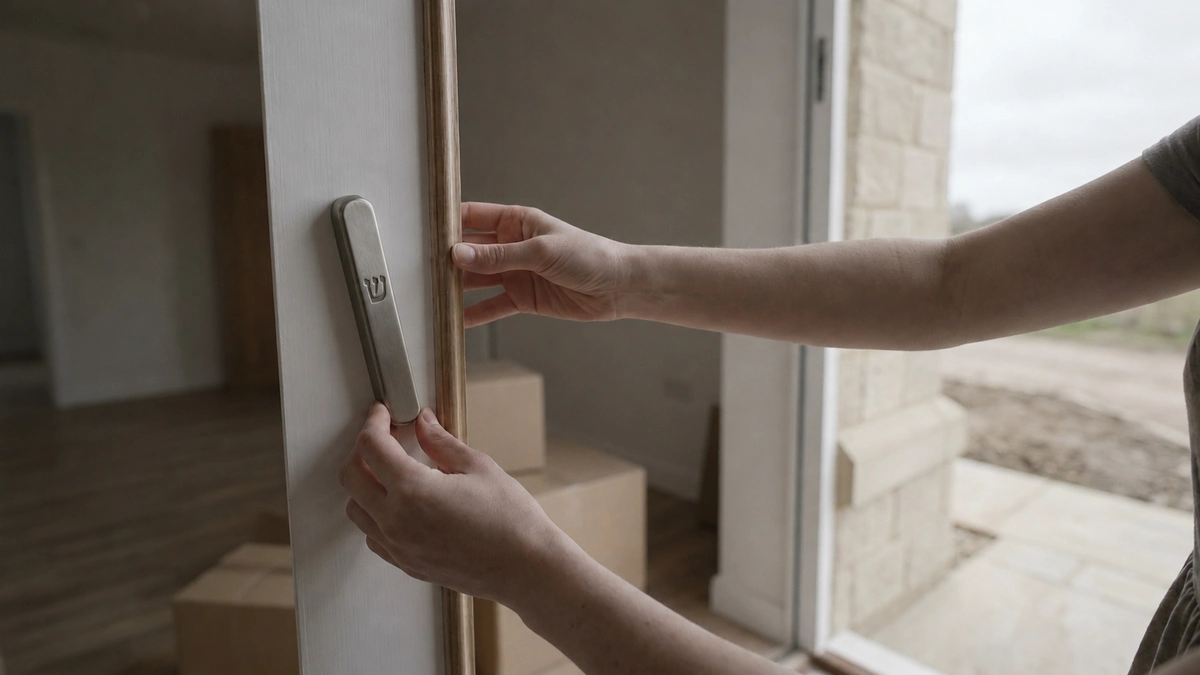
Yes. In a shared Jewish home, one resident can arrange for the mezuzah to be affixed on behalf of the household. You do not need every roommate to personally put up a mezuzah. What matters is that the home’s mezuzah obligation is properly taken care of. For details on mezuzah placement in an apartment setting, including which doorways require coverage and which may be exempt, it is worth reviewing the relevant halacha carefully before affixing. Understanding how to determine mezuzah direction in these shared doorways is a separate but related question worth clarifying once the obligation is established.
Women are also obligated in mezuzah. If a woman lives in the home, whether alone or with others, this obligation applies to her as well.
Timing Matters Too
Timing matters here as well. The halachah distinguishes between Eretz Yisrael and outside Eretz Yisrael. Outside Eretz Yisrael, a renter is generally exempt for the first thirty days. In Eretz Yisrael, the obligation begins immediately. That distinction is important and should be kept clear. So when roommates move into a rental, one of the first questions is not only which doors require mezuzot, but also when the obligation begins in that location.
The Most Common Mistake in Shared Living
The most common error is not ideological at all. It is simply that everyone assumes someone else is taking care of it. In a family home, responsibility usually feels obvious. In a roommate apartment, responsibility can become blurred. One person thinks the other bought the mezuzah. Another assumes the landlord handled it. A third assumes it can wait until later. As a result, the doorway stays bare.
That is exactly why the subject deserves a clear explanation. Shared responsibility does not mean no responsibility. If Jewish residents are living there, the presence of multiple people does not cancel the mezuzah obligation. It simply means someone needs to step forward and ensure it is addressed properly.
A Word About Kosher Mezuzah
At Kosher Mezuzah, every scroll we provide is written by a qualified sofer, checked by a trained magiah (examiner), and comes with full documentation, including the name of the sofer, the name of the magiah, the date of writing, and materials used. Each mezuzah is OU Endorsed by one of the most trusted kosher certification agencies in the world. This level of traceability gives buyers genuine confidence that the scroll they are placing on their doorpost is halachically valid.
If you are unsure whether your current mezuzot are kosher, or if you need guidance on why the mezuzah is slanted and how to affix it correctly, we invite you to reach out. You can also browse our frequently asked mezuzah questions for answers to common halachic and practical questions.
If you would like help selecting a mezuzah for your apartment, shared or private, contact us at Kosher Mezuzah and we will guide you toward the right option for your situation. May the mezuzah on your doorpost be a source of blessing and protecction for everyone in your home.


.svg)
Bring a true Kosher Mezuzah into your home
Fulfill the mitzvah with confidence, beauty, and meaning.
Buy a Mezuzah