
How Mezuzah Scrolls Are Written: Tradition and Technique
The mezuzah scroll is not simply prepared, or produced by machine. Every letter of a kosher mezuzah is written by hand, one at a time, by a qualified sofer who has trained for years and whose fulfillment of the sacred nature of his work determines whether the scroll is valid and whether the mitzvah holds.. See also Machine Written Mezuzah.
Understanding how mezuzah scrolls are written — and what makes each tradition distinct — allows every Jewish home to purchase, affix, and care for the mitzvah with the full knowledge it deserves. Kosher Mezuzah is dedicated to ensuring the proper fulfillment of the mitzvah of mezuzah, and we welcome you to reach out to us directly with any questions about the writing process or how to choose the right scroll.
The Halachic Ruling: Mezuzah Scrolls Must Be Written by Hand on Parchment
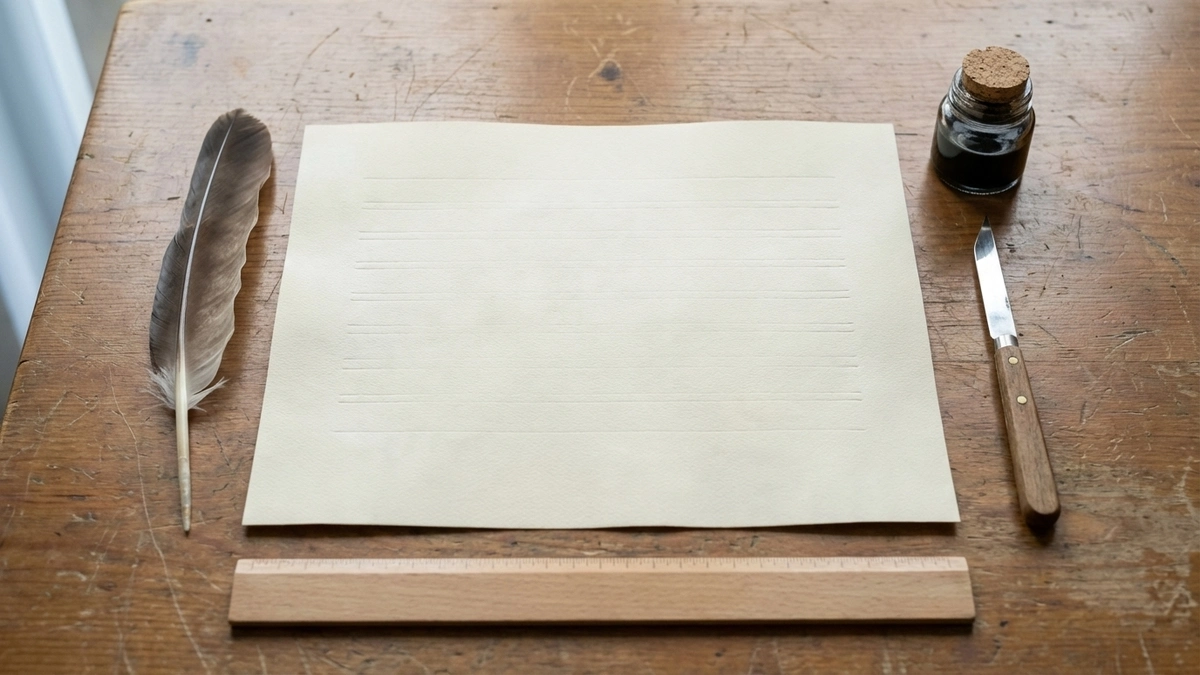
A mezuzah scroll must be written by hand on kosher klaf (parchment) prepared by a qualified person specifically for the sake of the mitzvah. It may not be written on cardboard, tin, cloth, or any other material. The Shulchan Aruch (Yoreh De’ah 271:1) and the Rambam (Hilchos Mezuzah) codify that the klaf should be the outer side of a split animal hide taken from a kosher animal—with kosher black ink, by a Torah-trained sofer writing with proper lishmah (intent for the sake of the mitzvah), using a quill. Later authorities note that the quill is traditionally taken from a kosher species and that the ink must meet specific standards so that the letters remain clear and intact over time.
The letters must be written in the correct order (kesidran), without skipping and then going back, and must form the complete text of the two parshiyos of Shema (Devarim 6:4–9) and V’haya Im Shamoa (Devarim 11:13–21). Many of these conditions are me’akev; a serious lapse can render the scroll pasul (halachically invalid) until the problem is properly corrected.
The Parchment: Klaf
There are several halachically defined ways to prepare animal hide for sacred writing—known as gvil, klaf, and duchsustus—but in contemporary practice mezuzot are written specifically on klaf, the properly processed outer layer of the hide, the side closer to where the hair grew after the hide is split into two layers. After tanning and processing, this thin outer sheet is called klaf, and in practice today almost all mezuzot and tefillin are written on klaf.
As part of the preparation process, the skin of a kosher animal is soaked, limed, and then stretched on a wooden frame, where it is scraped and sanded down until it becomes a thin, smooth writing surface. Throughout the key stages of this processing, the parchment maker or sofer explicitly declares that the work is being done lishmah – for the sake of the sanctity of STaM – so that the material itself is designated for this mitzvah.
Rishonim and later authorities stress that this processing must be done lishmah, and that parchment whose preparation was not done lishmah should be avoided when possible. According to the Rishonim, as codified by the Rambam and the Shulchan Aruch (Yoreh De’ah 288:1), a mezuzah scroll must be written on a single continuous piece of parchment. Even if two pieces are sewn together, the scroll is pasul. This is why asking whether a scroll has been written in a single, continuous hand, on one piece of klaf, matters when assessing kashrut.
The Ink
The dio (ink) used in writing a mezuzah must be kosher and specifically prepared for the writing of sacred texts. Traditional halachic inks are made from ingredients such as gallnuts, natural resins (like gum arabic), and metal salts, cooked together into a black, durable liquid that adheres well to the surface of the klaf. As with the klaf, the ink is prepared lishmah for the sake of STaM.
Halachic authorities note that the ink must be kosher, black, and applied in a way that leaves a clear, stable letter on the surface of the klaf. Poor-quality ink or application can cause letters to crack or bleed into each other over time – a primary cause of hidden invalidations. The importance of the quality of the dio is one reason that a sofer should be selected based on well-established credentials and community standing, not price.
Designing the Layout of the Mezuzah Text
The text of a mezuzah is fixed: it consists of the two parshiyot of Shema (Devarim 6:4–9) and Vehaya im shamoa (Devarim 11:13–21), written in their proper order. To avoid even the smallest textual error, the sofer places a tikkun – a model STaM text – beside him and follows it letter by letter, never relying on memory, no matter how well he knows the words.
As part of the mezuzah writing process, the sofer plans the layout in advance. He decides how many lines the text will take, how many words will appear on each line, and exactly where larger spaces and paragraph breaks will fall, in accordance with his accepted mesorah and the rulings of his posek. This planning ensures that the text fits comfortably on the klaf, that the spacing remains consistent, and that each mezuzah he produces follows a reliable and recognized format.
Tools of the Sofer: Quill, Ink, and Work Environment
Another key part of how mezuzah scrolls are written is the careful preparation of the writing tools. The sofer writes with a kulmus, usually a feather from a turkey or goose, which he cuts and shapes at a precise angle to produce the traditional thickness and look of STaM letters, including their small serifs and curves. The ink is a special black, durable formulation created for STaM, designed to bond well to the klaf and remain truly black over time without flaking or fading.
Before beginning the actual text, the sofer tests both quill and ink on scrap parchment. He confirms that each stroke comes out clean and that the lines are neither too thick nor too thin. He also verifies that the ink flows smoothly from the kulmus and does not bleed. Even the desk and lighting are part of the mezuzah scroll technique: the table must be stable, the lighting strong and even, and the sofer positioned so his hand can move steadily and comfortably.
Writing with Kavanah and Precision
Once the tools and klaf are ready, the sofer begins to write. Several core halachic principles define how a mezuzah is written and guide his every move.
One of the most important is kesivah k’sidran, writing in order. The sofer writes from the first letter to the last without going back to insert or fix letters out of sequence. If a serious problem is discovered in an earlier word after he has already continued beyond it, certain types of corrections may no longer be allowed, which can render the mezuzah invalid. This requirement pushes the sofer to check constantly as he goes, catching issues in real time.
Particular care is taken when writing the Divine Names. Whenever the sofer reaches a Shem Hashem – the four-letter Name or other holy Names – he pauses to focus and has specific kavanah that he is about to write a holy Name. Many explicitly say “l’shem kedushat Hashem” before writing it and are careful not to engage in any unrelated speech or interruptions between this intention and the act of writing the Name itself.
The manner and pace of the writing also shape the mezuzah writing process. The sofer writes slowly and precisely, standing or sitting in a stable position over the parchment. After each word, or every few words, he looks back and forth between the tikkun and the klaf to confirm that he has not skipped, added, or changed any letters. This alternating rhythm of careful writing and immediate checking is one of the most practical safeguards built into traditional mezuzah scroll techniques.
Guarding the Shape of Every Letter: Tzurat Ha’otiyot
Throughout the writing, the sofer monitors tzurat ha’otiyot, the halachic form of the letters, with meticulous attention. Each letter must have the classic STaM shape, so that, for example, a beit is clearly different from a kaf, and a dalet cannot be mistaken for a reish. Letters must not touch each other; each should be surrounded by enough “white space” that no two letters visually merge into a new or ambiguous shape. The letters must also remain complete, with no missing pieces or cracks in the ink that would break their form.
Size and alignment are monitored at the same time. The letters sit squarely on the sirtut lines and remain relatively uniform in height and width throughout the scroll. On certain letters – traditionally שעטנז ג״ץ and, depending on mesorah, some others – the sofer adds small crowns known as tagin. He typically writes the main body of each letter first and then returns to add the tagin carefully, making sure they are neat and do not distort the basic shape of the letter.
When a letter comes out questionable, the sofer tries to address it immediately, while he is still working on that word and before he moves on. Prompt correction is critical both because of kesivah k’sidran and because small imperfections are easier to fix before they spread or become more complicated to repair.
Halachic Corrections: Fixing Mistakes in the Mezuzah Scroll
Even the most careful sofer can make a mistake, and halachah provides detailed guidance on what can and cannot be corrected as part of the mezuzah writing process. If the sofer notices an extra or wrong letter before he reaches a Divine Name, he can often carefully scrape off the unwanted ink with a sharp blade or razor and write the correct letter in its place. The key is that the klaf must remain structurally sound and the word must still be read in proper order as if it were written correctly from the outset.
After a Divine Name has been written, the rules become stricter. A Shem Hashem is generally not erased. If a flaw is discovered inside the Name itself that cannot be repaired according to accepted halachic methods, the entire mezuzah may have to be set aside for genizah, the respectful burial of sacred texts. In such a case, the sofer will start over with a new parchment rather than tamper with the Divine Name.
Because of these constraints, sofrim receive training in a variety of subtle corrections: slightly widening a stroke, extending a line, or softening a corner to transform a borderline letter into a clear, kosher one without creating a new problem. At the same time, they are especially vigilant about catching and correcting issues immediately, before they write further and limit the options for repair.
Bedikah: Multi‑Layered Checking of the Finished Mezuzah
Once the writing is complete, the mezuzah undergoes bedikah, a multi‑layered checking process that ensures the finished scroll is truly kosher. First, the sofer conducts a thorough self‑check. He slowly reads through the entire text, letter by letter and word by word, comparing what he wrote to the tikkun. During this review he confirms that no letters are touching, no cracks developed in the ink as it dried, and that all lines, paragraph breaks, and spaces match the expected layout.
After this internal review, it is common and strongly recommended to have a second trained checker examine the mezuzah. A fresh set of expert eyes often catches details the original sofer may have overlooked simply due to familiarity and fatigue. In many communities, a mezuzah is not sold or installed without this additional human inspection.
Today, many sofrim also incorporate a computer check as an added layer of protection. The text as written on the klaf is entered into a specialized program, which compares every letter and word against a documented standard text. This can help identify typographical mistakes such as missing, extra, or transposed letters. However, the computer cannot evaluate letter shapes, ink quality, or spacing, so it supplements but does not replace human halachic checking. Only after these checks show everything to be in order is the mezuzah treated as finished and kosher.
Final Steps: Back of the Klaf, Rolling, and Casing
The final stage of how mezuzah scrolls are written takes place on the back of the parchment and in the way the scroll is stored and protected. On the reverse side of the klaf, opposite a blank area so as not to press against the written text, the sofer usually writes one of the Divine Names, “Shaddai,” following accepted practice. According to some mesorot, additional traditional permutations such as “כוזו במוכסז כוזו” are also written on the back.
When the writing is complete, the mezuzah is prepared for installation. The scroll is rolled from left to right so that, if unrolled, it would open inward toward the house. It may be tied or wrapped with kosher thread or suitable tape that will not damage the letters or create pressure marks on the text. Finally, the rolled parchment is placed into a protective case, with the side bearing the Name “Shaddai” facing outward.
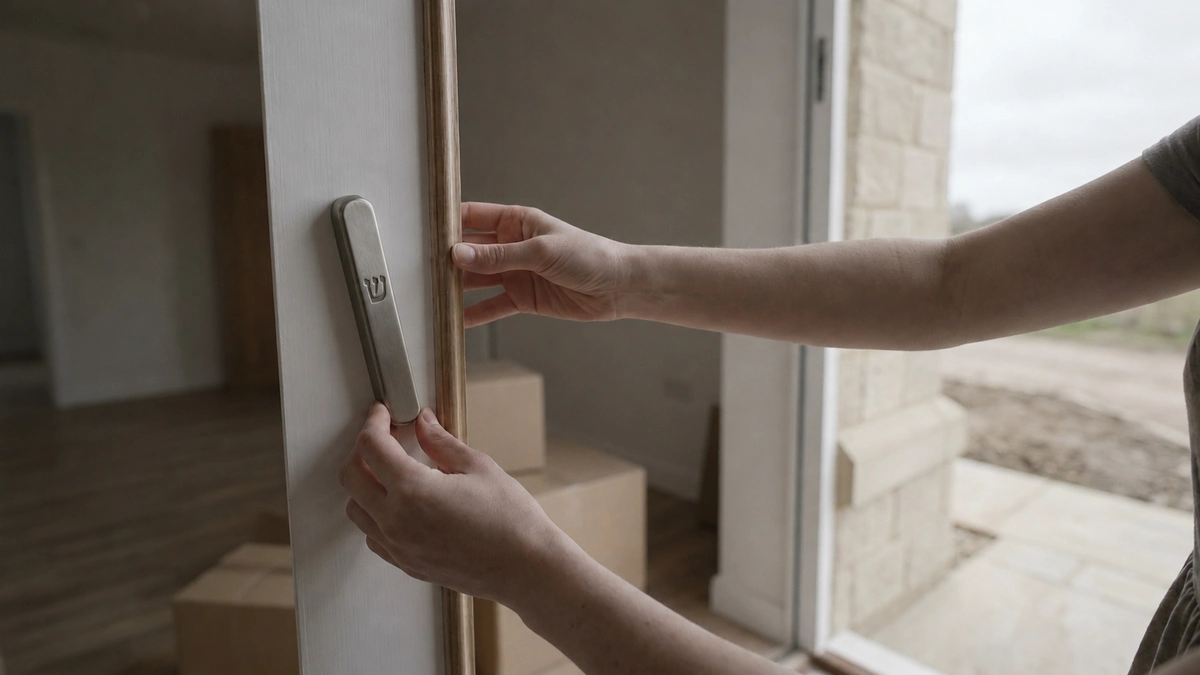
The actual affixing of the mezuzah to the doorway is usually left to the homeowner or installer, who recites the berachah and places the mezuzah at the correct height and angle on the doorpost.
Why a Kosher Mezuzah Takes Time and Expertise
From the outside, every mezuzah case looks simple. But inside is a hand‑written Torah text produced through a slow, disciplined, and highly technical process. Each stroke of the kulmus is governed by halachah and mesorah. Throughout the work, the sofer maintains kavanah, writing l’shem kedushat mezuzah and, where appropriate, l’shem kedushat Hashem, while at the same time tracking countless technical details: letter forms, spacing, alignment, sirtut, kesivah k’sidran, and the rules for corrections.
For anyone curious about how mezuzah scrolls are written, this behind‑the‑scenes look reveals why a kosher mezuzah cannot be rushed or casually copied. The traditional mezuzah writing process and the careful mezuzah scroll techniques used by a trained sofer are what transform a piece of animal hide into a sacred scroll guarding the entrances of Jewish homes.
Choosing a Mezuzah Written With Integrity
When you understand what goes into a mezuzah scroll, it becomes clear that a kosher mezuzah is a living mitzvah: a hand‑written Torah text that brings the words of Shema into the very structure of a Jewish home. When the parchment, ink, and writing are all done lishmah, under reliable halachic oversight, the mezuzah becomes what it is meant to be — a constant fulfillment of a Torah commandment, a reminder of Hashem’s presence, and a source of spiritual protection for everyone who passes through the doorway.
That is why it matters where your mezuzah comes from. A scroll whose origins are vague, whose sofer is unknown, or whose checking is uncertain may look similar from the outside, but it does not offer the same confidence that you are truly fulfilling the mitzvah in all its details. Choosing a mezuzah from a source that treats every stage — from processing the klaf, to writing each letter, to final bedikah — as a halachic responsibility rather than a business shortcut, is the most reliable way to honor both the mitzvah and your home.
At Kosher Mezuzah, we see ourselves as partners in that responsibility. Every scroll we sell is written by a qualified, G‑d‑fearing sofer, checked by expert magi’im, and accompanied by clear documentation so you know exactly who wrote and inspected it. Every scroll we offer carries full traceability from the sofer's writing to the magiah's review. Our goal is that when you affix a mezuzah to your doorpost, you can do so with peace of mind — confident that the mitzvah is being fulfilled according to halachah, and that the words guarding your home were written with integrity, care, and genuine yirat Shamayim. If you are ready to bring that level of mezuzah into your home, we invite you to reach out with your questions or choose your kosher mezuzah parchment.


.svg)
Bring a true Kosher Mezuzah into your home
Fulfill the mitzvah with confidence, beauty, and meaning.
Buy a Mezuzah