

Mezuzah in Apartment, Dorm Room, or Office: What Halacha Requires
Whether you rent, share, or work in a space — if it qualifies as a beis dira (dwelling), the mezuzah obligation applies, and understanding the details matters.
The question of whether a mezuzah is required in an apartment, a dorm room, or a workplace is one that affects a wide range of people, from a student settling into a campus room to a professional moving into a new office. The answer, rooted in the Shulchan Aruch and the broader body of halachic literature, is clear in principle, though the specific details require careful attention. Understanding what halacha requires in each setting allows us to fulfill this precious mitzvah properly and completely, without inadvertently leaving an obligation unfulfilled. For the full discussion, read Entering a Home Without a Mezuzah.
Kosher Mezuzah is dedicated to ensuring the proper fulfillment of the mitzvah of mezuzah, and we are here to help you fulfill this mitzvah with confidence and care. We welcome your questions about specific situations in your home, dormitory, or office.
This article provides a general overview of mezuzah obligations in common settings. It is not a substitute for personal halachic guidance; specific cases should always be discussed with a competent rav.
Key Takeaways
- A mezuzah in an apartment or dorm room — and in many offices and workplaces — is halachically required as long as the space meets minimum size requirements, has proper doorposts and a lintel, and is used for dignified purposes
- Renters and students are equally obligated to affix a mezuzah — ownership of the property is irrelevant; it is the act of dwelling or working in the space that creates the obligation
- Outside of Israel, classic halachic sources rule that a renter becomes obligated in mezuzah after thirty days of living in the home. In practice, many are careful not to delay affixing the mezuzah beyond that point, and some are stringent to put it up earlier. The exact timing should be discussed with a competent rav
- Every qualifying doorway in an apartment requires its own mezuzah — including bedrooms and living areas — while bathrooms and spaces used without dignity are exempt
- When the halachic obligation is uncertain, such as in some office settings or short-term stays, many poskim advise affixing a mezuzah without reciting a berachah, so that the mitzvah is fulfilled without entering into concern of a berachah-levatalah (blessing in vain). Each case should be reviewed with a rav
- The quality of the mezuzah scroll matters greatly — a passul (invalid) scroll does not fulfill the mitzvah, so always ensure your scroll is certified and verified as kosher
Do Apartments, Dorm Rooms, and Offices Require a Mezuzah?
Yes — apartments, dorm rooms, and many offices will require a mezuzah, provided they meet the basic halachic criteria. In practice, the status of offices can depend a great deal on how the space is used (eating there, regular presence, etc.), so each case should be reviewed with a competent rav.
A mezuzah is obligatory in any place that qualifies as a proper dwelling or workplace. It must have a minimum size of four amos by four amos (approximately six and a half feet by six and a half feet), proper doorposts and a lintel, and it must be used in a dignified manner. These rules apply regardless of whether one owns or rents the space.
The Halachic Basis for This Ruling
The obligation of mezuzah is derived from the verse in Devarim 6:9: "And you shall write them on the doorposts of your house and upon your gates." The Gemara in Yoma 11b and the Shulchan Aruch (Yoreh De'ah 286) establish that the obligation applies to any space that functions as a genuine dwelling place. The Rambam (Hilchos Mezuzah 6:8) teaches that even ten houses arranged one inside the other are each individually obligated in mezuzah, provided each one qualifies as a proper space. The key principle is that the space must be used as a defined, purposeful area, whether for living, working, or studying, and must be treated with appropriate kavod (dignity).
Halachic authorities discuss whether and when a temporary dwelling is exempt from mezuzah. There are differing views and important nuances — for example, the length of stay, how settled the person is, and whether family and belongings are there. Because of this, many rabbanim advise that dormitory rooms and longer short-term rentals should not be treated as obviously exempt, and that one should consult a rav for the correct practice in each case (including whether to affix a mezuzah with or without a brachah).
With respect to offices and shops, some Acharonim (later halachic authorities) discuss whether a space used only during the day may be treated differently from a nighttime dwelling, and whether storing work materials there overnight gives the space a stronger obligation. The prevailing custom, as noted by contemporary poskim, is that many modern offices and workplaces are treated as obligated, though the brachah is often omitted when the obligation is not clear-cut. Each case should be set by a rav for the specific circumstances.
Rentals, Shared Spaces, and the Thirty-Day Rule
A renter is fully obligated in mezuzah just as an owner is. The Shulchan Aruch (Yoreh De’ah 286:22) states that a person who rents a home in the Land of Israel must affix a mezuzah immediately. Outside of Israel, classic halachic sources rule that the obligation takes effect after thirty days of living in the home. In practice, many are careful not to delay affixing the mezuzah beyond that point, and some are stringent to put it up earlier. The exact timing and whether to affix immediately or wait until fully settled should be discussed with a competent rav.
In many cases a dormitory room will fall within this framework. A student who moves into a campus room at the start of a semester, knowing the stay will last several months, will often be obligated to affix a mezuzah after thirty days, and sometimes earlier when the stay is clearly long-term. Whether and when to recite a brachah in a given dorm situation should be confirmed with a competent rav. The fact that the university owns the building is irrelevant. It is the student's use of the space as a dwelling that creates the obligation. Students living in shared dormitory suites with multiple rooms should also review which internal doorways require their own mezuzah, as each qualifying room has its own doorpost. See also Do Yeshiva Dorm Rooms Need Mezuzahs? What Every Student Must Know.
How This Applies in Practice
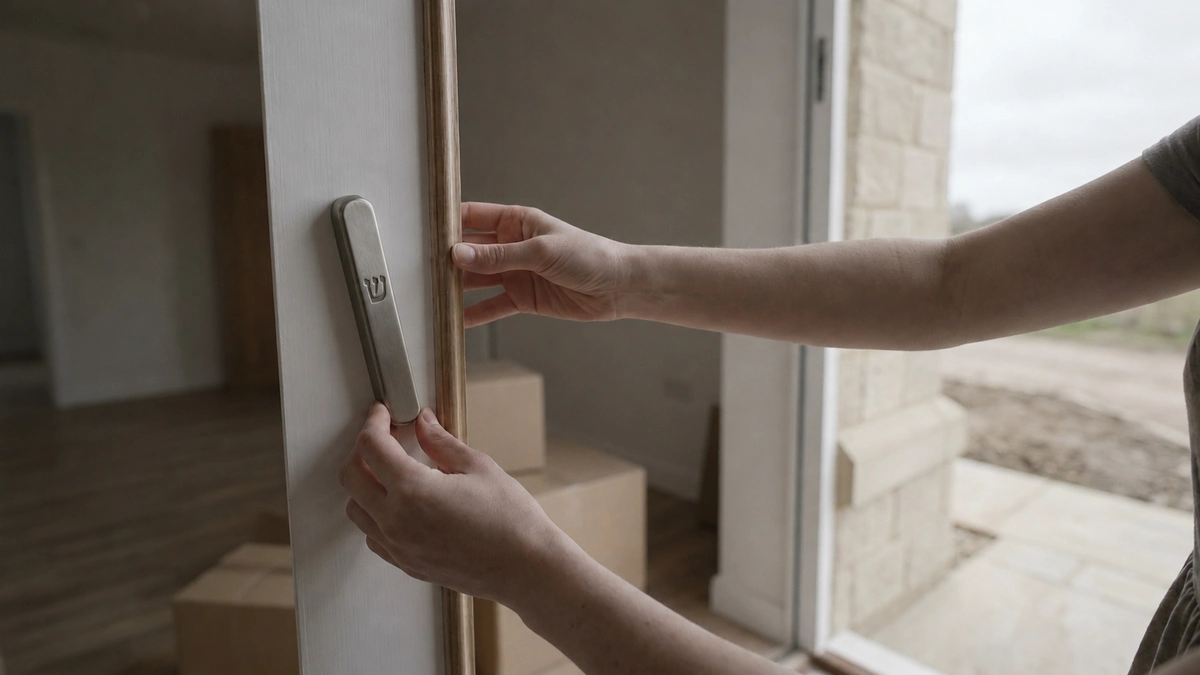
For apartments, the application is straightforward. Every doorway in the apartment that meets the four-amos minimum size requirement and has proper doorposts and a lintel requires a mezuzah. This includes the front entrance, bedrooms, living rooms, and any other rooms used regularly for dignified purposes. Bathrooms and spaces used primarily in ways that lack dignity are exempt, as the Shulchan Aruch (286:4) rules that places of uncleanliness do not receive a mezuzah. Laundry rooms and storage closets may also be exempt if they are not used as defined living or working spaces, although one should inquire with a rav and not make an independent determination.
When moving into an apartment and placing belongings before dwelling there, some poskim say the space is already obligated as a beis dira (dwelling), and a blessing may be recited. Others hold that the obligation begins only with actual dwelling. In practice, one should begin affixing mezuzos as soon as possible upon moving in and should not delay unnecessarily. A rav can advise on the specifics of each situation.
According to many authorities, rooms that have not yet been used or had items placed in them are not yet obligated in mezuzah. It is advisable to keep such rooms locked so that others do not inadvertently use them before the mezuzah is in place. Lechatchilah, the mezuzah should be affixed by a Jewish adult who understands the mitzvah and wishes to fulfill it. A Jewish worker may affix it on the occupant’s behalf. Using a minor or a non-Jew to affix the mezuzah should generally be avoided unless a rav rules otherwise in a specific case.
For offices and workplaces, the practical rule is to affix a mezuzah without a blessing when there is any doubt about whether the full halachic criteria are met. Many poskim rule that a rabbi’s office, a coffee room, a kitchen in a workplace, and a private office are all obligated. A workspace shared by several people, such as an open-plan area, may be exempt, but in many communities the common practice is to affix a mezuzah without a blessing.
Kosher Mezuzah ensures each mezuzah scroll meets the highest halachic standards, with full OU-endorsement and named sofer and magiah documentation. If you are setting up an office, moving into an apartment, or helping a student prepare a dormitory room, you can browse our full selection of verified mezuzah scrolls to ensure you have what you need to fulfill the mitzvah properly.
Common Mistakes to Avoid
One of the most common errors is assuming that a rented space or a dormitory room does not require a mezuzah because one does not own it. Ownership is not the criterion — dwelling is. Another frequent mistake is waiting too long to affix the mezuzah after moving in, sometimes for weeks or even months, under the mistaken impression that settling in fully comes first. In general, one should not delay unnecessarily.
Some people assume that offices are categorically exempt from the obligation because they are not homes. Many poskim rule that offices, study rooms, and workplaces used regularly during the day carry an obligation, even if the blessing is sometimes omitted. The exemption for spaces used only during the day applies in limited circumstances and should not be applied broadly without halachic guidance.
A third error involves placing a mezuzah in a location that is exempt, such as a bathroom doorway, under the impression that more mezuzos provide more protection. Placing a mezuzah where it does not belong can actually be problematic, as it may not be treated with the appropriate care it deserves.
For answers to common questions about these and related issues, our FAQ about kosher mezuzah provides clear, halacha-based answers. It is also important to ensure the scroll itself is genuinely kosher: purchasing from unverified sources carries real risk, and it is worth understanding why buying a mezuzah on Amazon can be risky before making that choice.
The Meaning Behind the Mezuzah in These Spaces
The mezuzah on the doorpost of an apartment, a dormitory room, or an office serves as a constant reminder that Hashem's presence extends into every space we inhabit and every life we undertake. The Rambam (Hilchos Mezuzah 6:13) teaches that each time a person enters or exits, they are reminded of the Oneness of Hashem and awakened to walk in upright paths. That reminder does not diminish because the space is rented, temporary, or commercial. In fact, the obligation in all of these settings reflects the foundational truth that kedushah is not confined to a permanent home or a family residence.
For a student in a dormitory room, far from home and navigating new responsibilities, the mezuzah on the door is a statement of identity and emunah. For a professional in an office, it is a daily reminder that the work of one's hands is carried out under the watchful care of the Ribbono Shel Olam. The Gemara teaches that the mezuzah guards the home, and by extension every space that a Jew calls his own, because Hashem guards from the outside what dwells within its protection. Your mezuzah should be a reminder of kedushah and protection for your home, your office, and every space where you dwell.
Fulfill the Mitzvah With Confidence — Kosher Mezuzah
Kosher Mezuzah has been dedicated to ensuring the proper fulfillment of the mitzvah of mezuzah for over forty years. Every scroll is written by a vetted sofer who has passed a rigorous halachic examination, double-checked by two expert examiners, and OU-endorsed — so that whether you are moving into an apartment, setting up an office, or helping a student prepare a dormitory room, every doorpost can be properly fulfilled. Each mezuzah comes with a unique QR code providing complete transparency: the sofer who wrote it, the examiners who reviewed it, the materials used, and when the scroll is next due for inspection.
To explore OU-endorsed mezuzah scrolls, visit kmezuzah.com/mezuzah-scrolls. If you have questions, the Kosher Mezuzah team is available through the contact form at kmezuzah.com/contact, and we will be glad to assist you in fulfilling this mitzvah with care and confidence.
May the mitzvah of mezuzah bring blessings and protection to your home, your dormitory room, and your place of work.



.svg)
Bring a true Kosher Mezuzah into your home
Fulfill the mitzvah with confidence, beauty, and meaning.
Buy a Mezuzah