

When is a Mezuzah Scroll Kosher: What Every Jewish Home Needs to Know
A mezuzah scroll must meet precise halachic requirements to be valid — and the case, however beautiful, cannot make the scroll inside any more valid than it actually is.
The mezuzah scroll requirements govern every element of its creation, from the parchment itself to the final letter of Hashem's Name. When a scroll falls short on even one of these standards, the mitzvah is not fulfilled, no matter how beautiful the case or how sincere the intention.
Kosher Mezuzah is dedicated to ensuring the proper fulfillment of this mitzvah, and if you are purchasing, placing, or checking mezuzahs in your home, the information in this article will help you fulfill this mitzvah with the confidence that comes from clarity.
Key Takeaways
- A mezuzah scroll is only kosher when handwritten by a qualified sofer, on properly prepared animal‑skin parchment using halachically approved ink. Computer‑generated or printed scrolls are entirely invalid and do not fulfill the mitzvah
- Every letter in a kosher mezuzah scroll must be formed correctly, written in the right order, and composed with proper intent (lishmah), as even a single cracked, touching, or malformed letter can render the entire scroll invalid.
- Reliable rabbinic certification, such as OU endorsement, is one of the most trustworthy ways to purchase a mezuzah scroll today, because it creates accountability for the sofer’s halachic standards and letter formations.
- A mezuzah scroll must be reviewed by a qualified magiah (halachic proofreader) after writing, and Chazal teach that each scroll should be checked twice within a seven‑year shemitah cycle to ensure the letters remain intact over time
- Choosing the correct script tradition for your household — Ashkenaz (Beit Yosef), Sefardi, or Arizal — should match your family's minhag, though all three traditions are fully kosher.
- A pasul (invalid) mezuzah scroll silently fails its purpose day after day, making it critical to verify the kashrut of every scroll in your ho.me on schedule and replace any that are uncertified or overdue for inspection
What Defines a Kosher Mezuzah Scroll?
A mezuzah scroll is kosher when it is handwritten by a qualified sofer (scribe) on properly prepared parchment, using halachically approved ink, with every letter formed correctly, in the right order, and with the proper intent. There are, in fact, numerous detailed halachic requirements governing every stage of this process, many of which are highly technical.
The Shulchan Aruch, the authoritative code of Jewish law authored by the Mechaber (Rav Yosef Karo), details these requirements with precision, and the Mishnah Berurah of the Chofetz Chaim elaborates on the consequences. An error in any of these elements — a crack, writing on invalid material, or a letter formed improperly — renders the scroll invalid, and the mitzvah is not fulfilled.
This is not a matter of stringency or custom. It is the baseline of what the Torah commands.
The Halachic Basis for Each Requirement
Chazal teach that several key details of mezuzah writing – such as scoring lines (sirtut) and writing the text in precise order (kesidran) – are halacha l’Moshe miSinai, a law transmitted from Sinai. The Rishonim and Shulchan Aruch apply these principles to the type of parchment used, the form of the letters (tzurat ha’ot), and the conditions under which the sofer writes, and later poskim such as the Mishnah Berurah (Biur Halacha) elaborate on their practical consequences.
The Rambam (Mishneh Torah, Hilchos Mezuzah) confirms that the mezuzah must be written on a single continuous piece of klaf (parchment), derived from the skin of a kosher animal. If one writes it on two separate pieces of skin, even if sewn together, the scroll is pasul. This ruling is cited directly in the Shulchan Aruch (Yoreh De’ah 288).
The hide itself must also be prepared lishmah – for the sake of the mitzvah. Some early authorities place the main lishmah requirement on the tanning of the parchment, while others emphasize the writing stage. The Shulchan Aruch rules that, ideally, both the preparation of the parchment and the writing should be done explicitly lishmah. In practice, detailed questions about parchment that may not have been prepared lishmah should be referred to a competent halachic authority, but a buyer should insist on klaf that was prepared and written with proper kavanah (intent) for mezuzah. Achieving this in real life depends on a trained sofer who is careful about kavanah for every scroll, and afterwards a qualified magiah (halachic proofreader) should review the finished scroll to ensure that the letters and spacing meet halachic standards.
Halachic sources also address which part of the hide may be used. Duchsustus – the inner layer of a split hide – is presented in the classical sources as the ideal material for a mezuzah scroll, while klaf – the outer layer – is accepted by major poskim and is widely used in practice today. The main practical point for a buyer is to confirm that the scroll was written on properly prepared animal‑skin parchment suitable for mezuzah, and not on any synthetic or paper material, which would render the scroll completely invalid.
Choose Your Mezuzah Scroll
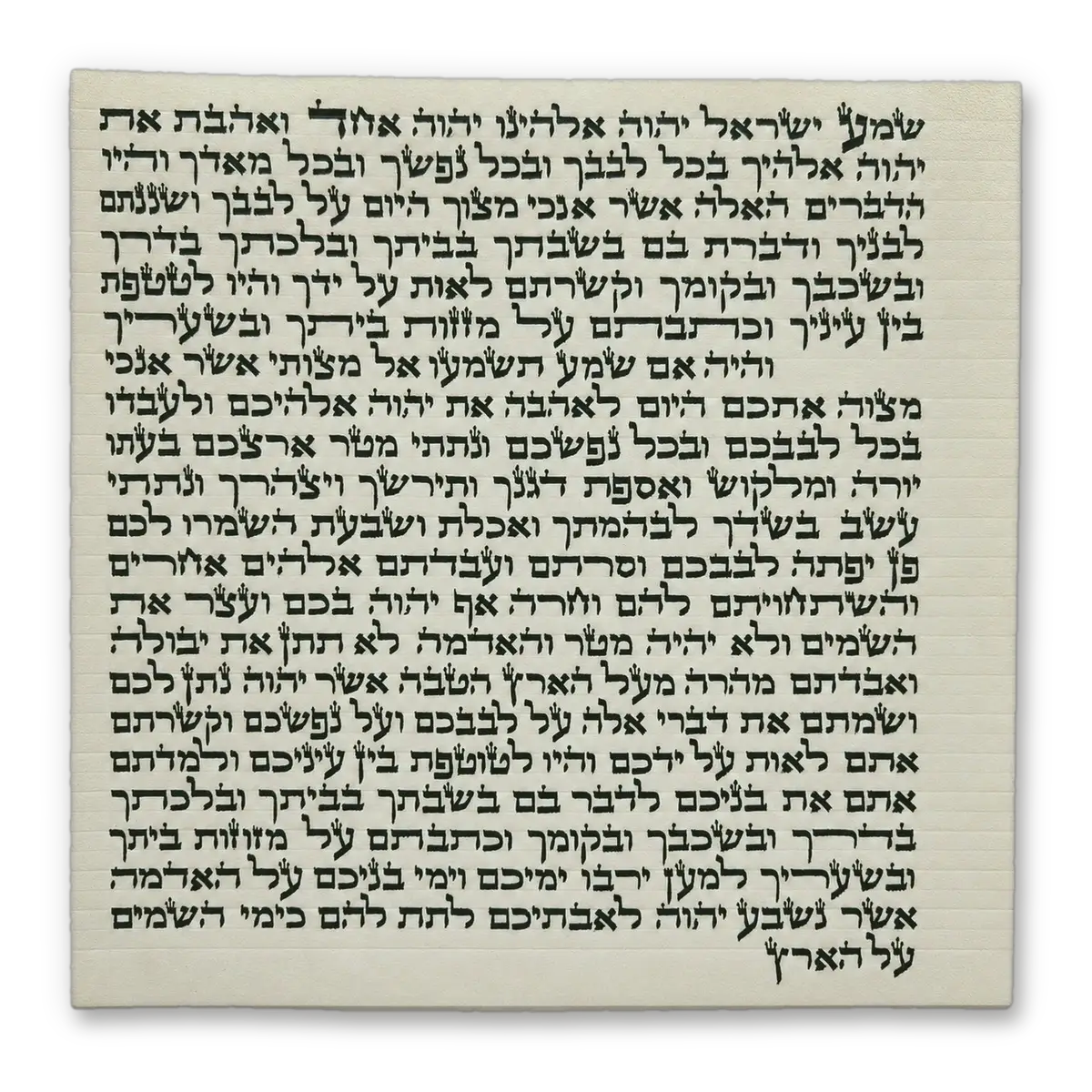
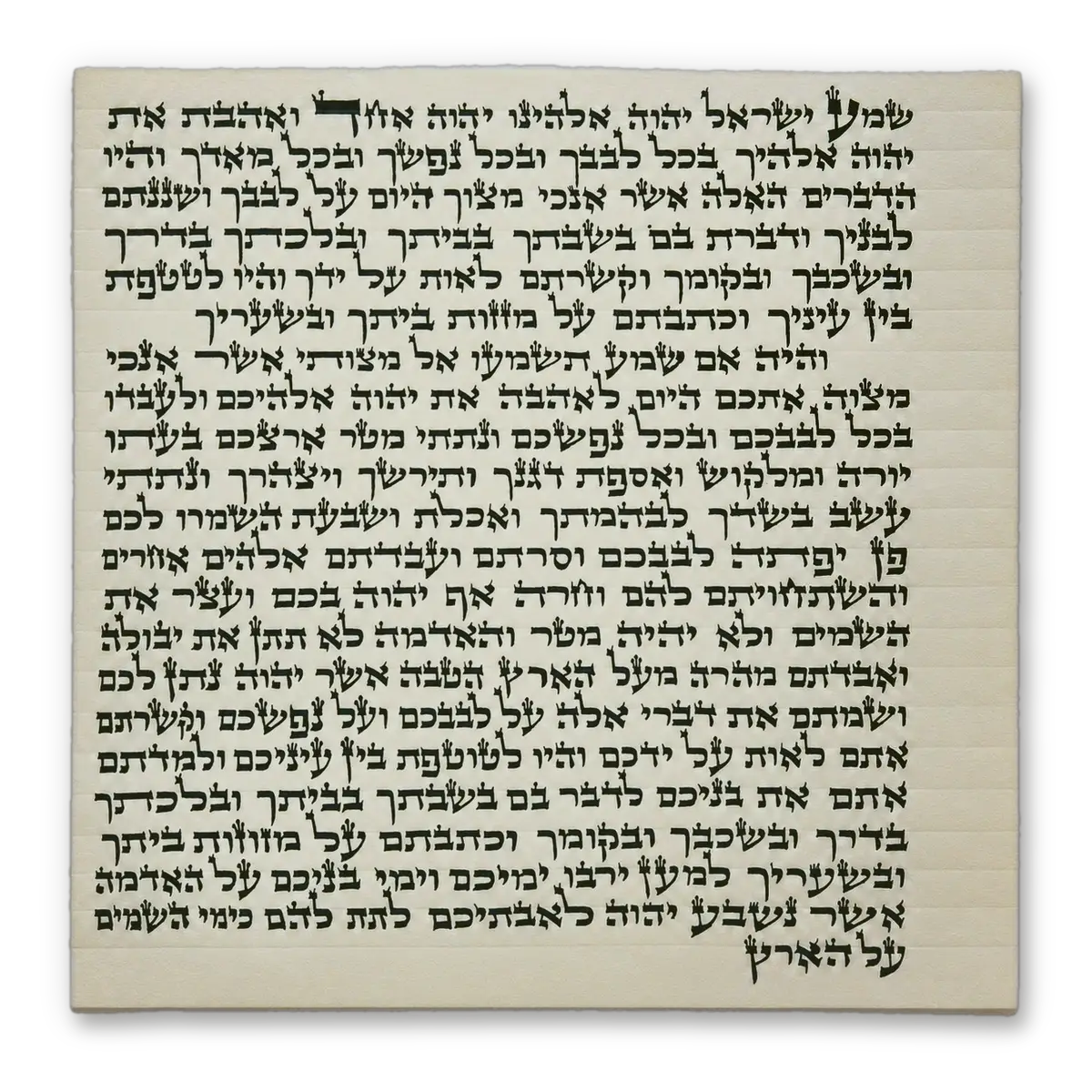
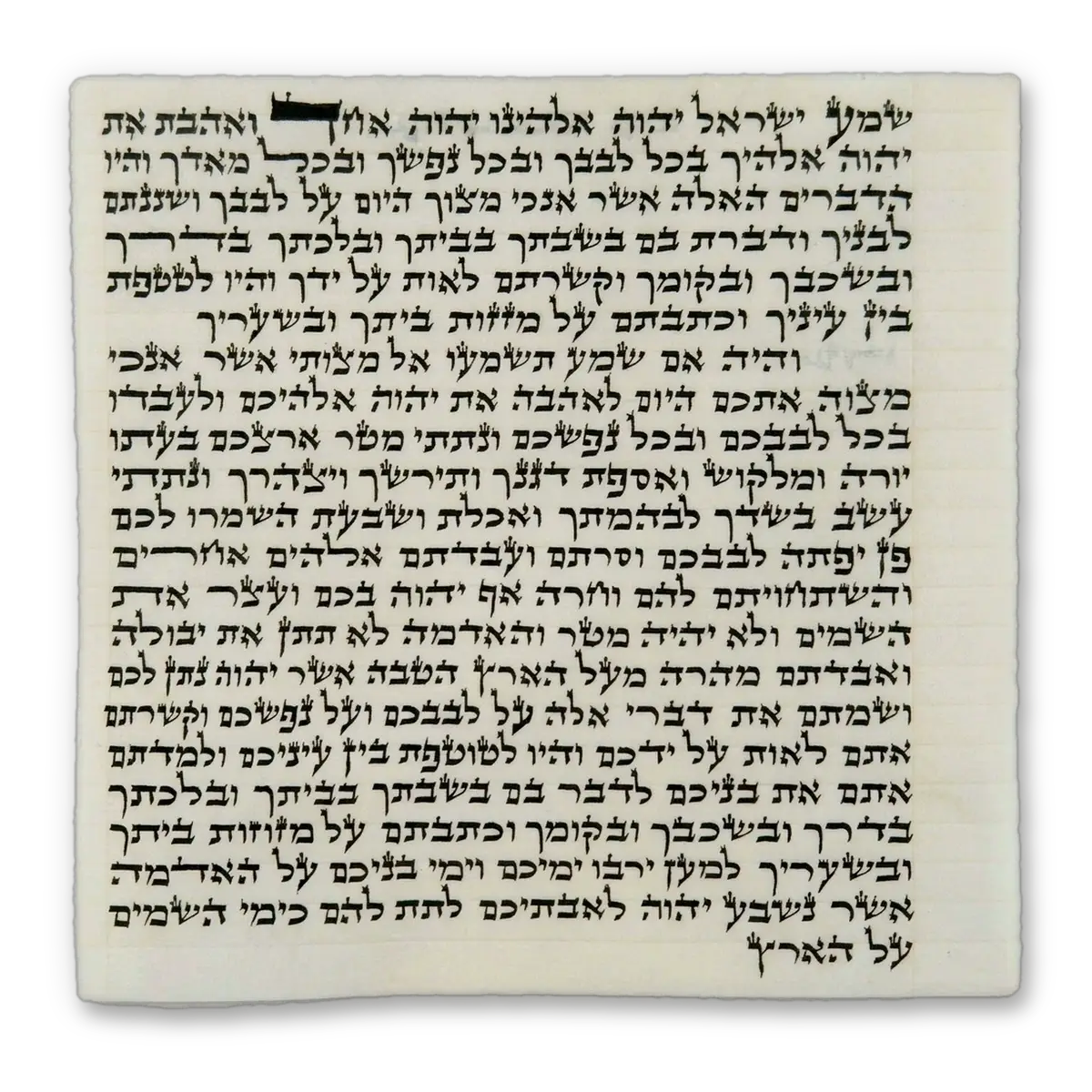
Each scroll is handwritten by a sofer on kosher parchment, following your minhag.
The Writing: Letters, Order, and Intent
Every letter of the 22 letters of the alef‑beis must be formed with tzurat ha’ot, the proper halachic form of the letter. A letter that is cracked, touching an adjacent letter, or missing a required component (such as the top on certain letters) may be pasul. Poskim emphasize that the text of the mezuzah must be written in the correct order (kesidran), and that even a single missing letter or word, despite the rest of the writing being in order, can invalidate the scroll. Later halachic works such as those in Yoreh De’ah and the Aruch HaShulchan discuss many practical examples of these issues.
The sofer must write each word lishmah with kavanah, specifically for the sake of this mitzvah. Hashem's names must be written with particular concentration, and they may not be erased or altered once written. This is one reason why a qualified sofer undergoes rigorous training and why a magiah (halachic proofreader) must review every scroll after it is completed. A scroll that has never been examined by a magiah should never be used. This is a basic precaution that every buyer should know.
The requirement of sirtut – scoring the parchment with lines before writing – is also necessary for a mezuzah scroll to be kosher. Halachic authorities rule that writing without proper sirtut can render the scroll invalid. The sofer scores the parchment so that each line of text is straight and properly aligned, maintaining the dignity and halachic integrity of the scroll.
Practical Application: What to Verify Before You Purchase
When purchasing a mezuzah scroll, it is strongly recommended that the scroll carry reliable oversight from a recognized halachic authority. Kosher Mezuzah ensures each mezuzah scroll meets high halachic standards, with every sofer and magiah personally identified and traceable. When a hashgachah such as the OU mezuzah certification is involved, its process includes certain guidelines and requirements, providing buyers with an accountable and verifiable standard.
It's important to note that the nusach of the scroll should match the minhag (custom) of the household. There are three main script traditions: Ashkenaz (Beit Yosef), Sefardi, and Arizal. These are distinctive scribal traditions passed down through different rabbinic communities. As a general rule, a family of Ashkenazic background will use an Ashkenaz (Beit Yosef) scroll, while a Sephardic family will use a Sefardi scroll, and families whose minhag is Arizal or who have Chassidic practice often use the Arizal (Ari HaKodesh) script. Where the family’s minhag is unclear, it is best to consult a rav. For a fuller explanation of these differences, see our article on understanding the differences between Ashkenaz, Sefardi, and Arizal mezuzah scripts.
The Gemara in Yoma (11a) teaches that a mezuzah scroll should be checked twice within a seven‑year cycle for private use, and twice within a Jubilee cycle for public mezuzahs. Contemporary poskim stress that even if several scrolls in a home have been checked and found valid, the remaining scrolls still require their own examination; one cannot assume that the rest are kosher based on a sample. Any pasul letter within a scroll renders it invalid. A trained magiah, certified and accountable, reviews each scroll carefully to assess subtle halachic questions of letter formation and spacing. Practical guidance on checking schedules and what to look for is available through our mezuzah FAQ.
One further point deserves attention. Chazal derive from the verses that the mitzvah is not only to write the words of Shema, but to place them correctly on the doorway. Proper placement and affixing are part of the mitzvah itself: the parchment must not merely be placed near the doorway or laid on a surface, but must be genuinely fixed in the required location according to the detailed laws of affixing. The spiritual reality of the mezuzah as a declaration of Hashem’s presence in the home depends on a scroll that is both kosher and properly affixed.
If you would like guidance in selecting the correct scroll for your home and minhag, you are welcome to browse our verified, scrolls from our OU Endorsed process and reach out with any questions.
Common Errors That Compromise Kashrut
One of the most serious and widespread problems in the mezuzah market is the sale of scrolls that appear handwritten but are in fact printed or photocopied. These scrolls are completely pasul and cannot fulfill the mitzvah under any circumstances. A buyer who does not verify the certification and traceability of the scroll before purchasing risks fulfilling nothing at all. Buying a mezuzah on Amazon or other online sources is risky, as it poses a serious failing in a mitzvah that is meant to protect and elevate the home.
A second common error involves purchasing scrolls that have never been reviewed by a qualified magiah. A sofer, but experienced, may still produce a pasul scroll through a careless movement or distraction. The magiah's role is not merely to check that letters appear correctly, but that the letters on the parchment actually conform to halachic requirements. Without magiah review, a buyer cannot verify the scroll's actual certification, regardless of how trustworthy the stated quality of the source.
A third misunderstanding concerns the covering of the scroll. The Rama notes that a mezuzah should be given a covering, and this is indeed the accepted practice. But covering does not affect the kashrut of the scroll itself. It is a matter of honor and protection. The Beis Yosef, citing the Zohar, notes that ideally the mezuzah should be visible where conditions permit, because visibility underscores the ongoing daily declaration of Hashem's Oneness. The Tur adds that the Name of Shaddai on the outer face should remain accessible. A covered scroll that is placed in a protective case still fulfills the mitzvah, but care should be taken that the covering does not allow moisture or other damaging forces to harm the scroll, especially in the area of Hashem’s Name.
The Meaning Behind the Requirements
The mezuzah scroll's requirements are not bureaucratic formalities. They reflect a profound halachic reality: the mezuzah is not merely a reminder or a symbol placed near a doorway. As the additional sources make clear, Chazal describe the mezuzah as closely bound up with the doorway itself once it is properly written and affixed. The two portions of Shema and V'haya Im Shamoa affixed to the doorpost become the written identity of the Jewish home.
Classical halachic works note that one who fulfills the mitzvah of mezuzah fulfills two positive commandments and thereby affirms the love of Hashem in a manner that is unique among the mitzvos. The ongoing, permanent nature of the scroll, fixed to the doorpost, means that every single moment the scroll remains properly affixed and kosher, it is a powerful declaration. This is precisely why every detail of the scroll's kashrut matters so greatly. A scroll that is pasul silently fails in its mission, day after day, without anyone in the home being aware.
Halachic discussions explain that the absence of a kosher mezuzah represents an ongoing lapse rather than a one‑time omission, which makes the obligation to fulfill it properly especially weighty. For this reason, our understanding of kedushah (holiness) sees the mezuzah at the doorpost as an active declaration of that reality, and for this reason, we regard the verification of each scroll not merely as a business practice but as a genuine responsibility toward the families and homes it serves.
What You Can Do Right Now
Fulfilling the mitzvah of mezuzah scroll kosher observance correctly requires two things: acquiring a scroll that meets the full halachic standard and ensuring it is properly placed and maintained over time. Begin by verifying that every scroll in your home carries recognized certification from a qualified halachic authority. If any scroll is uncertified, improperly written, or has not been checked within the halachically required timeframe, consult a rav and arrange for a qualified magiah to examine it.
For scrolls that need to be replaced, Kosher Mezuzah offers a full range of mezuzah scrolls from our OU Endorsed process, each written by a vetted sofer and reviewed by a qualified magiah, with the sofer's name, the magiah's name, and the date of writing available for every scroll. You can also review frequently asked questions about our certification process to understand exactly what our verification includes, from sofer to doorpost.
Fulfill the Mitzvah With Confidence — Kosher Mezuzah
Kosher Mezuzah has been dedicated to ensuring the proper fulfillment of the mitzvah of mezuzah for over forty years. Every scroll is written by a vetted sofer who has passed a rigorous halachic examination, double-checked by two expert examiners, and OU-endorsed — providing every family with the documentation and confidence that the scroll on their doorpost genuinely fulfills the mitzvah. Each mezuzah comes with a unique QR code providing complete transparency: the name of the sofer who wrote it, the examiner who reviewed it, the materials used, and when the scroll is next due for inspection. Kosher Mezuzah does not sell secondhand or returned scrolls. Every mezuzah that leaves the warehouse is new, certified, and ready to fulfill the mitzvah properly. To explore our OU-endorsed mezuzah scrolls, visit kmezuzah.com/mezuzah-scrolls.
If you have questions about scroll kashrut, certification, or checking intervals, the Kosher Mezuzah team is available through the contact form at kmezuzah.com/contact.
May the mitzvah of mezuzah bring blessings and protection to your home, and may every scroll on your doorpost be a genuine, verified declaration of Hashem's presence within it.




.svg)
Bring a true Kosher Mezuzah into your home
Fulfill the mitzvah with confidence, beauty, and meaning.
Buy a Mezuzah