
Teaching Children About Mezuzah: A Guide to Mezuzah Chinuch
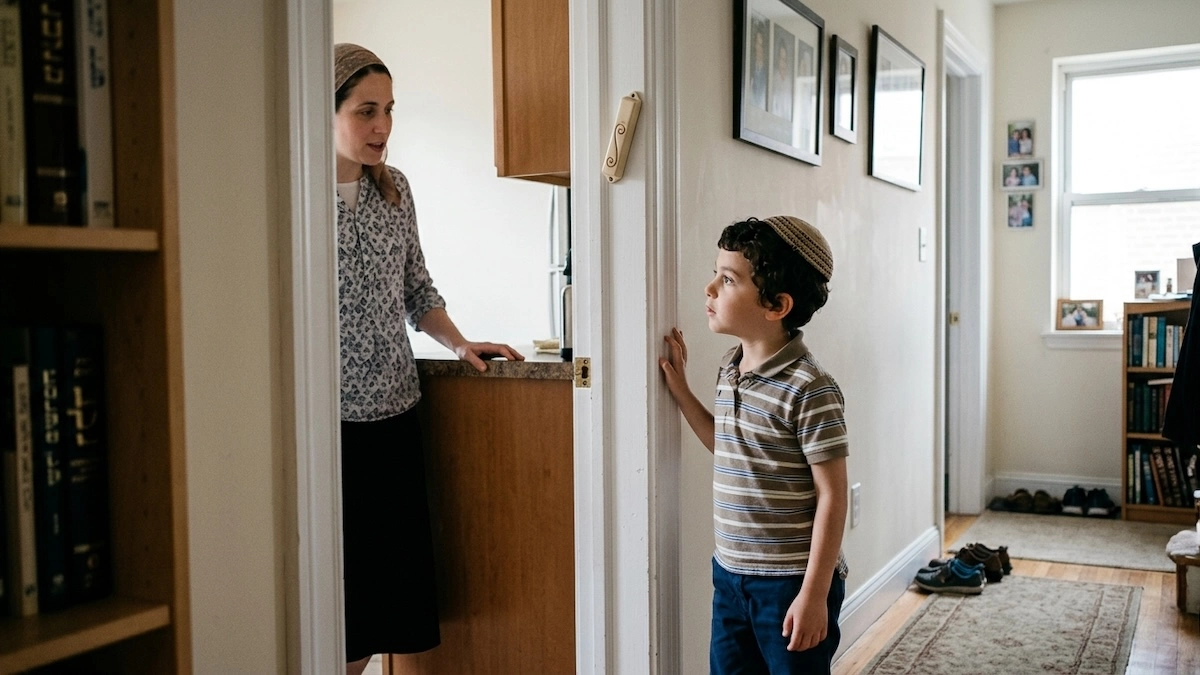
The mitzvah of mezuzah chinuch often begins with a simple moment: a child notices the case on the doorpost and asks what it is. That small question opens the door to discovering one of the most constant mitzvos a Jewish family lives with every single day.
Teaching children about mezuzah is a responsibility that belongs to every Jewish home. It is the beginning of a child's Torah education about what it means to live in a home where Hashem's presence is acknowledged and honored. We have both an opportunity and a responsibility to answer that question well, and this guide is here to help.
Kosher Mezuzah is dedicated to ensuring the proper fulfillment of the mitzvah of mezuzah, and we are here to help families do exactly that.
Key Takeaways
- Teaching children about mezuzah goes beyond identifying the case on the doorpost — it builds a lifelong awareness that Hashem's presence fills every doorway in a Jewish home
- According to the Rambam, the purpose of the mezuzah is for every person — including children — to remember Hashem's Oneness each time they enter or leave a room
- Mezuzah chinuch is most effective when parents walk through the home with their children, count each mezuzah together, and explain which doorways require one and why
- The scroll inside the case — written by a qualified sofer on parchment — is the true mezuzah. Halacha requires mezuzos in a private home to be checked periodically (Shulchan Aruch rules twice in seven years), and many contemporary rabbanim recommend having them inspected every few years to ensure they remain halachically valid
Teaching Children the Meaning of Mezuzah
Teaching children the meaning of mezuzah begins with one clear truth: the mezuzah on every doorpost is a direct commandment from Hashem, written in the Torah: that the words of the Shema (the declaration of Hashem's Oneness) and the parasha of Va'haya Im Shamoa (the second paragraph of Krias Shema) be affixed to the doorposts of our homes. When we teach children about mezuzah, we are teaching them about the foundation of Jewish life.
The Shulchan Aruch (Yoreh De’ah 286 and 291) and its commentaries are clear that the mitzvah of mezuzah applies to men, women, and even slaves, and that parents are obligated in chinuch (educating their children in mitzvos). The Mishnah (Berachos 3:3), as quoted by the Mishnah Berurah, states that although women and slaves are exempt from Krias Shema and Tefillin, but are fully obligated in tefillah (prayer), mezuzah, and Birkas HaMazon (Grace After Meals).
The Rambam, in Hilchos Tefillin, Mezuzah v’Sefer Torah (6:13), writes one of the most profound descriptions of why this mitzvah matters daily. In simple terms, he explains that a person must be very careful with mezuzah, because it is a constant obligation for everyone. Every time a person enters or exits, he encounters the unity of Hashem’s Name, remembers His love, wakes up from "sleep" in the vanities of the world, and returns to upright paths. This core of mezuzah chinuch is not just that children know what a mezuzah is, but that they understand that encountering it every day activates something deep in them.
The Sefer HaChinuch explains that the purpose of the mezuzah is to ensure that whenever a person moves through the doorway of daily life, he is reminded of who he is and Whom he serves. Teaching this to a child is not abstract. It is the most concrete daily reminder in Jewish life.
The Gemara in Shabbos (32b) records the teaching that children may be affected by the neglect of this mitzvah, citing the verse in Devarim (Deuteronomy 11:20): "And you shall write them on the doorposts of your house," followed immediately by: "So that your days and the days of your children may be multiplied." The connection between a home's mezuzah observance and the wellbeing of children is stated plainly in the Torah itself.
How to Explain Mezuzah to Kids
Explaining mezuzah to kids works best when we connect it to what they already experience. A child who touches the mezuzah case each time he passes through the front door is already doing something meaningful, but only if he understands why. The Rambam says the purpose is that a person will look at it and remember — remember who Hashem is, remember who we are as Jews, and remember to walk in upright paths.When we teach children, we can teach them that the custom of touching or kissing the mezuzah and its purpose, which is not the physical gesture but the awareness it is meant to create.
A meaningful starting point in mezuzah education is to open the Kosher Mezuzah learning center with your child and explain what is actually written inside the mezuzah scroll. These are the first two parshiyos (sections) of the Shema and Va'haya Im Shamoa — the same portions that children recite in their daily prayers. When a child understands that the same words he says in Shacharis (morning prayers) are the words enclosed in the mezuzah case on every doorpost of his home, the mezuzah becomes far more meaningful.
Practical Steps for Teaching Mezuzah to Children
Walk through your home with your child and identify each doorway that has a mezuzah. Count them together and explain which rooms require a mezuzah and which ones are exempt and why. For practical guidance on how many doorways in a home require a mezuzah, you can consult our detailed resource on which doorways require a mezuzah, which is helpful to review together with older children as part of their mezuzah chinuch.
Open the essential mezuzah knowledge guide with your child and read together about what is written inside the scroll, who writes it, and why it must be handwritten by a qualified sofer (Torah scribe). Teach your child the words of the Rambam quoted above in simple language: when we walk through the door, we look at the mezuzah and remember that Hashem is One and that He is with us in our home.
Establish the practice of touching or looking at the mezuzah each time your child enters and exits the home, and ask him or her to say quietly: "Hashem is my guardian."
Explain that a mezuzah scroll must be written by a qualified sofer, checked by a qualified magiah (inspector), and should be inspected again periodically to remain kosher. Shulchan Aruch rules that mezuzos in a private home are checked twice in seven years, and many contemporary rabbanim recommend having them inspected every few years, especially in climates where the scroll may be affected by heat or moisture.
For questions about your specific scrolls, you are welcome to contact Kosher Mezuzah, where we are dedicated to ensuring the proper fulfillment of the mitzvah of mezuzah.
If you are ready to help your family fulfill this mitzvah properly, you are welcome to browse our selection of mezuzah scrolls from our OU Endorsed process and speak with someone who can guide you to the right choice.
The Halachic Basis for Mezuzah Chinuch
The Deeper Meaning Children Carry With Them
The Rambam teaches that the mezuzah is not merely an item affixed to a doorpost. The portions of the Shema and Va'haya Im Shamoa are not placed on the doorpost in the way one hangs a picture on a wall. The parchment, when properly affixed with the blessing and the intention of fulfilling the mitzvah, becomes part of the entrance of the home. It inscribes a declaration of the meaning of entering and leaving. This is why the Sages called the parchment itself a "mezuzah," meaning "doorpost," even though the word actually refers to the wood or stone of the doorpost, not the scroll that merely sits on the doorpost. It becomes the declaration of Hashem's Oneness embedded in the very structure of the home.
When children grow up in homes where the mezuzah is taught, explained, and treated with respect, they carry that awareness with them throughout life. Every doorway in a shul where they daven, every classroom where they learn, every dormitory room where students actually live and may eat (which is generally obligated in mezuzah, often with a brachah when it functions as a residence), or eventually their own home, becomes a moment of encounter with the Oneness of Hashem.
The mitzvah mezuzah places Krias Shema into the physical structure of every Jewish space they inhabit. The Rambam declares that Jewish life is not divided into holy moments and ordinary ones. The mezuzah elevates the home, the doorway, and the daily activities, so that all the comings and goings of Jewish life are encounters with the presence of Hashem.
Fulfill the Mitzvah With Confidence — Kosher Mezuzah
Kosher Mezuzah has been dedicated to ensuring the proper fulfillment of the mitzvah of mezuzah for over forty years. Every scroll is written by a vetted sofer who has passed a rigorous halachic examination, double-checked by two expert examiners, and OU-endorsed — so that every mezuzah your child touches on the way in and out of your home carries the full weight of a properly fulfilled mitzvah. Each mezuzah comes with a unique QR code providing complete transparency: the sofer who wrote it, the examiners who reviewed it, the materials used, and when the scroll is next due for inspection.
To support and educate your family in this mitzvah, please reach out to us directly, and we are here to help.
May the mitzvah of mezuzah bring blessings and protection to your home, and may your children grow to cherish every doorpost they walk through as a reminder of Hashem's constant presence in their lives.

.svg)
Bring a true Kosher Mezuzah into your home
Fulfill the mitzvah with confidence, beauty, and meaning.
Buy a Mezuzah