

Best Mezuzah Case Material: Glass vs. Wood vs. Metal (Pros & Cons)
Choosing the best mezuzah case material is not just a matter of taste — the case you choose affects how well the klaf (parchment) is protected.. Related reading: Best Waterproof Mezuzah Cases.
Whether you are furnishing a new home, replacing a worn case, or simply trying to do the mitzvah right, understanding the differences between glass, wood, and metal cases will help you make a thoughtful, well-informed choice. Kosher Mezuzah is dedicated to ensuring the proper fulfillment of this mitzvah, and if you have specific questions about your situation, we welcome you to reach out for guidance.
Key Takeaways
- The best mezuzah case material depends on the doorpost’s location, the practical needs of that space, and the level of weather exposure the case will face.
- Glass and transparent acrylic cases can be acceptable coverings and may work well for many interior doorposts in clean, dignified rooms, though transparent cases should not be presented as universally ideal for every setting.
- Wood mezuzah cases are beautiful and fully opaque, and they can work well for many indoor doorposts.
- Metal cases are often the most durable option for outdoor doorposts, exposed entryways, porches, and gates because they generally offer stronger protection against weather and moisture.
- In certain settings, halachic questions about additional covering may apply regardless of case material, so any such requirement should be confirmed with a qualified rav based on the mezuzah’s exact location.
- No matter which case material you choose, the klaf inside must be handwritten by a qualified sofer, properly placed according to halacha, and checked periodically by a qualified magiah; the classic halachic standard for a private mezuzah is twice in seven years, with harsher conditions sometimes justifying more frequent inspection.
- A stunning case does not fulfill the mitzvah if the scroll inside is printed or if the klaf is invalid — always verify that your mezuzah scroll is kosher before installation.
The best mezuzah case material depends on where the mezuzah is placed, what halachic requirements apply to that location, and how much durability you need. For most doorposts in a standard home, any well-made case — glass, wood, or metal — can work beautifully, and each material has distinct halachic implications and practical strengths worth understanding before you decide. See also Each Mezuzah Is Its Own World.
Why the Case Matters
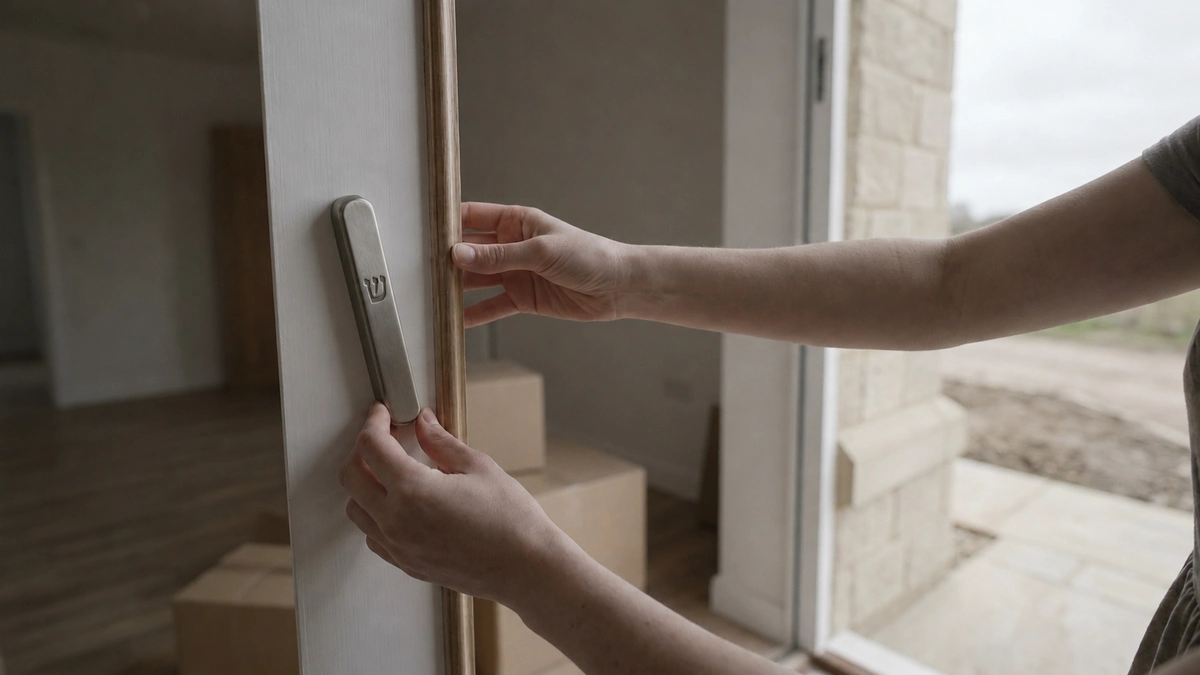
The Torah commands, "וּכְתַבְתָּם עַל מְזוּזוֹת בֵּיתֶךָ וּבִשְׁעָרֶיךָ" — "And you shall write them on the doorposts of your house and on your gates" (Devarim 6:9). Shulchan Aruch focuses on where the mezuzah must be placed: on the right side of the doorway, in the outer handbreadth of the entrance, at the beginning of the upper third of the doorpost (Shulchan Aruch Yoreh De'ah 289:2).
Halachically, the case is best understood as a practical protection for the klaf. A good case helps shield the parchment from moisture, handling, impact, and weather exposure. It can also contribute to hiddur mitzvah — beautifying the mitzvah — by honoring the mezuzah in a dignified and attractive way.
That means the "best" material is not the same in every setting. An interior bedroom doorway does not face the same conditions as an outdoor gate or exposed front entrance. The right choice depends on use, environment, and durability.
Glass Mezuzah Cases: Clear and Elegant
Glass cases, along with clear acrylic and transparent plastic cases, are especially popular for interior doorposts. Their main advantage is that they allow the mezuzah to remain visible while still protecting it. Many people like the clean, simple appearance, and transparent cases make it easy to inspect the general condition of the case without opening it.
For most ordinary indoor rooms, a glass or clear case is a practical and attractive choice. It works especially well in clean, climate-controlled parts of the home where the mezuzah is not exposed to rain, steam, or major temperature swings.
Pros of glass or transparent cases:
- Elegant, minimal appearance
- Lets the mezuzah remain visible
- Easy to notice condensation, shifting, or seal issues
- Well suited to living rooms, dining rooms, hallways, and bedrooms
Cons of glass or transparent cases:
- Glass can shatter if struck
- Acrylic can scratch, cloud, or yellow over time
- Less ideal for exposed outdoor conditions
- Offers less natural concealment in places where extra privacy concerns may arise
In a marital bedroom, some later halachic discussions raise questions about how sacred writings should be treated in a room used for intimacy. The explicit source for kli b’toch kli — "a vessel within a vessel" — is discussed regarding sacred texts in Orach Chaim (Shulchan Aruch Orach Chaim 40:2). How that applies in practice to a mezuzah on a bedroom doorway is an area where customs and rabbinic guidance may vary. For that reason, if the mezuzah is on a marital bedroom door, it is wise to ask your rav whether a more concealed or opaque arrangement is preferable.
Wood Mezuzah Cases: Warm, Classic, and Decorative
Wooden mezuzah cases are among the most traditional and visually warm options. They can be simple and understated or beautifully carved and decorative, and many people feel that wood gives the mezuzah a natural dignity that fits the mitzvah well.
From a practical standpoint, wood is a strong option for indoor use. It is usually fully opaque, resists ordinary bumps well, and offers a wide range of design possibilities. For homeowners who want something traditional-looking and less modern than acrylic or metal, wood is often the most appealing choice.
Pros of wood mezuzah cases:
- Warm, classic appearance
- Usually opaque and discreet
- Good durability for indoor use
- Wide variety of handcrafted and decorative styles
- Excellent choice for hiddur mitzvah
Cons of wood mezuzah cases:
- Can warp, crack, or absorb moisture if exposed
- Less suitable for wet or outdoor environments unless heavily sealed
- Damage inside the case is not visible without opening it
- May require periodic checking for wear in humid climates
For most interior rooms, wood is an excellent choice. But for outdoor doorposts, wood should be used only when it has been properly sealed and maintained. If the case begins to swell, crack, or loosen, the klaf inside may become vulnerable to moisture damage.
Metal Mezuzah Cases: Strongest for Outdoor Use
Metal cases — commonly aluminum, stainless steel, brass, or silver-plated metal — are usually the most durable option. They are especially useful for front doors, outdoor entrances, porches, gates, garages, and any doorway exposed to weather.
A well-made metal case can protect the klaf better than most other materials in difficult conditions. It stands up well to impact, sun, rain, and shifting temperatures, especially when the case is properly sealed.
Pros of metal mezuzah cases:
- Strongest durability overall
- Best choice for outdoor and semi-outdoor use
- Resists impact, moisture, and sun exposure better than most materials
- Often available in elegant, refined designs
- Long-lasting and low-maintenance
Cons of metal mezuzah cases:
- Some metals can tarnish or oxidize over time
- Not transparent, so the klaf cannot be visually checked without opening the case
- Can become hot or cold in extreme weather
- Heavier cases may need more secure mounting
For exposed entryways, metal is usually the most reliable choice. If your mezuzah is on an exterior door, side entrance, or gate, a sealed metal case is often the safest long-term option.
Matching the Case to the Location
Once you understand the strengths of each material, the practical decision becomes much easier.
For interior doorposts in dry, clean rooms — such as living rooms, dining rooms, offices, hallways, or children’s bedrooms — glass, acrylic, wood, and metal can all work well. In these locations, the choice is often mostly aesthetic. Transparent cases are especially popular because they are clean-looking and easy to monitor.
For a marital bedroom, the room itself is generally treated as a regular living space for mezuzah purposes, but questions about privacy and sacred writings can arise in practice. Some authorities discuss whether the mezuzah in a marital bedroom should have an additional covering beyond its standard wrapping and case. Others are more lenient, since the scroll is already enclosed. Because the practical details are treated differently by different poskim, the safest guidance is to ask your rav whether the mezuzah’s existing covering is sufficient or whether an extra opaque covering is appropriate.
For outdoor doorposts, entryways, porches, garages, and gates, a well-sealed metal or durable outdoor-grade plastic case is usually best. Moisture, wind, temperature fluctuation, and sun exposure can all damage a klaf over time, so the main priority is a case that offers dependable protection from the elements.
For bathrooms and bathhouses, the halachah is more straightforward: such spaces are exempt because they are not considered places of honorable dwelling (dirat kavod). Rambam explicitly lists a bathroom and bathhouse among the spaces that are exempt from mezuzah for that reason (Rambam, Hilchot Mezuzah 6:9).
For utility rooms, storage rooms, laundry spaces, and similar areas, the answer depends on how the space is built and used. Some are obligated in mezuzah, and some are not. That question turns more on the room itself than on the case material, so when in doubt, it is best to ask a competent halachic authority.
One Final Practical Point
No matter which case material you choose, the most important thing is the kosher klaf inside. A beautiful case does not compensate for a mezuzah that has become damaged or invalid.
Shulchan Aruch rules that a private mezuzah should be checked twice every seven years, while a communal mezuzah is checked twice every fifty years (Shulchan Aruch Yoreh De'ah 291). In practice, mezuzot in exposed or humid environments may need more frequent attention.
So if you are choosing the best mezuzah case material, the short answer is this:
- For most indoor rooms: glass, acrylic, wood, or metal can all work well
- For warmth and traditional style: wood is often the most attractive choice
- For visibility and a modern look: glass or clear acrylic is very popular
- For outdoor durability: metal is usually best
- For a marital bedroom or any halachically sensitive setting: ask your rav which arrangement is most appropriate. You can find answers to many common questions like this in our mezuzah FAQ.
We also recommend reviewing essential mezuzah knowledge to understand the full scope of placement, checking, and case requirements.
Kosher Mezuzah
Kosher Mezuzah ensures every scroll we offer is written by a vetted sofer and checked by a qualified magiah before it reaches your doorpost. Our process is endorsed by the Orthodox Union. We provide full traceability — who wrote it, who checked it, when it was written, and what materials were used. This level of traceability gives buyers confidence that the mitzvah they are fulfilling is genuine. We welcome you to browse our selection of mezuzah scrolls from our OU Endorsed process.
We also believe that proper fulfillment of the mitzvah of mezuzah includes regular checking. A scroll that was kosher when you purchased it may become pasul (invalid) over time as letters crack or ink fades. We encourage every family to have their mezuzah checked according to the halachic schedule appropriate for their climate and location.
If you have questions about choosing the right case, verifying your scroll, or understanding the halachic requirements for your specific doorposts, contact us at kmezuzah.com/contact and we will be glad to guide you.
May the mezuzah on your doorposts be a source of protection, blessing, and zechus for your entire family, v'chein yehi ratzon.

.svg)
Bring a true Kosher Mezuzah into your home
Fulfill the mitzvah with confidence, beauty, and meaning.
Buy a Mezuzah