

If a Mezuzah Was Placed Incorrectly, How Urgent Is It to Fix?
If you discover that a mezuzah in your home may have been placed incorrectly, the natural question is: How urgent is it to fix? In many cases, the answer is simple: very urgent. Mezuzah is not just about having a scroll somewhere near the doorway. It is a mitzvah with specific halachic rules about where it goes and how it must be affixed. If those rules were not followed, the mitzvah may not be being fulfilled properly.
That does not mean every imperfect installation calls for panic. But it does mean the issue should not be brushed aside. Some placement errors are serious enough that the mezuzah should be corrected as soon as possible, while other cases are more technical and should be reviewed with a rav.
Why Correct Placement Matters So Much
The Torah commands that these words be written “on the doorposts of your house and on your gates.” Chazal understood that this is not just a symbolic instruction. A mezuzah must actually be fixed to the doorway in the halachically proper place.
The Talmud speaks sharply about certain mistakes. It says that if someone hangs the mezuzah on a stick or places it behind the door, it is considered a danger and the mitzvah is not fulfilled. That is strong language. It shows that proper placement is not a nice extra detail. It is part of the core mitzvah itself.
Rashi explains that the home is not protected by the mezuzah until it is affixed properly according to halachah. In other words, the mezuzah’s role is not fulfilled simply because the scroll exists. It has to be installed the right way. A helpful overview of these requirements can be found in our halachic placement guide.
So How Urgent Is the Fix?
If the mezuzah was placed in a way that halachah clearly rejects, then the fix should be made without unnecessary delay. Once you know there is a problem, the obligation is active. This is especially true if the issue is one of the basic rules of placement rather than a minor question of custom or appearance.
A good way to think about it is this: if the mezuzah is not where halachah recognizes it as a mezuzah, then the home is still waiting for the mitzvah to be properly fulfilled. That is why serious placement mistakes should be corrected promptly.
Which Mistakes Are Clearly Serious?
Some errors are straightforward.
- If the mezuzah was hung loosely rather than properly affixed, that is a classic example discussed by the Talmud and Rambam. A mezuzah must be set in place securely. If it is merely hanging, that is not considered proper affixing.
- If it was placed behind the door, Rambam writes that the person has effectively done nothing. That is not a valid fulfillment of the mitzvah.
- There is also the matter of the wrong side mezuzah, placing the mezuzah on the left doorpost instead of the right. If it was attached on the left side of the doorway instead of the right, Rambam states explicitly that it is invalid. The mezuzah belongs on the right side of the entrance as a person enters.
- There are also rules about placement within the doorway itself. Halachah places the mezuzah in the outer handbreadth of the doorway and at the beginning of the upper third of the doorpost. If it was installed in a way that clearly conflicts with those rules, the case should be reviewed and often corrected.
Many common mezuzah placement mistakes fall into this category and require immediate correction.
Other placement problems can also require correction. For example, if the mezuzah was inserted into the doorway in an unnatural way, recessed too deeply into the frame, or installed too far inward instead of within the outer part of the entrance, the placement may not meet halachic standards. Height can also become an issue. The mezuzah belongs in the upper third of the doorway, and while halachah allows some upward flexibility, a mezuzah that is clearly outside its valid placement zone should not be left as-is. In short, any installation that removes the mezuzah from its proper place within the doorway — whether by depth, position, or form of affixing — should be reviewed and, when necessary, corrected.
Our halachic guide on placement can help orient you before that conversation. The principle that guides all of this is straightforward: when the mitzvah is not being fulfilled, the obligation is active and ongoing, and it should be corrected as soon as it is practically possible.
Not Every Problem Is the Same
This point matters. Some mistakes are clear invalidations. Others are not so simple.
For example, there are situations where the mezuzah may be slightly higher or lower than ideal, or where the angle of the case may not look quite right. In those cases, the right response is usually not to make sweeping statements, but to ask a rav or a qualified sofer what should be done.
Knowing how many doorways require a mezuzah in your home is also part of ensuring no obligation has been overlooked. A room-by-room review, guided by a knowledgeable source, is a worthwhile undertaking, especially after discovering one error, since additional placements in the same home may warrant a second look.
What Halachah Actually Requires
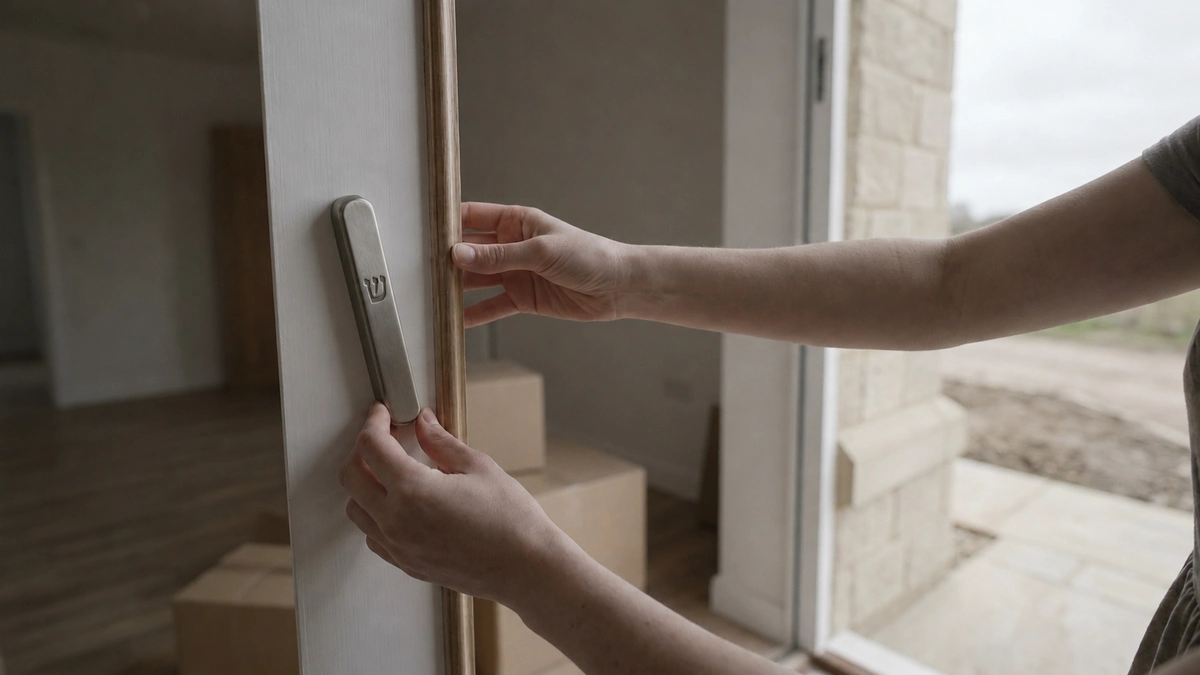
The basic requirements are clear. The mezuzah should be affixed:
- on the right side of the entrance,
- within the outer part of the doorway,
- and in the upper third of the doorpost.
For Ashkenazim, the common custom is to place the mezuzah on a slight diagonal, following the ruling of the Rema. That said, the main point is not the decorative case. It is the halachically correct placement of the mezuzah itself.
This is why knowledgeable installation matters. A mezuzah can look perfectly fine from the outside and still be installed in a way that needs correction.
What Should You Do If You Suspect a Problem?
If you think a mezuzah in your home may have been placed incorrectly, the best next step is simple: have it checked now. If the problem is obvious, it should be corrected promptly. If the issue is less obvious — for example, its exact height, direction, or placement inside the frame — ask a rav or an experienced sofer to review it. That is especially important if the mezuzah may need to be removed and re-affixed, since the question of whether a new blessing is made can depend on the details.
Why This Deserves Attention
A mezuzah is one of the mitzvot that meets a person at the threshold of daily life. It marks the home with kedushah and reminds a Jew, again and again, of Hashem’s presence and commandments. That is exactly why proper placement matters. A spiritually and halachically sound mezuzah is not just about technical compliance, it is about fulfilling the mitzvah as HaKadosh Baruch Hu intended, with precision and with kavanah (intention).
And that is also why the tone should be calm but serious. Anyone responsible for a mezuzah, homeowner, renter, or otherwise, carries this obligation. If there is a real problem, fix it. If there is doubt, clarify it. But do not leave the question sitting unresolved for any length of time. Discovering a mezuzah mistake years later does not mean the situation cannot be corrected. It simply means the correction must happen now.
How Kosher Mezuzah Can Help You Fulfill This Mitzvah Correctly
At Kosher Mezuzah, every mezuzah we provide is written by a qualified sofer (Torah scribe) and reviewed by a trained magiah (halachic mezuzah examiner). Each scroll is verified through a process that includes documented information about the sofer, the magiah, the materials used, and the date of writing, providing a level of traceability that gives buyers genuine confidence in what they are placing on their doorposts. Our process is OU-endorsed.
We understand that the mitzvah of mezuzah carries real halachic weight, and that an incorrectly placed or halachically invalid mezuzah leaves the obligation unfulfilled. That is why we take seriously not just the quality of the scroll itself, but the information and guidance we provide to help you place it correctly. If you have questions about whether a mezuzah in your home is properly situated, we encourage you to consult your rav, and we are here to support that process with accurate, halacha-based information.
If you have discovered an incorrect mezuzah placement, contact us today so we can help you correct it properly and fulfill the mitzvah with confidence. May your home be blessed with shalom, with kedushah, and with the zechus of a mitzvah performed as it should be, b'hiddur and with care.


.svg)
Bring a true Kosher Mezuzah into your home
Fulfill the mitzvah with confidence, beauty, and meaning.
Buy a Mezuzah