
How to Install a Mezuzah Properly: A Complete Step-by-Step Guide
Installing a mezuzah is not simply attaching a case to a doorway. The scroll has to be kosher, the case has to go in the right place on the right side, and it has to be fixed firmly rather than hung loosely. The halachic rules are detailed, but they are manageable once you take them in order.
This guide covers the sequence: what to check before you start, where the mezuzah goes, when to say the bracha, and what counts as being properly affixed. For an ordinary doorway this is all you need. For an unusual one, such as an opening between two rooms where the direction of entry is not obvious, that is the point to ask your rav rather than guess.
How to Install a Mezuzah: The Steps
- Confirm the doorway is obligated in a mezuzah in the first place.
- Check that the scroll is kosher and sits correctly inside the case.
- Stand where a person normally walks in and identify the doorpost on your right.
- Measure the doorway from the floor to the lintel and mark the start of the upper third.
- Recite the bracha.
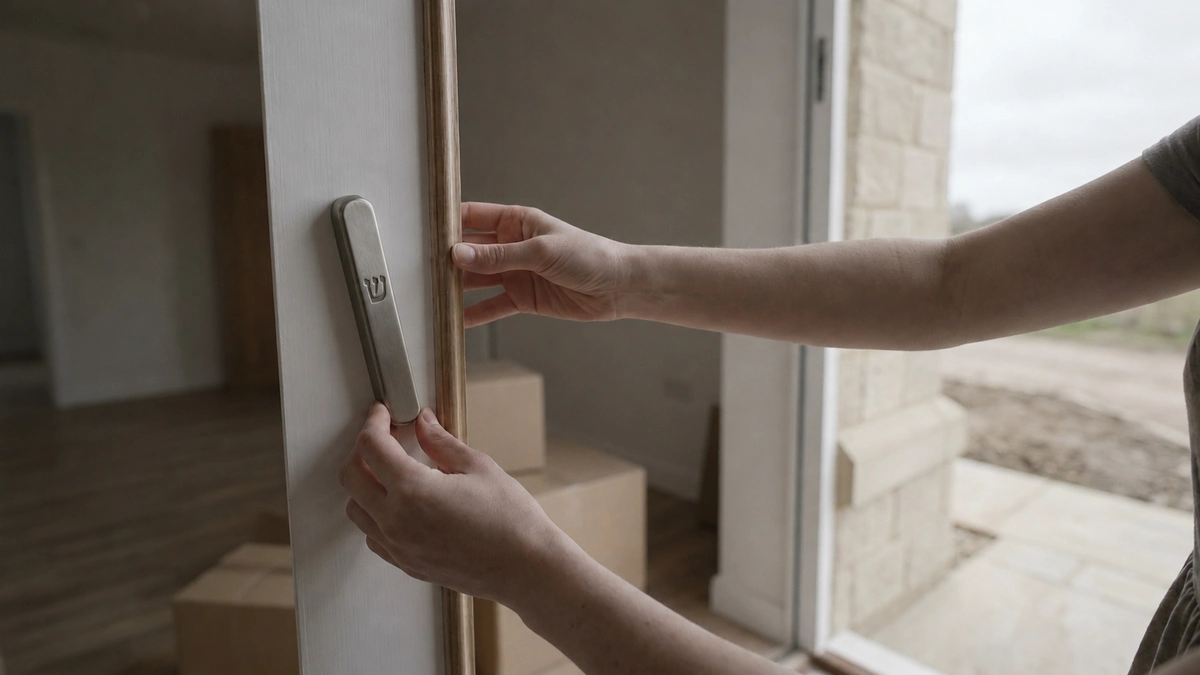
- Immediately affix the case firmly, at that mark, on the inner face of the post.
Each step is explained below.
Before You Start: Check the Scroll
Make sure the scroll itself is kosher and was written by a qualified sofer. The case is not the mitzvah; the handwritten parchment is. A beautiful case cannot compensate for an invalid scroll, and a plain case is perfectly fine if the klaf inside is valid and well protected.
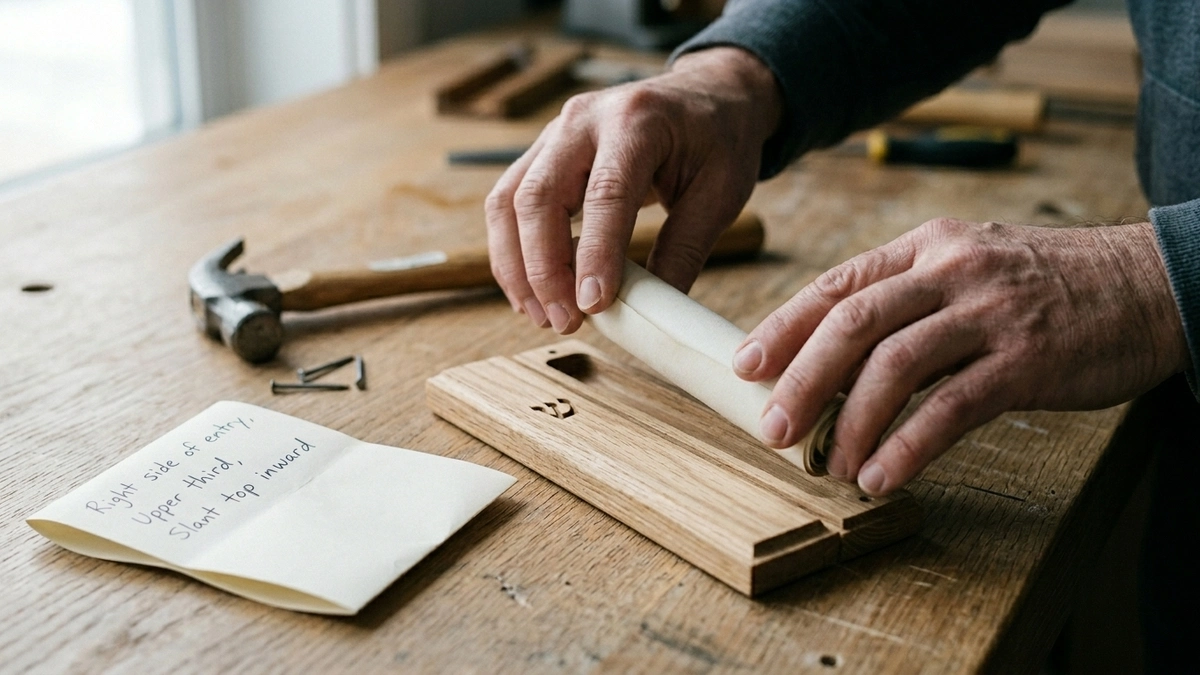
The scroll should be inserted into the case carefully. It should not be crushed, folded improperly, or forced into a case that is too small. People often focus on the wall mounting and overlook the handling of the klaf, which is the part that actually carries the mitzvah. If the case has a window or a visible opening, check that the scroll sits the way the sofer or seller instructed. If anything is uncertain, ask before mounting rather than after.
The Placement Rules in Brief
Four things determine where the mezuzah goes. Each is covered in full elsewhere, so here is what you need at the moment of installation.
Side. The right doorpost as you enter, judged by the direction a person walks in, not out. Placing it on the left does not fulfill the mitzvah, so this is worth settling before you drill anything. Our guide to which side of the door a mezuzah goes on covers doorways where the direction is not obvious.
Height. Measure the full height of the doorway from the floor up to the lintel, divide it into three, and place the lower end of the mezuzah where the upper third begins. Not measured downward from the top, and not at eye level. See mezuzah height for tall doorways and unusual proportions.
Depth. Within the outer handbreadth of the doorway, close to the outside edge rather than deep inside the frame, so that a person meets the mezuzah on entering. On a narrow frame this is automatic. On a wide or decorative frame it takes a moment's thought.
Angle. Ashkenazim place it on a diagonal with the top angled inward, following the Rema. Sefardim follow the Shulchan Aruch and place it upright. This follows your community's custom, not your preference. Where to place a mezuzah sets out all four together with a diagram.
The Bracha Before Affixing the Mezuzah
The bracha is recited immediately before the mezuzah is attached:
בָּרוּךְ אַתָּה ה׳ אֱלֹהֵינוּ מֶלֶךְ הָעוֹלָם, אֲשֶׁר קִדְּשָׁנוּ בְּמִצְוֹתָיו וְצִוָּנוּ לִקְבֹּעַ מְזוּזָה.
Baruch Atah Hashem, Elokeinu Melech ha'olam, asher kid'shanu b'mitzvotav v'tzivanu likboa mezuzah.
Blessed are You, Hashem our G-d, King of the universe, Who has sanctified us with His commandments and commanded us to affix a mezuzah.
The wording fits the mitzvah exactly: the blessing is not on owning a mezuzah or on writing one, but on affixing it. After saying it, attach the mezuzah without unrelated interruption. If you are putting up several mezuzot in one continuous session, one bracha covers all of them, provided you move from one doorway to the next without breaking off into unrelated conversation. Our guide to the mezuzah blessing covers when a new bracha is required and when it is not.
What Counts as Proper Attachment?
The Talmud teaches that if a mezuzah is merely hung on a rod or placed behind the door, it does not fulfill the mitzvah. That language is unusually strong, and it makes the point that the mezuzah has to be genuinely fixed to the doorway rather than resting against it.
In practice, the case should be secured with nails, screws, or a strong adhesive so that it sits solidly on the frame and does not dangle or shift. Which fixing you use depends on the surface, and our guide to wall and frame materials works through the options. The standard to aim for is permanence and stability. If the case rattles, slips, or comes away easily, the installation should be redone more securely.
One related point: the mezuzah should not be set into a hollowed-out cavity in the doorpost in a way that treats the groove itself as the placement, since the classic sources treat that as invalid.
If Something Was Done Wrong
The errors that come up most often are the wrong side, mounting at eye level rather than in the upper third, tucking the case too deep into a wide frame, and a weak attachment that works loose over time. Each of these is correctable, and our full breakdown of mezuzah placement mistakes covers how to fix each one and how urgent it is.
What a general guide cannot resolve is every architectural variation. A doorway between rooms of equal standing, a very tall opening, a non-standard frame, or a doorway whose usage is genuinely ambiguous needs more than a standard answer. Knowing the basic rules should tell you when you have an ordinary case and when to ask.
The Meaning Behind the Mitzvah
The Rambam explains that when a person enters and leaves a home with a mezuzah, he encounters the truth of Hashem's unity and is reminded of his love for Him. Every time he goes in and out, he meets the awareness of the Oneness of the Divine Name, awakens from spiritual distraction, and recognises that nothing lasts forever except knowledge of the Creator.
That is what gives the measurements their weight. The side matters, the height matters, the angle matters, and the firmness of the attachment matters because this is a real mitzvah with a real halachic form. At the same time, the mezuzah shapes the atmosphere of the home, turning entering and leaving into a repeated encounter with Torah.
Fulfilling the Mitzvah with Confidence Through Kosher Mezuzah
At Kosher Mezuzah, we understand that proper installation begins with a kosher scroll. A mezuzah affixed with perfect precision but written on an invalid klaf (parchment) by an unqualified sofer (scribe) does not fulfill the mitzvah at all. Every mezuzah we offer is written by a qualified sofer and checked by a trained magiah (halachic mezuzah examiner). Each scroll comes with full traceability: the name of the sofer, the name of the magiah, the date of writing, and the materials used. Our process is endorsed by the Orthodox Union.
We also believe a mezuzah should be checked periodically, as the Shulchan Aruch (YD 291:1) requires: twice in seven years for a privately owned home, and once in three and a half years for rental properties. Over time the dio (ink) can fade, crack, or peel, rendering letters invalid and the mezuzah pasul without any visible sign from the outside. Discovering a problem years later is painful, and proper checking prevents it. We recommend setting a schedule for checking all the mezuzos in your home.
If you have a question about a specific doorway, a case that will not stay fixed, or whether a particular room requires a mezuzah, we encourage you to reach out. When you are ready to affix a mezuzah written with yiras Shamayim (fear of Heaven) and verified with rigor, browse our selection and fulfill this mitzvah with confidence. May the mezuzah on your doorpost be a source of blessing, protection, and connection to Hashem for all who dwell within.


.svg)
Bring a true Kosher Mezuzah into your home
Fulfill the mitzvah with confidence, beauty, and meaning.
Buy a Mezuzah