

Which Doors Need a Mezuzah? (Complete Room-by-Room Guide)
The obligation of mezuzah comes from the Torah (Devarim 6:9). The Gemara in Menachot (33b–34a) discusses placement and the treatment of multiple openings, and the Rambam in Hilchot Mezuzah chapter 6 lays out the conditions that create an obligation.
The Rambam lists ten conditions for a house or opening to be fully obligated, including: that it contain at least four by four amot, have two doorposts, have a lintel, have a roof, have doors, be at least ten tefachim high, used for ordinary residential use, not sacred institutional use, be made for human dwelling, be a place of honorable dwelling, and be a permanent structure. In ordinary homes, the most visible structural features are the doorposts, lintel, and usable entrance, but they are not the whole list. We cover this in more depth in Do Rarely Used Doors Need a Mezuzah? (Storage Rooms, Side Doors, etc.).
The Rambam further rules that gates of courtyards, alleyways, provinces, and towns can also be obligated, because houses that are themselves obligated open into them. So the mitzvah is not limited only to intimate rooms inside the home.
Room by Room: How the Halacha Applies in Practice
The front door is ordinarily obligated. It is the primary entrance to the home and, in a standard house, satisfies the ordinary doorway conditions.
Interior bedrooms and living rooms are obligated. The Shulchan Aruch states that rooms within rooms all require mezuzah, so one should not assume that only the exterior entrance counts. Examples would include:
- a nursery or office opening off a master bedroom
- a playroom opening off a family room
- a walk-in closet opening off a bedroom
The kitchen is ordinarily obligated if it is a normal room in the house and meets the general halachic criteria.
Bathrooms and toilet rooms are exempt because they are not considered a dirat kavod. One should not place a mezuzah on the bathroom entrance itself.
A storage room or pantry should not automatically be treated as exempt. Classical sources discuss storehouses, woodsheds, and similar utility spaces as often falling within the laws of mezuzah, so if the room is a genuine room with normal doorway features, it may well require a mezuzah. A very small or atypical closet should be asked on.
A garage should be written more cautiously. Classical sources do discuss spaces like a beit habakar and storage areas, but a modern garage does not map perfectly onto those categories. In practice, this is a case to ask your rav about directly, including whether a mezuzah should be affixed with or without a berachah.
A balcony, porch, or landing should also be stated more carefully. The Shulchan Aruch treats a marpeset, beit sha'ar, and garden area as generally exempt in themselves, but adds that if a house opens into one of these areas, that opening can be obligated. So this depends heavily on the actual layout and should not be presented as an across-the-board rule.
A doorway with no door is indeed a major halachic dispute. The Rambam counts doors among the conditions of obligation, while the Shulchan Aruch cites both opinions regarding a house with no doors. Because of that dispute, the practical ruling — including whether to affix a mezuzah and whether a berachah is recited — should be taken from a rav.
A room with multiple entrances requires careful mezuzah placement on each qualifying entrance. The Gemara and Shulchan Aruch both state that a house with many openings requires a mezuzah on each one. Regularly using one entrance more than another does not, by itself, cancel the obligation on the others.
Common Mistakes That Affect Proper Fulfillment
Skipping interior doors. Many homeowners affix a mezuzah only on the front door under the mistaken assumption that the front door is the only obligation. Interior bedrooms, living rooms, and other qualifying rooms all require a mezuzah.
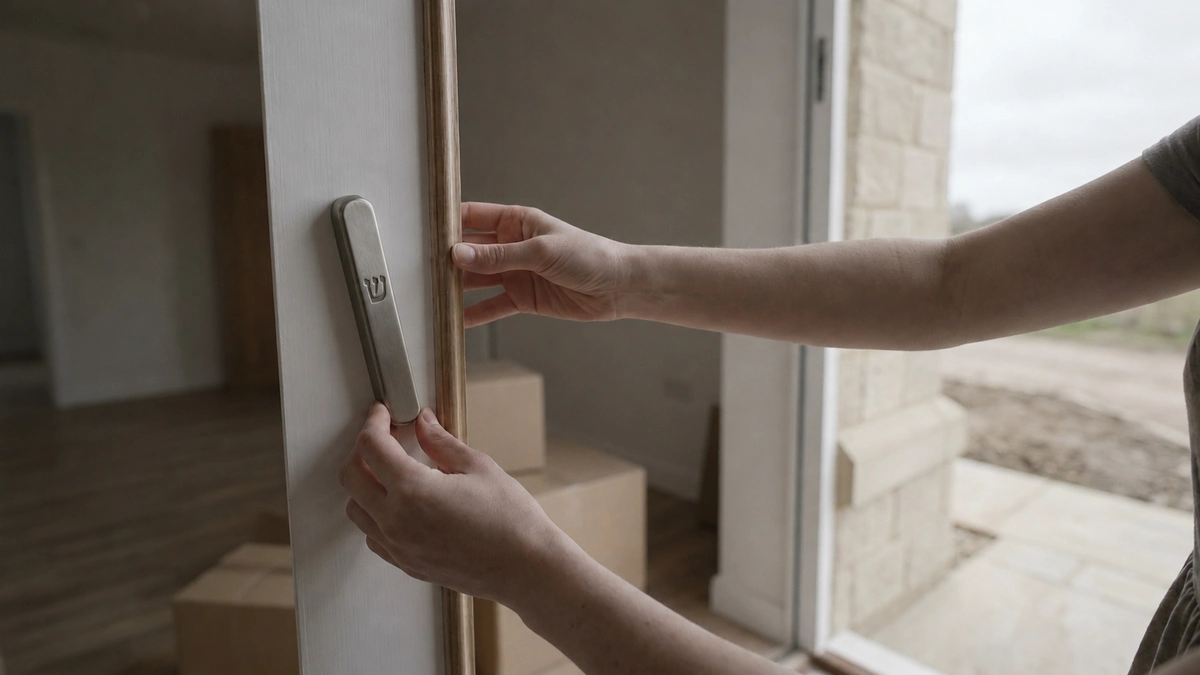
Wrong side. The Mezuzah must be on the right side as you enter the space. When it is not obvious which direction counts as “entering” — especially for an inside doorway between two rooms — the classic rule is heker tzir: the doorway is judged by the side of the hinge / door swing, and that determines which side is the “right of entry.”
Pasul scrolls. A decorative case proves nothing about the scroll inside. Every mezuzah scroll should be written by a qualified sofer, and the scroll must be checked periodically. The Gemara states that a private mezuzah is checked twice in seven years, and the Shulchan Aruch codifies that schedule.
About Kosher Mezuzah
At Kosher Mezuzah, we understand that the mitzvah is only as strong as the scroll inside the case. Every mezuzah scroll we carry has been written by a qualified sofer and checked by a trained magiah with documented certification. We provide traceability from the sofer's quill to your doorpost, so you can know exactly what is hanging on your door.
If you have any doubt about whether a specific doorway in your home is obligated, or whether the scrolls currently in your home are still kosher, we are here to help.
If you are ready to ensure every doorpost in your home is properly covered, you can explore our mezuzah scrolls, written and checked through our OU Endorsed process, here.
Conclusion
The mezuzah obligation extends throughout your home — not just the front door. Every room that meets the four conditions is obligated, and the mitzvah is only fulfilled when the scroll inside is kosher, placed on the correct side, and checked on schedule. Walk through your home room by room, consult your rav for edge cases, and make sure every doorpost has a mezuzah properly affixed.


.svg)
Bring a true Kosher Mezuzah into your home
Fulfill the mitzvah with confidence, beauty, and meaning.
Buy a Mezuzah