
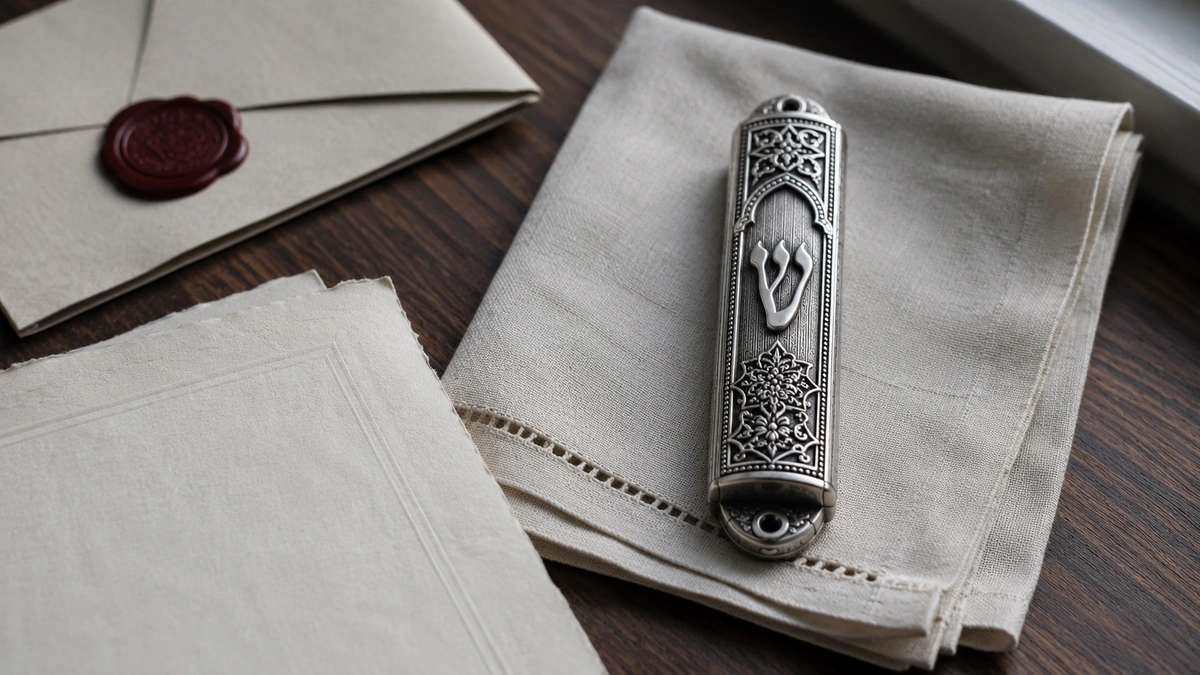
Can a Mezuzah Be Insured? What Every Jewish Homeowner Should Know
Can a mezuzah be insured? Yes, a kosher mezuzah scroll can be insured, and for many families, doing so is a practical and responsible step. A quality klaf (parchment scroll) written by a Hashem-fearing sofer (scribe) can carry real monetary value, and protecting that investment is entirely reasonable. At the same time, the mezuzah is first and foremost a mitzvah, not a possession, and how we think about it, document it, and protect it should reflect that. This article will walk you through what you need to know about mezuzah theft insurance, how to document your mezuzah's value properly, and how to make sure the scroll you're protecting is actually kosher in the first place.
Can You Insure a Mezuzah? What You Should Know
The Monetary Value of a Kosher Mezuzah Scroll
A kosher mezuzah scroll is a handwritten Torah document, and like a Sefer Torah or a pair of tefillin, it carries genuine monetary value. The klaf must come from the skin of a kosher animal, prepared under strict halachic supervision. The dio (ink) must be made according to specific requirements, and every letter must be formed correctly, a process that takes a skilled sofer considerable time and care. Because of these requirements, a mehudar (beautifully written, high-quality) mezuzah scroll can cost anywhere from $150 to over $200.
This means that a home with multiple doorways, a modest Jewish household might need ten or more mezuzos, can have hundreds of dollars' worth of scrolls affixed to its doorposts. It is entirely reasonable to want to protect that investment. Homeowners and renters insurance policies often cover religious articles and Judaica, and mezuzah scrolls can typically be included under personal property coverage or, in some cases, as a scheduled item. If you are unsure whether your policy covers them, it is worth asking your insurance provider directly.
The Halachic Background: Why the Mezuzah Is Treated With Such Care
The Torah commands us in Devarim (Deuteronomy 11:20): "U'chtavtam al mezuzos beisecha u'vishaarecha", "And you shall write them on the doorposts of your house and on your gates." The Shulchan Aruch (Yoreh Deah 285–291) and its commentaries, including the Rema, the Shach (Siftei Kohen), and the Taz, discuss the mezuzah at great length, addressing not only how it must be written and affixed, but also how it must be treated with dignity and kavod (honor).
One of the recurring themes across these poskim (halachic decisors) is that the mezuzah must be given proper honor (kavod). This is why the Shulchan Aruch requires that it be covered in an appropriate case, and why the Rema specifies that the covering itself must be recognizable as serving the mezuzah, not just any wrapping, but something that reflects the honor due to the scroll. The Talmud in Avodah Zarah (11a) records that when Onkelos the Convert was confronted by Roman soldiers, he pointed to the mezuzah and explained: the way of the world is that a king sits inside while his servants guard him from without, but Hashem's servants are inside and He guards them from without. This captures something essential about how we relate to the mezuzah: it is not merely an object. It is a symbol of Hashem's presence guarding our homes.
The Jerusalem Talmud (Pe'ah 1:1) records another striking story: Artaban, a Persian king, sent a priceless pearl to Rabbeinu HaKadosh (Rabbi Yehuda HaNasi) and asked for something of equal value in return. Rabbi Yehuda HaNasi sent him a mezuzah. Artaban objected, he had sent something priceless, and received something worth a single small coin. Rabbi Yehuda HaNasi replied: "You sent me something I must guard, but I sent you something that guards you while you sleep." This is the Torah's understanding of the mezuzah's true worth. Insuring the physical scroll is sensible and responsible, but the zechus (merit) of the mitzvah itself cannot be quantified or replaced.
How to Document a Mezuzah's Value for Insurance Purposes
If you want to insure your mezuzah scrolls, whether for theft, loss, or damage, you will need to start by properly documenting mezuzah value.
The most important step is to obtain a written certification or receipt that identifies the mezuzah and the purchase price or value of the mezuzah. For insurance claims involving mezuzah theft insurance or loss, an insurer will typically want either a receipt showing the purchase price or an independent appraisal. Keep a record of where each scroll was purchased, what you paid, and what certification accompanied it. If you have photographs of the scrolls themselves, those can help too. Some families photograph each scroll before placing it in its case, which serves both documentation and halachic purposes.
It is also worth knowing that not every scroll sold as a "mezuzah" in the marketplace is genuinely kosher. Printed scrolls, mass-produced items, and scrolls sold without sofer attribution are unfortunately common. Before insuring a scroll, and certainly before relying on it for the mitzvah, make sure it has been properly verified. If you have questions about a scroll you already own, contact Kosher Mezuzah and we are glad to help you evaluate it.
What the Mezuzah Actually Protects, and Why That Changes the Conversation
There is something worth pausing on here. The Zohar (Parashat Va'etchanan) teaches that when a person affixes a mezuzah to his gate, Hashem guards him when he goes out and when he comes in. Rav Huna (Shabbat 23b) teaches that one who is careful with the mitzvah of mezuzah merits a beautiful dwelling. These are not metaphors. They reflect a Torah understanding that the mezuzah, when it is kosher and properly placed, brings genuine shemirah (protection) to the home and its inhabitants.
This is precisely why the kashrut (halachic validity) of the scroll matters so much. A pasul scroll affixed to a doorpost fulfills no mitzvah and carries no spiritual protection, it is simply parchment in a case. The practical concern of insuring the mezuzah and the spiritual concern of ensuring its kashrut are hence not separate questions. They point in the same direction: know what you have, verify that it is kosher, document it properly, and treat it with the honor it deserves.
Fulfilling the Mitzvah With Confidence: How Kosher Mezuzah Can Help
At Kosher Mezuzah, we are introducing a breakthrough level of transparency in the mezuzah market. Every scroll we sell comes with full documentation, including the name of the sofer who wrote it, the name of the magiah who checked it, the date of writing, and the materials used. Our process is endorsed by the Orthodox Union, which endorses Kosher Mezuzah as a vendor, providing an additional layer of accountability and communal trust.
This level of transparency helps prevent a number of common and serious issues that can arise in the mezuzah market. It reduces the risk of uncertainty about the scroll's origin, where mezuzahs may be sold without clear information about who wrote or checked them. It also helps prevent gaps in halachic accountability, where a mezuzah may not have a clear record of proper checking or certification, making it difficult to verify its status over time. For institutions and families managing multiple mezuzahs, it avoids confusion between scrolls and ensures that each one can be accurately tracked, maintained, and checked when required. In addition, it helps guard against overlooked maintenance schedules, since the writing date and checking history are clearly documented, reducing the chance that a mezuzah remains in use past its recommended review period without anyone realizing it. Overall, this system helps eliminate ambiguity, strengthens halachic oversight, and ensures each mezuzah can be confidently accounted for throughout its lifecycle.
When a scroll is fully documented in this way, ensuring it becomes straightforward. You have a receipt, a certification, and a named sofer, exactly what an insurance provider needs and exactly what halacha demands you know about what hangs on your doorpost. We also encourage every customer to have their mezuzos checked on a regular basis, because a documented scroll that has become pasul still needs to be replaced. The mitzvah must be alive, not just recorded.
If you are unsure whether the mezuzos in your home are kosher, properly documented, or due for checking, please contact Kosher Mezuzah, we are here to help you fulfill this mitzvah with clarity and confidence. You can also browse our full selection of verified mezuzah scrolls to find a scroll that suits your home and your minhag (community custom).
May the mezuzos on your doorposts be a source of shemirah and berachah for your entire household, and may Hashem guard your going out and your coming in, from now until eternity.



.svg)
Bring a true Kosher Mezuzah into your home
Fulfill the mitzvah with confidence, beauty, and meaning.
Buy a Mezuzah