

Do Renters Need a Mezuzah? The Halacha Every Tenant Must Know
The renter mezuzah obligation is real and well-established in halacha.The renter’s mezuzah obligation is real and well established in halachah. Outside of Eretz Yisrael, a renter is exempt from affixing a mezuzah for the first 30 days of occupancy; after 30 days, the obligation applies fully. In Eretz Yisrael, however, a renter is obligated immediately. If you are moving into a new rental outside Eretz Yisrael, you should plan to put up mezuzahs within those first 30 days so that you are ready when the obligation takes effect. If you are moving into a rental in Eretz Yisrael, the mezuzahs should be affixed right away. For a related question, see Do Renters Need a Mezuzah Right Away When Moving In?. Related reading: Mezuzah in Exile.
You can find out who is obligated to place a mezuzah and in what circumstances on our dedicated resource page.
The Halachic Basis for Tenant Mezuzah Responsibility
When it comes to renter mezuzah obligation, the Gemara in Menachot (44a) states explicitly: one who rents a house in the Diaspora is exempt from mezuzah for 30 days. After that, he is obligated. The reason for the initial exemption is that during those first 30 days, the dwelling is still considered temporary, not yet his home in a meaningful sense. Once 30 days pass, the residence has taken on the character of a permanent dwelling, and the obligation applies.
In Eretz Yisrael, the rule is different. A renter in Israel is obligated from the very first day, without any 30-day grace period. The Gemara explains this based on the mitzvah of Yishuv Eretz Yisrael (settling the Land of Israel). Rashi adds that the immediacy of the obligation makes it harder for a person to leave the Land lightly, anchoring them to their home in Israel.
The Gemara in Bava Metzia (101b) clarifies who bears the responsibility: "Mezuzah, it is the obligation of the resident (Chovat HaDar)." This tenant mezuzah responsibility is fundamental. The mitzvah rests on the one living in the home, not the one who owns it. The question of whether this mezuzah obligation falls on the person or the home is one that has practical implications, and the answer from Chazal is clear: it is the resident who is obligated.
There is a dispute among the Rishonim about the nature of a renter's obligation. Rashi, the Sefer HaChinuch, and one view in Tosafot hold that after 30 days, the renter is obligated by Torah law (d'Oraita), since the home is no longer considered temporary. The Rosh, Ran, Mordechai, and a second opinion in Tosafot hold that since the renter does not own the home, his obligation is Rabbinic (d'Rabbanan), instituted because his dwelling now resembles that of a homeowner. In practice, we follow the stringent view, with a rental mezuzah 30 day rule.
What This Means in Practice
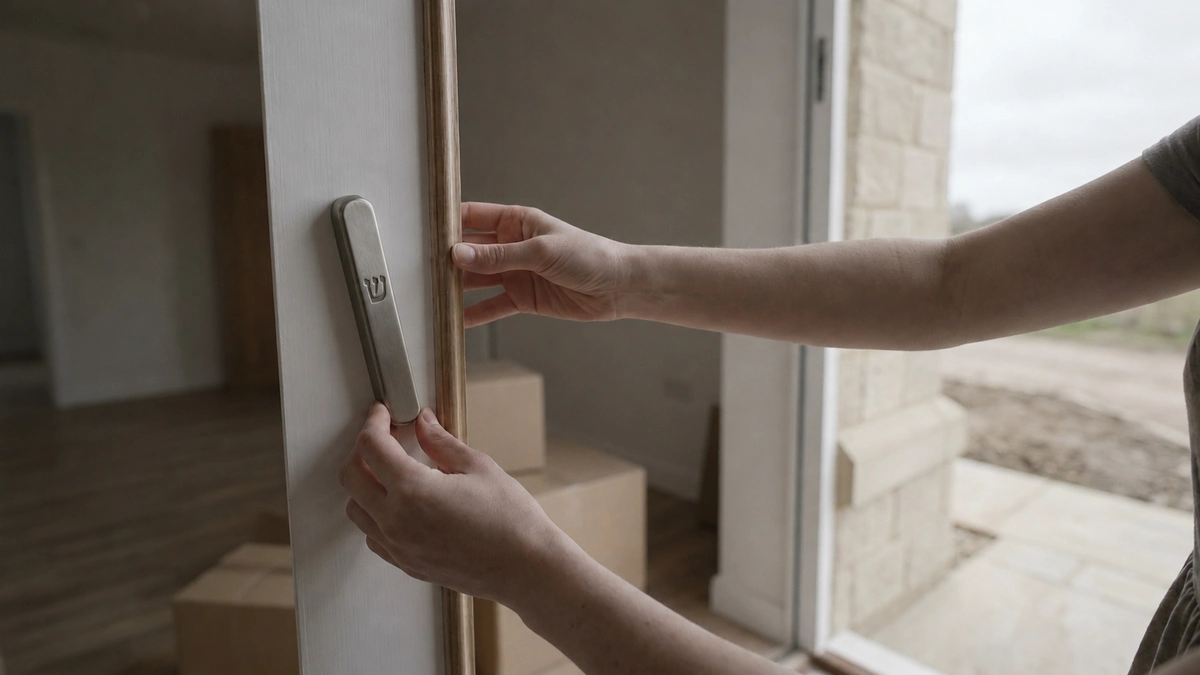
The practical application of the renter’s mezuzah obligation is fairly straightforward, though a few details are important. If you are renting outside of Eretz Yisrael, although the formal obligation begins after 30 days of residence, many people choose to affix mezuzahs as soon as they move in so that the home is marked as a Jewish dwelling from the outset. The question of whether to make a berachah immediately, wait until the 30th day, or re-affix one afterward with a berachah depends on halachic detail and should be clarified with a competent rav.
The responsibility to obtain and install the mezuzah falls on the renter, not the landlord. The Gemara in Bava Metzia 102a states this directly: when a home is rented, the duty to provide the mezuzah rests on the tenant. This reflects the broader halachic principle that mezuzah is generally a chovat hadar, an obligation tied to the person dwelling in the home.
When a renter moves out, the halachah changes. If another Jewish resident will be living there after you, the mezuzahs should not be removed. The same sugya in Bava Metzia 102a records a severe warning through a baraita, describing a man who removed his mezuzah upon leaving and then suffered terrible loss. If, however, the property is being turned over to a non-Jew, the mezuzah is removed so that it will not be treated disrespectfully. If there is a financial concern about leaving behind expensive mezuzahs, that should be worked out in advance with the landlord and clarified with a rav rather than assumed casually. Questions about cost-sharing and shared apartment mezuzah responsibility are addressed separately for those in multi-tenant situations.
If you are renting with roommates, there is another layer of halachic consideration. Questions can arise about who bears the obligation, how the cost should be divided, and which doorways require a mezuzah. Those issues do have a halachic framework, but they are often fact-sensitive, so it is wise to review the details carefully before a disagreement develops. These questions around who pays for a mezuzah in a shared apartment have clear halachic frameworks, and we encourage you to review them to avoid confusion or dispute.
Common Mistakes Renters Make
One of the most common errors renters make is assuming that if the landlord has taken care of the mezuzahs, the matter is settled. In halacha, the obligation is on the resident. The Gemara describes mezuzah as chovat ha-dar, the obligation of the one who dwells there. Even if a landlord installs mezuzahs as a courtesy, the renter should verify that those mezuzahs are actually kosher and fit for use. A mezuzah that is invalid (pasul) provides no fulfillment of the mitzvah, regardless of who put it up. If there is any doubt about the mezuzahs, they should be checked by a qualified magiah.
Another mistake is speaking too broadly about timing. One should not delay beyond the point of obligation. In Eretz Yisrael, a renter is obligated immediately. Outside Eretz Yisrael, a renter is exempt for the first 30 days and becomes obligated afterward. Roommate disputes about the mezuzah are also more common than people expect, and it is better to clarify these questions with competent halachic guidance in advance.
The Deeper Meaning Behind the Renter's Obligation
The fact that the mezuzah obligation falls on the resident, not the property owner, teaches an important lesson. The mitzvah of mezuzah is not centered on legal ownership of the property, but on the life being lived inside it. The Gemara’s language is precise: chovat ha-dar, the obligation of the one who dwells. Wherever you live, that space becomes your home, and it should reflect your connection to Hashem.
As a matter of hashkafic reflection, one may say that affixing the mezuzah marks the home as a Jewish dwelling, a statement that this entrance and this home are lived in under the sovereignty of HaKadosh Baruch Hu. A renter’s home is no less a Jewish home than an owner’s.
Key Takeaways
The renter’s mezuzah obligation is a real halachic obligation. Outside of Eretz Yisrael, the obligation begins after 30 days of residence; in Eretz Yisrael, it begins immediately. The responsibility to affix the mezuzah falls on the resident, not on the landlord. When moving out, a renter generally should not remove the mezuzahs; if a non-Jew will be moving in, that changes the halachah. And as always, the mezuzahs must be kosher, written on proper klaf (parchment) by a qualified sofer. If their status is uncertain, they should be checked by a qualified magiah.
How Kosher Mezuzah Helps You Fulfill This Mitzvah Properly
At Kosher Mezuzah, we understand that renters often face unique challenges, tight timelines, uncertainty about which doorways require a mezuzah, and questions about what to do when moving out. Every mezuzah we carry is written on proper klaf by a named, qualified sofer, and checked by a qualified magiah. We provide full traceability so that you know exactly who wrote your mezuzah and who examined it. Our process is produced under a process endorsed by the Orthodox Union.
Proper fulfillment of this mitzvah means more than simply purchasing a mezuzah. It means ensuring the scroll inside is kosher, that it is affixed correctly, and that it is checked periodically. The Shulchan Aruch (Yoreh De'ah 291:1) requires checking mezuzot twice every seven years, though many have the custom to check more frequently, especially if the mezuzah has been exposed to moisture or harsh conditions. Understanding the full scope of mezuzah responsibility is part of what we help our customers navigate.
We also recognize that questions about forcing mezuzah installation or navigating difficult landlord situations come up for renters. We are here to provide clear, halacha-based guidance, not pressure. Consult your rav for any edge cases specific to your situation, and come to us when you are ready to fulfill the mitzvah with confidence.
If you have questions about your rental situation and which mezuzahs you need, contact us at Kosher Mezuzah, we are here to help you fulfill this precious mitzvah properly.
May the mezuzah on your doorpost be a source of zechus (merit) and shmirah (protection) for all who enter your home. Yehi ratzon that Hashem watch over your dwelling and all who dwell within it.



.svg)
Bring a true Kosher Mezuzah into your home
Fulfill the mitzvah with confidence, beauty, and meaning.
Buy a Mezuzah