

Sliding Door Mezuzah: Do Sliding Doors, Double Doors, or Arches Need One?
The Torah commands in Devarim (6:9) to write the words of Shema "on the doorposts of your house and on your gates." Chazal and the poskim explain that the obligation of mezuzah depends on the status of the entrance and the status of the space it serves.
Rambam (Hilchot Mezuzah 6:1) lists the classic conditions for a house or room to be obligated in mezuzah. Among them: the space must be fit for normal, honorable, and permanent human dwelling; the entrance must have two sideposts and a lintel; it must be at least ten tefachim high; and the house must meet the required minimum size. Shulchan Aruch further rules that the mezuzah is fixed on the right side of entry and at the beginning of the upper third of the doorway (Yoreh De'ah 289:2).
A doorless opening is not a simple case. Shulchan Aruch (Yoreh De'ah 286:15) states: "פתח שאין לו דלתות, פטור מן המזוזה, עד שיתקין לו דלתות" — an opening without doors is exempt from mezuzah until doors are installed. Because there is wider discussion in the halachic literature around unfinished openings and related cases, practical questions of this kind should be reviewed with a rav.
How This Applies to Sliding Doors
A sliding door raises a practical question because the panel does not swing on standard hinges. Still, the basic halachic analysis remains the same: is this a real entrance to a space used for dwelling, and does the opening have the form of a proper doorway — namely sideposts and a top frame? We cover this in more depth in A Mezuzah at the Door of a New Home for Yedei Chesed in Rockland County.
That means a sliding glass door should not be dismissed simply because it slides rather than swings. If it serves as a genuine entrance to a room or home, it must be evaluated under the regular laws of mezuzah. The mezuzah is affixed on the right side as one enters and at the beginning of the upper third of the doorpost (Yoreh De'ah 289:2).
Glass doors that lead to patios, balconies, or yards can therefore become real mezuzah questions. The details may depend on which side is considered the primary entrance and on the status of the area being entered. When the layout is not obvious, a rav should determine the correct side and placement. For a related question, see Do Automatic or Smart Doors Affect Mezuzah Placement? What You Need to Know. We cover this in more depth in Do Rarely Used Doors Need a Mezuzah? (Storage Rooms, Side Doors, etc.). See also Can Vibration Damage a Mezuzah? Doors, Movement, and Real Risk.
A Common Mezuzah Placement Issue With Sliding Doors
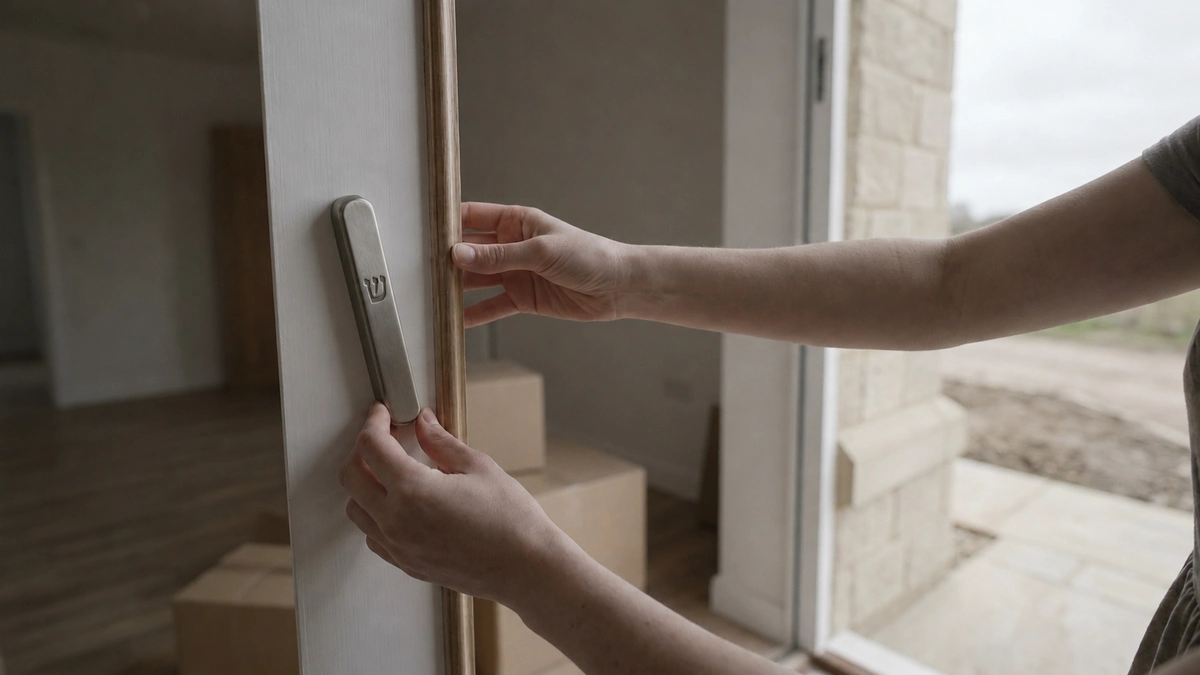
Sliding doors can make mezuzah placement more confusing than standard hinged doors. The mezuzah must be attached to the actual halachic doorway — meaning the sidepost of the real entrance frame — not automatically to the first narrow strip of molding or trim visible outside the track.
In many sliding-door setups, the outermost frame piece is only part of the decorative trim or part of the track system, while the true doorway begins slightly further in. That means a mezuzah placed on the wrong vertical strip may be attached to the wrong part of the structure, even if it looks visually close to the entrance.
The practical question is: which vertical sidepiece actually defines the usable opening through which a person enters? That is the surface that must be evaluated for mezuzah placement. Because sliding-door frames vary widely, and because some have multiple layers of aluminum, wood, or trim around the track, this detail should be checked carefully before attaching the mezuzah. When there is any uncertainty about which post counts as the true doorway, a rav should inspect the exact setup before placement.
Hanging a Double Door Mezuzah
Double doors — two panels that meet in the middle — require care, because not every set of two panels is treated as two separate halachic entrances.
Shulchan Aruch (Yoreh De'ah 286:17) rules that when an opening is divided by a central pillar, and the heker tzir (hinge, or pivot side) is recognizable on each side, the two sides are treated as two separate entrances, and each requires its own mezuzah.
In practical terms, the key question is whether the structure creates two distinct entrances or one entrance with two leaves. If there is a true dividing post and each side functions as its own doorway, each side may require its own mezuzah. If it is one broad entrance with two panels but not two halachically distinct openings, the case is different and should not be described automatically as requiring two mezuzot. Because the construction details matter, this is a case where the exact doorway should be checked carefully before giving a final ruling.
Hanging an Archway Mezuzah
An archway is a classic mezuzah question, because the top of the opening curves rather than running straight across like a standard lintel.
Shulchan Aruch (Yoreh De'ah 287:2) rules: a doorway made like an arch, if its height is ten tefachim, is obligated in mezuzah. In other words, an archway can certainly be obligated.
The mezuzah is placed on the right side of entry and at the beginning of the upper third of the doorway (Yoreh De'ah 289:2). In an arched opening, however, the exact point of placement may depend on where the usable sidepost is measured and how the curve begins. For that reason, an archway should be measured carefully, and unusual shapes should be reviewed with a rav before the mezuzah is fixed.
Common Mistakes Pertaining to Unusual Door Mezuzahs
Skipping the sliding door entirely because it does not look like a conventional hinged door is a common mistake. The fact that a panel slides rather than swings does not eliminate the mezuzah question; the real issue is whether this opening qualifies as a halachic doorway leading into a dwelling space.
Treating every doorless opening as automatically obligated is also a mistake. Shulchan Aruch, Yoreh De'ah 286:15 states, "A house, even if it has no doors, is obligated in mezuzah; however, there are those who exempt it." Because of that, this case should not be handled casually or assumed to be simple.
Assuming that every double door requires two mezuzot is another error. The determining factor is not merely that there are two panels, but whether there are actually two halachically distinct entrances that each require their own mezuzah.
Placing the mezuzah on the wrong side is another frequent problem. The mezuzah belongs on the right side as one enters, but when the direction of entry is unclear, the function of the doorway and the overall structure of the entrance must be analyzed carefully before deciding placement.
Placing the mezuzah too high or too low is also incorrect. Shulchan Aruch, Yoreh De'ah 289:2 rules, "צריך לקבעה בתחילת שליש העליון של גובה השער" — it must be affixed at the beginning of the upper third of the doorway’s height — so incorrect placement can undermine proper fulfillment of the mitzvah.
About Kosher Mezuzah
At Kosher Mezuzah, every scroll we offer is written by a qualified sofer, checked by a trained magiah, and endorsed by the OU. We provide clear documentation of who wrote your scroll, who checked it, and when — because fulfilling this mitzvah properly begins with knowing that your scroll is genuinely kosher. If you have questions about any doorway in your home — sliding, arched, double, or otherwise — we are here to help you fulfill this mitzvah with clarity and confidence.
To get started with a scroll you can rely on, explore our verified mezuzah scrolls here.


.svg)
Bring a true Kosher Mezuzah into your home
Fulfill the mitzvah with confidence, beauty, and meaning.
Buy a Mezuzah