
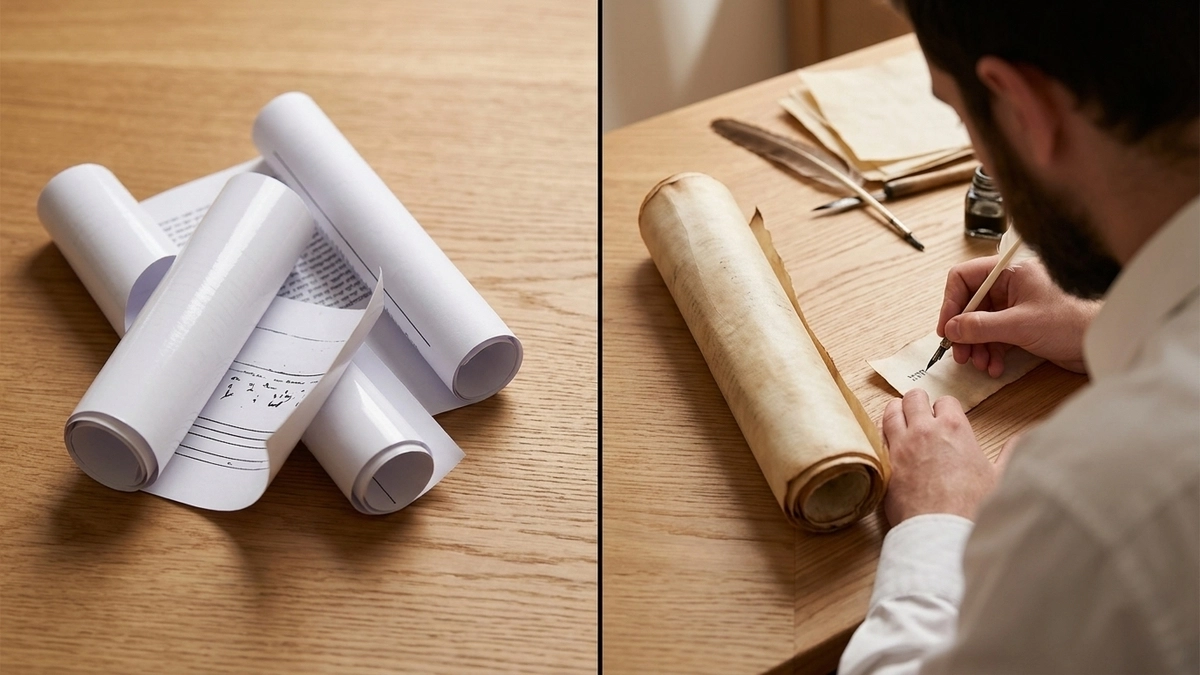
Fake Mezuzah Scroll: How Fraud Happens and How to Protect the Mitzvah
A fake mezuzah scroll may even look like a kosher klaf from the outside, but it fails to meet the most basic halachic requirements for the mitzvah of mezuzah.
Many families affix such scrolls to their doorposts in complete sincerity, believing they have fulfilled the mitzvah. However, it is possible that if all required halachos have not been met, in reality no mitzvah has been performed at all.
Understanding how counterfeit and invalid scrolls enter the market is the first step toward protecting yourself, your home, and your fulfillment of this precious mitzvah. Kosher Mezuzah is dedicated to ensuring the proper fulfillment of the mitzvah of mezuzah. If you have questions about whether your current mezuzahs are kosher, you are welcome to reach out to us for guidance.
Key Takeaways
- A fake mezuzah scroll — whether printed, machine-reproduced, or written by an uncredentialed scribe — is halachically invalid and means the mitzvah of mezuzah has not been fulfilled at all
- The Shulchan Aruch requires every mezuzah scroll to be handwritten on kosher parchment by a trained, G-d-fearing sofer using proper ink and intent — no printed or photocopied scroll can ever meet this standard
- Online marketplaces and tourist shops are common sources of counterfeit mezuzah scrolls, often listed as "kosher" despite having no verifiable certification, sofer identity, or halachic checking
- To avoid a fake mezuzah scroll, always purchase from a documented source that can provide the sofer's name, the magiah (checker) who reviewed it, the production date, and a recognized endorsement such as OU endorsement
- Even a genuine kosher mezuzah scroll must be professionally checked twice every seven years, as faded or cracked letters can render a once-valid scroll invalid without the homeowner knowing
- The spiritual protection associated with the mezuzah depends entirely on the scroll being halachically valid — a counterfeit or pasul (invalid) scroll offers no mitzvah fulfillment and no divine protection for the home
What Makes a Mezuzah Scroll Invalid in the First Place
A fake mezuzah scroll is one that cannot fulfill the mitzvah of mezuzah because it does not meet the foundational requirements established by halacha (Jewish law). The Shulchan Aruch (Yoreh De’ah 271 and 285–288) rules that a mezuzah scroll must be written by hand on klaf (parchment) specifically prepared for this purpose, handwritten lishmah (for the sake of the mitzvah) on ruled lines, by a halachically acceptable and written by a trained, G-d-fearing sofer with the proper kavanah (intent). If any of these conditions is absent, the scroll is pasul (invalid) and the mitzvah has not been fulfilled. This is not a matter of aesthetics or personal preference. It is the baseline of what the Torah requires.
Beyond these visible basics, there are many halachic details that can render a mezuzah invalid even when it looks beautiful to the untrained eye. Every letter must be written with the exact halachic form and spacing, with no touching letters, no cracks or smudges that break the shape of a letter, and with the precise traditional spelling of each word—no extra or missing letters anywhere in the text. The mezuzah must also be written completely in order, from beginning to end, with each Name of Hashem written with special care and with proper intent. Many of these issues can only be checked by carefully examining the scroll letter by letter, often under magnification and with clear knowledge of the halachah, which is why a reliable, yerei-shamayim sofer or competent checker is essential; a casual glance, a pretty case, or a general certificate on the batch is not enough to guarantee that the mezuzah fulfills the requirements.
The Rambam (Hilchos Mezuzah 1:1) defines the mitzvah as affixing a mezuzah to the doorposts of one’s home, and in the rest of that chapter he spells out that this must be done with a properly written scroll, following the halachic rules of STaM. A scroll that merely resembles a kosher klaf but lacks the substance of proper scribal work is, in the eyes of halacha, the same as having no mezuzah at all.
The Printed Mezuzah Scam
The most widespread form of the fake mezuzah scam involves machine-printed or photocopied text sold inside a mezuzah case as though it were a handwritten scroll. These items circulate widely in tourist markets, general retail settings, and online platforms. To the untrained eye, a printed scroll and a genuine handwritten klaf can appear nearly identical, especially when the scroll is rolled up and placed inside a case. The fraud is not always intentional on the part of every seller: some third-tier vendors sell such items without verifying its origins. But the halachic result is the same: the purchaser has acquired a counterfeit mezuzah that fulfills no mitzvah whatsoever.
Printed text, no matter how beautiful or precise, does not meet the requirement of lishmah (writing for the sake of the mitzvah) by a human sofer. The Gemara (Gittin 20a) and the Shulchan Aruch both make clear that scribal documents must be written by a qualified individual with a quill and kosher ink on properly prepared parchment. A laser printer or lithograph cannot perform this act. Mechanical reproduction lacks these requirements, which is why even a visually perfect printed scroll is halachically worthless as a mezuzah.
For a deeper look at what distinguishes authentic scribal work from counterfeit production, the beauty of mezuzah script and why clear writing matters is an important resource for any purchaser seeking to understand what a genuine klaf should look like.
How Unverified Scrolls Enter the Supply Chain
Another subtle form of fraud involves scrolls that are technically handwritten, but were produced by uncredentialed individuals who lack the training, yiras Shamayim (fear of Heaven), and halachic knowledge required of a qualified sofer. These scrolls may have letters that are malformed, improperly spaced, or even incorrectly ordered. The Shulchan Aruch (Yoreh De’ah 274, in the laws of Sefer Torah, and 288 in the laws of mezuzah) discusses how certain defective or malformed letters can render a scroll pasul. The problem is compounded when scrolls pass through multiple layers of distributors without any formal certification. A scroll produced overseas may change hands several times before reaching a retail buyer, and at no point along that chain does anyone confirm the scroll's halachic standing. The opacity of these supply chains has allowed invalid scrolls to persist in the market for generations. This is why traceability, knowing who wrote the scroll, when it was written, and who checked it, is a necessity. The OU endorsement process requires rigorous oversight standards, and a mezuzah bearing OU endorsement has been subjected to exactly this kind of accountable, traceable review.
Misrepresentation of Quality Level
Another form of counterfeit mezuzah fraud involves the misrepresentation of quality grades. A seller may describe a scroll as mehudar (beautiful, of the highest quality) when it barely meets the minimum threshold for kashrut, or may not meet it at all. The buyer pays a price appropriate for a mehudar scroll and receives something far inferior. Because most buyers do not have the ability to evaluate a scroll themselves, this deception is rarely discovered until a qualified magiah examines the scroll during a checking appointment.
Chazal (for example, in Maseches Sofrim 3) teach that one should seek a beautiful mezuzah in fulfillment of the principle of hidur mitzvah, based on the verse “This is my G‑d and I will beautify Him.” When a seller falsely labels a mezuzah as mehudar, the buyer believes he is investing extra to fulfill “זה אֵלִי וְאַנְוֵהוּ / This is my G‑d and I will beautify Him,” yet is in fact being deprived of the very enhancement he sought. Such misrepresentation undermines the mitzvah, and in serious cases may even call into question whether the basic obligation of mezuzah has been fulfilled.
The Online Marketplace and Counterfeit Mezuzah Risk
The rise of large online marketplaces has created new and significant risks for buyers seeking a kosher mezuzah. Items listed as "handwritten kosher mezuzah" on these platforms are frequently printed reproductions or scrolls of unknown origin with no certification. The seller may be located in a country where halachic standards are not enforced or understood, and there is no practical mechanism to verify the claims made about the parchment, the process, or the credentials. The listing information may include Hebrew text, a mezuzah case, and photographs that evoke a sense of legitimacy, but none of these elements speak to the actual kashrut of the scroll inside.
Buying a mezuzah through such platforms is a serious halachic risk. The risks of purchasing a mezuzah through Amazon and similar platforms are significant, and even a well-intentioned purchase from such a source may result in a non-kosher scroll on your doorpost.
How to Avoid Falling Victim to a Fake Mezuzah Scroll
How to avoid fake mezuzah situations begins with purchasing from a source that can provide clear, documented answers about the scroll's provenance. The buyer should be able to confirm the name of the sofer who wrote it, the name of the trained magiah who checked it, the date it was produced, and the certification body that endorsed it. If any of these details are unavailable, the kashrut of the scroll cannot be confirmed.
Kosher Mezuzah is dedicated to ensuring the proper fulfillment of the mitzvah of mezuzah. Every scroll available through Kosher Mezuzah includes documentation identifying the sofer, the magiah, and the certification, and carries OU endorsement. Our QR-code verification system allows buyers to view the actual image of their scroll, trace its full history, and confirm its kashrut before or after purchase. This level of traceability, from the sofer's quill to your doorpost, gives buyers genuine confidence that the mitzvah has been properly fulfilled.
Beyond initial purchase, the Shulchan Aruch (Yoreh De'ah 291) rules that a private mezuzah must be checked twice in seven years to ensure that the scroll does not become pasul from deterioration through time. The Gemara (Yoma 11a) records this requirement, and Rashi explains that a scroll left unchecked may deteriorate without the homeowner's knowledge. Checking is not optional. It is a halachic obligation. Our comprehensive resources on Mezuzah placement, styles, and purchase covers the checking requirement in full detail for those who wish to understand their ongoing obligations.
To fulfill the mitzvah of mezuzah with complete confidence, we invite you to browse our full selection of certified, OU-endorsed mezuzah scrolls and review the documentation provided for each one.
A Note on the Spiritual Dimension of Proper Fulfillment
The Tur (Yoreh De'ah 285) teaches that the mezuzah functions as a constant declaration of the oneness of Hashem within the Jewish home, in a sense the direct literal counterpart of Krias Shema — the verbal declaration of that same oneness. Just as Krias Shema must be recited with proper kavvanah and in the correct form, the mezuzah must be written properly and affixed halachically for this declaration to be present in the home. A printed scroll or an unchecked, possibly invalid scroll does not make this declaration. It is merely an object on a doorpost.
Later sources, citing the Maharam of Rothenburg, describe a home properly fixed with a mezuzah as being guarded from harmful forces, with the Holy One, Blessed be He, watching over those who dwell inside. This protection is not a segulah (spiritual remedy) disconnected from the mitzvah itself. It flows from proper halachic fulfillment of the act. A fake mezuzah scroll carries no such zechus (merit) because no mitzvah has been performed. The zechus (merit) of the mitzvah, and the protection it carries, depends entirely on the kashrut of the scroll inside the case.
Kosher Mezuzah ensures each mezuzah scroll meets the highest halachic standards, so that the mitzvah you perform is real, complete, and a genuine source of connection to Hashem and kedushah in your home. To explore these concerns in detail, our frequently asked questions about kosher mezuzah and OU endorsement address many of the concerns buyers encounter.
Fulfill the Mitzvah With Confidence — Kosher Mezuzah
Kosher Mezuzah has been dedicated to ensuring the proper fulfillment of the mitzvah of mezuzah for over forty years. Every scroll is written by a vetted sofer who has passed a rigorous halachic examination, double-checked by two expert examiners, and OU-endorsed — so that no fake or uncertified scroll reaches your doorpost. Each mezuzah comes with a unique QR code providing complete transparency: the sofer who wrote it, the examiners who reviewed it, the materials used, and when the scroll is next due for inspection. Kosher Mezuzah does not sell secondhand or returned scrolls. Every mezuzah that leaves the warehouse is new, certified, and ready to fulfill the mitzvah properly.
If you have questions about the kashrut of an existing scroll or need guidance on what verified fulfillment looks like, the Kosher Mezuzah team is available through the contact form at kmezuzah.com/contact.
If you have uncertainty about the differences between scrolls, understanding the difference between Ashkenaz, Sefardi, and Arizal mezuzahs can help a buyer ask the right questions before purchasing.
May the mitzvah of mezuzah bring blessings and protection to your home, and may every scroll on your doorpost be genuinely kosher, verified, and worthy of the declaration it carries.


.svg)
Bring a true Kosher Mezuzah into your home
Fulfill the mitzvah with confidence, beauty, and meaning.
Buy a Mezuzah