
If a Room's Purpose Changes, Does It Still Need a Mezuzah?
When a room’s purpose changes, its mezuzah requirement based on room function should be reconsidered based on what the room now is in halachic terms. The classical sources define mezuzah obligation by the character of the space: whether it is made for human dwelling, for dignified dwelling, and for permanent dwelling. The question is not only what the room used to function as, but how the space will now be used and defined.
The Halachic Framework: What Makes a Room Obligated?
The controlling halachic question for mezuzah requirement based on room function is not what you used to do in the room previously; it is what kind of space the room will function as now. Rambam writes that a space obligated in mezuzah must be made for human dwelling, made for honorable dwelling, and made for permanent dwelling. He also rules that places such as a bathroom, bathhouse, mikveh, and tannery are exempt because they are not made for honorable dwelling. The same principle appears in the Gemara and in Shulchan Aruch. So when a room changes purpose, the mezuzah question must be evaluated based on what the space has now become in halachic terms, and not only by its original label.
That functional framework leads directly to the next question: even if a space is being used in a way that could make it halachically significant, does it qualify as a room of sufficient size to carry a mezuzah obligation at all? In other words, after defining what the room has become, halachah then asks whether it meets the minimum dimensions of a chashuv space.
One key dimension is room size. Shulchan Aruch states plainly that a room that does not have four by four amot (6.3–6.4 x 6.3–6.4 feet — roughly 1.9 m × 1.9 m) is exempt. At the same time, where the room is very small, unusually configured, or used in a less standard way, the practical ruling should be checked more carefully.
The flip side is equally explicit in Shulchan Aruch: beit hakisei, beit hamerchatz, beit haburski, and beit hatevilah are exempt “לפי שאינן עשויין לדירת כבוד.” Therefore, a space that truly functions as a bathroom or bathhouse is not treated like an ordinary room for mezuzah purposes. If you are dealing with an actual conversion of that kind, consulting your rav is the right step. You can also point readers to your mezuzah during renovation article for related transitional cases.
How This Applies to Real Rooms in Your Home
Let’s walk through the most common scenarios that people face when a room’s purpose changes.
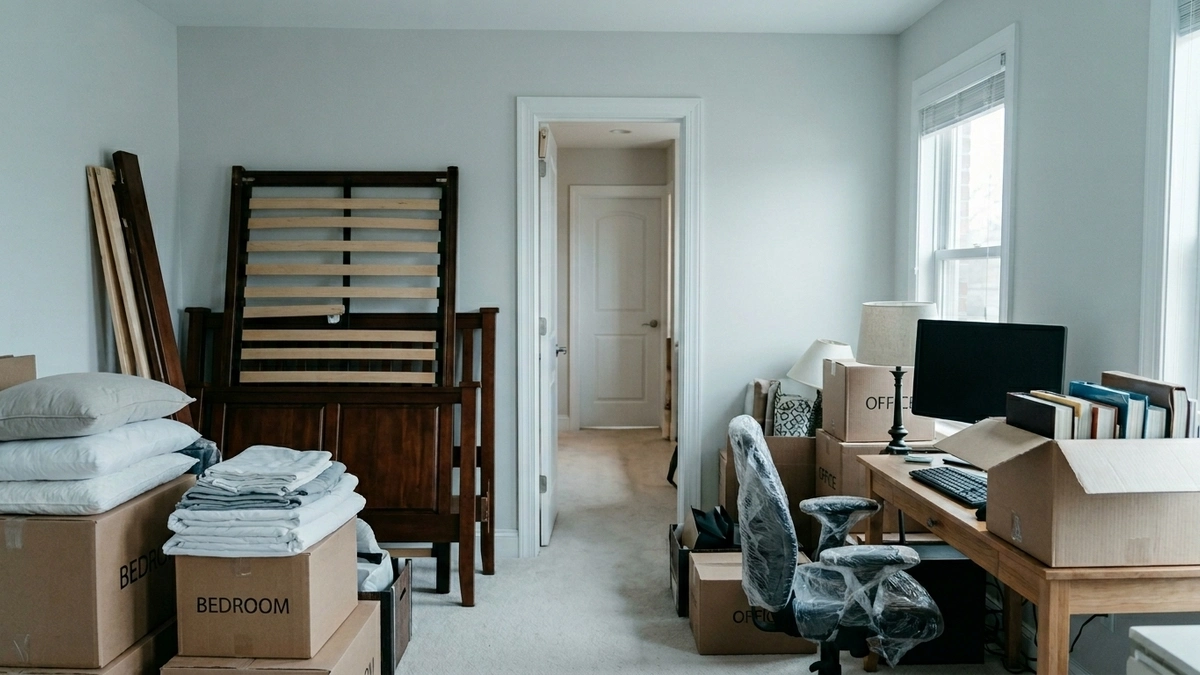
- A bedroom converted to a home office or study. This will often remain obligated, because it remains a regular, dignified room in the home. Still, details of structure, doorway status, and whether any new mezuzah action is needed should be reviewed case by case rather than assumed.
- A living room or dining room converted to a classroom or playroom. This remains a normal, regularly used room, so it should not automatically be assumed exempt simply because its use has changed. At the same time, the exact status can depend on the room’s specific setup and use.
- A bedroom or finished room converted to a storage room. Do not assume that storage automatically removes the mezuzah obligation. Many storage-type spaces are still obligated in the classical sources. Where size, configuration, or use makes the case less straightforward, ask a rav rather than stating an absolute rule. If you do need to remove the mezuzah for any reason, the laws around removing a wall are relevant and worth reviewing.
- A bathroom — and any room that actually functions like a bathhouse or place of undignified exposure. A bathroom is exempt from mezuzah. A laundry room should not automatically be grouped together with a bathroom; that depends on how the room actually functions in halachic terms. But if a former bedroom has truly been converted into a bathroom or bathhouse-type space, that changes the mezuzah status fundamentally. This also connects to questions about when to remove a mezuzah when the obligation no longer applies.
- A temporary partition or wall that creates a new room. This can raise a real mezuzah question if it creates a halachically valid doorway, but these cases are too fact-specific to state categorically here. The laws are complex, and the question of a temporary wall mezuzah deserves its own careful attention. When in doubt, ask your rav before affixing or removing.
- Adding a new door to an existing space. If a new doorway is created between rooms, a mezuzah question may arise at that entrance. Whether a new mezuzah is required, and whether a brachah is recited, depends on the exact structure and use. Your article on adding a door mezuzah can cover those practical details separately.
If you have a specific room in your home that does not fit neatly into one of these categories, we’re glad to help. Reach us directly through Kosher Mezuzah, and we’ll assist you in presenting the question clearly for a rabbinic ruling.
The Most Common Mistake People Make
A common error is assuming that a room without a bed or couch is automatically exempt from mezuzah. That is too simplistic. The halachic question is not only whether someone sleeps there, but whether the room is treated as a bona fide, dignified room rather than a space excluded from dirat kavod.
A second common mistake is removing the mezuzah during renovations or room transitions and then forgetting to replace it. If your room is undergoing changes, keep track of the mezuzah carefully. Questions about mezuzah during renovation come up often. Once the room and doorway return to normal use, the obligation should be reviewed again rather than assumed.
The Mezuzah Reminds Us That Every Room Belongs to Hashem
For a stronger source-based reflection, Rambam writes in Hilchot Mezuzah 6:13: Whenever a person enters or leaves, the mezuzah brings him into encounter with the unity of Hashem and reminds him of His love. The mezuzah does not only mark a doorway; it quietly calls a person back from routine and distraction to awareness, purpose, and avodah. Each entrance and exit becomes a small moment of return. So when a mezuzah remains relevant even in a room whose purpose has changed, that too becomes part of the home’s avodas Hashem — a reminder that no room in a Jewish home is spiritually empty, and every space truly belongs to Hashem.
The Ruling in Brief
When a room’s purpose changes, the mezuzah question should be judged by the room’s present use. Rooms that remain ordinary, dignified rooms will often remain obligated. A bathroom is exempt. Small, unusual, or converted spaces should be described more cautiously and referred to a rav rather than presented as a simple universal rule. When in doubt about any specific room, the right step is to consult your rav. We cover this in more depth in Do Decorative Doorways Need a Mezuzah? When Design Changes the Rule.
How Kosher Mezuzah Supports Proper Fulfillment of the Mitzvah
At Kosher Mezuzah, every mezuzah scroll we provide is written by a qualified sofer and reviewed by a trained magiah. Our process is produced under a process endorsed by the Orthodox Union, and we maintain full traceability for every scroll, including the name of the sofer, the name of the checker, the date of writing, and the materials used. This level of transparency allows buyers to have genuine confidence that what they are affixing to their doorposts is halachically reliable.
One of the most important responsibilities that comes with owning a mezuzah is having it checked periodically. The halacha requires mezuzahs to be inspected twice in seven years under normal circumstances. If conditions are unusually harsh, it is sensible to consult a qualified sofer or rav about checking sooner. If you're unsure whether your mezuzahs have been checked recently, that is worth attending to. A pasul mezuzah on your doorpost means the mitzvah is not being fulfilled.
If a room in your home has changed purpose and you're not sure whether the current mezuzah is still properly placed, or whether it needs to be replaced or re-examined, we're here to help. Questions about can you take a mezuzah when moving, room changes, and related halachic situations are ones we address regularly. Our goal is always the same: to help you fulfill the mitzvah correctly, with confidence, and with the clarity of Daas Torah behind every decision.
We're Here to Help You Get It Right
If you have a room in your home whose purpose has changed and you're uncertain about the mezuzah, please reach out to us at Kosher Mezuzah and we'll help you bring the question to the right halachic authority.
May it be the will before our Father in Heaven that the mezuzahs affixed to your doorposts be a merit for your home, your family, and all who enter.


.svg)
Bring a true Kosher Mezuzah into your home
Fulfill the mitzvah with confidence, beauty, and meaning.
Buy a Mezuzah