
Klaf for Mezuzah: Ink, Parchment, and Quill Explained
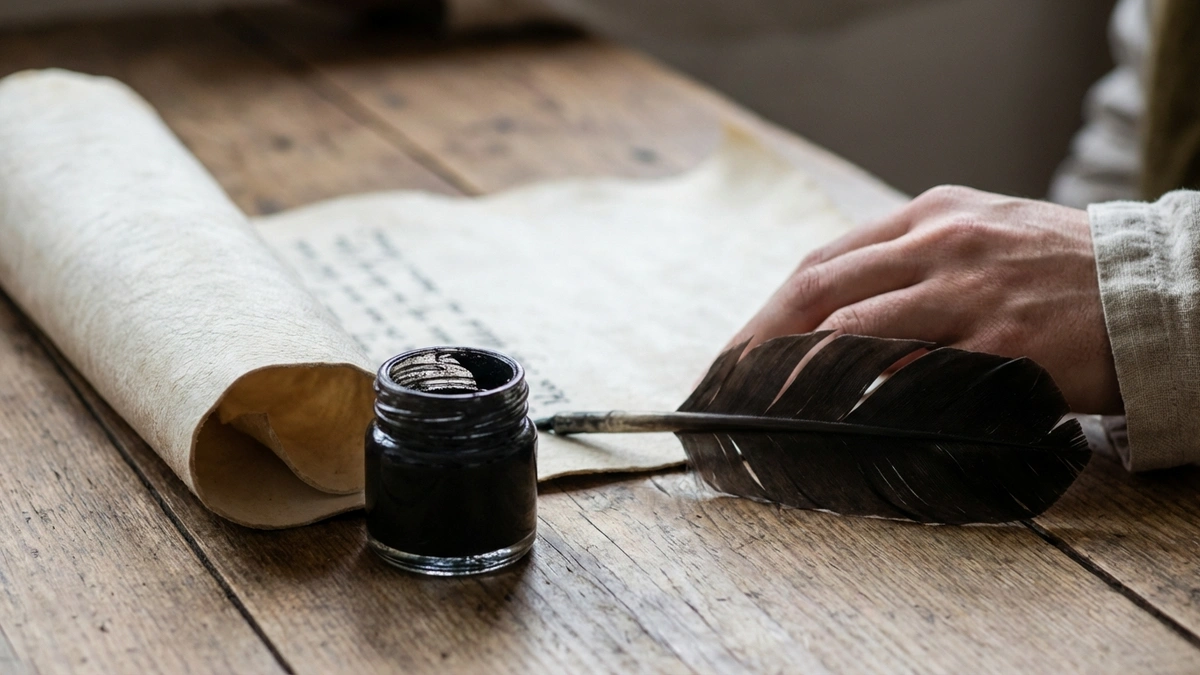
The klaf for mezuzah, the parchment scroll at the heart of the mitzvah, is a sacred object whose validity depends on precise halachic standards governing every element of its creation: the parchment itself, the ink, and the quill used to write each letter.
Understanding what makes these materials kosher is a window into the seriousness with which the Torah commands us to fulfill this precious mitzvah.
Kosher Mezuzah is dedicated to ensuring the proper fulfillment of the mitzvah of mezuzah, from acceptable mezuzah materials such as properly-prepared mezuzah parchment and ink, to a carefully crafted quill for mezuzah writing in the hands of a qualified sofer.
You are welcome to reach out to us directly with any questions about specific scrolls or standards, and we are here to help you fulfill this mitzvah with confidence.
Ink, Parchment, and Quill: The Materials Behind a Mezuzah
The Klaf: Parchment Preparation
The parchment of a mezuzah is not paper and not plastic. Every kosher mezuzah scroll sold today is written on real animal hide, known as klaf. Halachically, that hide has to come from a kosher species – usually a calf or cow, sometimes a goat or sheep. This is not just a custom or extra stringency; it is a binding halachic requirement rooted in the Talmud and accepted by the classic halachic authorities. The Gemara in Menachos (32a), understood as a halacha l’Moshe miSinai (an oral law given to Moshe at Sinai), teaches that the passages of the mezuzah, Shema and Ve’haya Im Shamoa, must be written on animal hide.
That hide itself can be prepared in several ways. When a parchment maker works with a hide, they can either keep it whole or split it into layers. Gevil is the full, unsplit hide, processed and used as one thick piece. Klaf is produced when the hide is split and the outer layer, closer to where the hair grew, is used. Duchsustus is the inner layer, closer to the flesh. The early halachic authorities (Rishonim) debate which of these layers is ideal for a mezuzah. The Shulchan Aruch (Yoreh De’ah 271:2) rules that a mezuzah is kosher if it is written on duchsustus, on klaf, or even on gevil, and the Rema notes that the way parchment is processed in our communities today renders it valid for all STa"M – Sifrei Torah, Tefillin, and Mezuzos.
In practical terms, the story of a mezuzah scroll starts in a regular slaughterhouse that handles kosher species. After the animals are processed for meat, the hides are set aside and sold in bulk to parchment makers. At this stage the hide is just raw material – thick, heavy skin that still carries hair and flesh. Only later will it be refined into the thin, smooth surface we recognize as mezuzah parchment.
From the slaughterhouse the hides go to specialized parchment workshops, not ordinary leather factories. These workshops, found in Eretz Yisrael and in some communities abroad, are dedicated to producing parchment for STaM and work under halachic supervision. Workers soak the hides in a lime solution to loosen the hair, then stretch each hide tightly over a frame. From the flesh side they scrape layer after layer until the hide reaches the proper thickness for klaf. Once the basic thickness is right, the parchment is left to dry, then sanded and smoothed to create a clean, writable surface.
A critical part of this process is that the parchment be made lishmah – with explicit intention for STa"M, and in our case, for the mitzvah of mezuzah. Key stages are done by, or under the direction of, a Jew who states that intent out loud. Many halachic authorities treat this as a firm requirement for a kosher mezuzah. In rare, emergency situations – when proper parchment is not available and a doorway would otherwise be left with no mezuzah at all – some later authorities discuss a limited leniency: under rabbinic guidance, one may temporarily put up a mezuzah written on parchment from a kosher animal that was not prepared lishmah, and do so without a berachah, until it can be replaced. This is not a standard option for buying mezuzos. In normal circumstances, mezuzah parchment today is produced lishmah from the outset, and that requirement runs through every stage of the scroll’s creation.
The halachah also requires that the text be written on one continuous sheet. The Gemara in Menachos (33a) teaches that a mezuzah written on two separate pieces of parchment is invalid, and the Shulchan Aruch rules that even if two pieces are sewn together, they do not count as one scroll. Only when the words are written on a single, unbroken sheet is the mezuzah fully valid. This is more than a technical rule. The physical unity of the klaf reflects the unity of the text written upon it.
The parchment (klaf) for a mezuzah has to be made from the skin of a kosher animal. This is not just a custom or stringency. It is a binding halachic requirement that comes from the Talmud and is accepted by all the classic halachic authorities.
The Ink: Halachic Standards for Mezuzah Writing
The ink used for a mezuzah is also not regular office or fountain‑pen ink. Halachah requires a durable black ink for Sifrei Torah, tefillin, and mezuzos – ink that bonds well to parchment, does not fade easily, yet can be scraped off cleanly if a correction is needed.
Today, mezuzah ink is produced by specialized STa"M ink manufacturers working under halachic supervision. They do not simply re‑label commercial ink. Instead, they mix specific ingredients – commonly carbon or soot for deep black color, tannins from gallnuts, water, and binders like gum arabic, sometimes with additional stabilizing minerals – in carefully measured proportions.
The ingredients are soaked or cooked together, then the liquid is strained and filtered to remove any grit that could clog a quill or scratch the parchment. The result is a smooth, concentrated black ink that flows well from a properly cut quill and dries with a slightly raised, solid line on the klaf. During production, key stages are done with explicit lishmah for STa"M, and the process is often documented and certified with a hechsher.
Before writing an actual mezuzah, a sofer will test the ink on scrap parchment, adjusting its thickness with small amounts of water or additional binder so the strokes neither run nor break. Only once the ink has the right consistency and color will he begin writing the Shema on the prepared klaf. Using reliable, halachically supervised mezuzah ink is part of what ensures that every letter remains intact and readable for years on the doorway.
The ink must be applied to the correct, that is, the valid, side of the parchment. Some kabbalistic sources mention practices about how much margin to leave at the beginning of the scroll so that the Name Shaddai written on the back can be visible through the parchment. From a halachic standpoint, the Shulchan Aruch (YD 288:1) requires leaving a small margin above and below the text; the Rema notes that a bottom margin is not strictly required, though many sofrim are careful to leave some blank parchment around the writing.
Ink for a mezuzah must meet the same standards as Sefer Torah ink; any deviation, such as using non-standard ink, machine-applied ink, or specifically prepared for STAM (sta"m — the acronym referring to sacred scribal documents) writing is problematic. This is one reason why the clarity and integrity of the script matters so deeply: the ink must form letters whose tzurat ha'ot (letter form) is fully intact and halachically recognized.
The Quill: The Instrument of Sacred Writing
Every letter of a mezuzah is written with a specially prepared quill, called a kulmus. This is not a regular calligraphy pen. Traditionally, sofrim use feathers from large kosher birds, most often goose or turkey, because their thick, straight shafts give the right balance of strength and flexibility for STa"M writing.
In practice, these feathers are sourced in bulk from poultry processors that handle those birds. From piles of raw feathers, the sofer or supplier selects only those that are straight, uncracked, and the right thickness. The feather is then cleaned and dried so it can harden properly.
Next comes the careful shaping. Using a sharp knife, the sofer trims away parts of the outer membrane, then cuts the tip of the shaft at a precise angle and opens a narrow slit so the quill can hold and release ink in a controlled way. The point is then squared and sized to match the script of STa"M letters – wide enough to form clear, dignified strokes, but not so wide that the letters blur together. Throughout the writing of a mezuzah, the sofer will periodically re‑cut and sharpen the quill so every line stays crisp. A sofer who uses a poorly prepared quill risks producing letters with irregular strokes, incomplete forms, or unclear distinctions between letters, all of which can render a scroll pasul.
Because a mezuzah is a mitzvah object, many sofrim prepare the quill with explicit intention for STa"M, often saying lishmah when cutting and shaping it, and reserving that quill for holy writing alone. A properly selected and prepared quill is part of what gives a kosher mezuzah its clean, balanced letters.
The lines governing the letter formations are a specific size, each line carefully scaled to the proportion of the letter it is meant to produce. Rashi and other Rishonim advise that only a properly cut quill can produce letters. These detailed rules of letter-formation are not decorative flourishes: they are halachic requirements that cannot be separated from a kosher scroll.
The sofer's skill with the quill is inseparable from his yiras Shamayim (fear of Heaven) and his kavvanah (intention) while writing. Each letter of each of Hashem's Names must be written with explicit intention for the sake of the mitzvah. A sofer who lacks the technical proficiency to form letters correctly, regardless of his intention, will produce a scroll whose validity is in question. This is why both the sofer and scroll are required of a qualified sofer. Buyers who would like to explore how different scribal traditions affect the appearance of the scroll may find it helpful to review the differences between Ashkenaz, Sefardi, and Arizal mezuzah scripts, as each tradition is an established mesorah for letter formation.
Once a scroll is written and checked, it has to be treated with care. Halachic authorities warn against touching the bare parchment or letters with one’s fingers, both out of respect and to avoid slowly rubbing away the ink – especially any of Hashem’s Names. For that reason, it is best to place the mezuzah inside a case that has a clear glass or plastic front. The letter shin on the outside can still be seen and kissed, but the actual parchment inside is protected from direct contact. This helps preserve every letter, including the Divine Name, so the mezuzah can continue to guard the home in its full strength for many years.
Common Mistakes in Understanding Mezuzah Materials
One of the most widespread errors is assuming that any parchment-like material will suffice as a klaf for mezuzah. This is incorrect. The halacha is clear: the scroll must be written on the skin of a kosher animal, processed appropriately, and prepared lishmah. A scroll written on paper, synthetic material, or the skin of a non-kosher animal is pasul without question. There is no bedieved leniency that rescues a mezuzah written on such an inappropriate surface.
Another common mistake is treating the ink requirement as secondary. Some reason that as long as the parchment is proper, the ink is a minor concern. But because the laws of the ink in mezuzahs are the same as for a Sefer Torah, any compromise in ink quality introduces serious halachic concerns. Ink that deteriorates, and this deterioration may occur silently over time, is not halachically important: even a scroll that was fully kosher at the time of writing may become pasul if the ink deteriorates. The Shulchan Aruch and subsequent poskim require checking mezuzahs twice in seven years precisely for this reason, and the obligation is ongoing.
A third mistake involves assuming that a nice-looking case indicates a kosher scroll inside. The case has no bearing on the validity of the klaf. A scroll that was not written on proper parchment, with proper ink, by a qualified sofer, remains invalid regardless of the beauty of the case that holds it. When evaluating a mezuzah, the place to look is the scroll itself, the documentation that accompanies it, and the identity of the sofer who wrote it. Every mezuzah klaf available through Kosher Mezuzah includes documentation of the sofer and the magiah who reviewed it, as well as the materials used. The Orthodox Union is among the most trusted certifying bodies in the world, and its endorsement of a seller's writing and checking process is a meaningful assurance of halachic reliability.
Why These Materials Point to the Heart of the Mitzvah
The portions of the Shema and Va'haya Im Shamoa inscribed on the klaf are a declaration of Hashem's oneness, the same declaration made in Krias Shema. When those portions are fixed to the doorpost on a valid, halachically processed klaf with kosher ink, they become the doorpost, part of the home itself.
The Gemara in Menachos (34a) notes that the plain reading of the verse "and you shall write them on the doorposts" would suggest writing directly on the wood of the doorpost. It is only through the derivation of a gezeira shava (verbal analogy) that we learn the text must be written on klaf, and that klaf, when written and affixed properly to the doorpost, joins it in such a way that the scroll becomes the doorpost. This is why the integrity of the klaf for mezuzah, the ink, and the quill are not peripheral concerns. They are part of what makes the mezuzah a genuine presence of kedushah (holiness) in the Jewish home, not a decorative reminder of one.
What Every Home Must Know Before Purchasing a Mezuzah Scroll
The klaf for mezuzah is the foundation of the mitzvah. Every other detail: the case, the placement, the angle on the doorpost, depends on having a valid scroll to begin with. A scroll that is pasul due to improper parchment, insufficient ink quality, or a sofer's technical error fulfills no mitzvah at all, regardless of how long it has been on the doorpost. This is why verifying the identity and qualifications of the sofer, the type of parchment used, and the certification behind the scroll is not optional due-diligence; it stands as a fundamental part of responsible mitzvah fulfillment.
Kosher Mezuzah is dedicated to ensuring the proper fulfillment of the mitzvah of mezuzah. Every scroll we offer is OU Endorsed, written by a verified sofer on properly prepared klaf, with kosher ink, and reviewed by a trained magiah. We make both the sofer's identity and the details of each scroll available so that every buyer can fulfill this mitzvah with full confidence and clarity.


.svg)
Bring a true Kosher Mezuzah into your home
Fulfill the mitzvah with confidence, beauty, and meaning.
Buy a Mezuzah