

The Mezuzah Prayer and Blessing: Exact Text, Translation, and When to Say It
People look for this in two different ways. Some want the words said when hanging a mezuzah on the doorpost. Others are asking what prayer is written inside the scroll itself. This page answers both. A note on terminology first: in halachic terms, the words said when affixing a mezuzah are a berachah (blessing), not a tefillah (prayer), though in English the two are commonly used interchangeably.
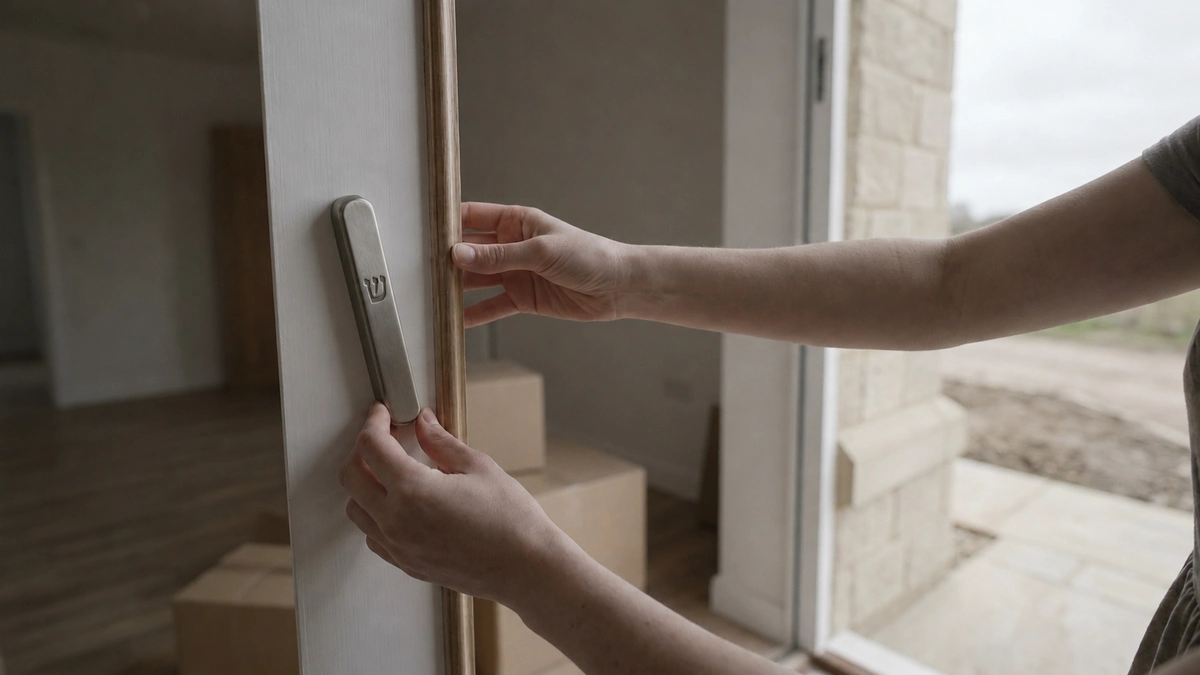
The blessing on a mezuzah is recited immediately before the act of affixing it to the doorpost. This follows the general rule stated in the Gemara that mitzvah blessings are said before the mitzvah is performed (Pesachim 7b). Rambam states this explicitly with regard to mezuzah: “Before affixing it to the doorpost, one first recites the blessing... and one does not recite the blessing at the time of writing it, because the affixing is the mitzvah” (Mishneh Torah, Tefillin, Mezuzah and the Torah Scroll 5:11; Mechon Mamre). Shulchan Aruch likewise places the blessing at the time of kvi'at ha-mezuzah, not afterward (Shulchan Aruch, Yoreh De'ah 289:1).
If you are placing mezuzot on multiple doorways in the same home in one session, a single blessing covers all of them, but you should not speak about unrelated matters between rooms.
If you need guidance on which doorways require a mezuzah, our mezuzah halacha resource can help you work through your specific home. Recite the blessing, then immediately affix the scroll.
The Mezuzah Prayer: Bracha Text and Translation
The prayer for hanging a mezuzah, more precisely the mezuzah bracha, is worded as follows. This is what to say when putting up a mezuzah, recited immediately before the scroll is fixed to the doorpost:
בָּרוּךְ אַתָּה יְיָ אֱלֹהֵינוּ מֶלֶךְ הָעוֹלָם, אֲשֶׁר קִדְּשָׁנוּ בְּמִצְוֹתָיו וְצִוָּנוּ לִקְבֹּעַ מְזוּזָה.
Baruch Atah Adonai, Eloheinu Melech ha'olam, asher kid'shanu b'mitzvotav v'tzivanu likboa mezuzah.
Mezuzah Blessing English Translation: Blessed are You, Hashem our G-d, King of the universe, Who has sanctified us with His commandments and commanded us to affix a mezuzah.
Notice that the mezuzah blessing says likboa mezuzah, "to affix a mezuzah." The Hebrew word mezuzah literally means "doorpost." The Poskim (halachic authorities) explain that this is not a coincidence. When we properly affix the scroll to the doorpost, the parchment and the doorpost become unified, the written words of Shema and V'haya Im Shamoa become part of the entrance itself.
Just as saying Kriyat Shema (the recitation of Shema) is an act of declaring Hashem's Oneness with our mouths, affixing the mezuzah is an act of declaring Hashem's Oneness through the very structure of our home. That is why the act, and the blessing, is called mezuzah, meaning the doorpost, and not simply "the scroll."
What Prayer Is Inside a Mezuzah?
A mezuzah scroll does not hold a prayer in the way a siddur does. It holds two passages copied by hand from the Torah: Shema Yisrael (Devarim 6:4-9) and V'haya Im Shamoa (Devarim 11:13-21). Both passages contain the instruction to write these words on the doorposts of your house and on your gates, which is the source of the mitzvah itself.
These are the same two passages recited as part of Kriyat Shema, which is why the scroll is often described as containing a prayer. The distinction matters in practice. Because the scroll is a Torah text, it must be written by a trained sofer with the proper intent, letter forms, and spacing. A printed or photocopied version of these passages is not a kosher mezuzah, however accurate the wording may appear. Our guide to what the mezuzah scroll says covers the full text and what makes it valid.
The Halachic Basis for Reciting the Mezuzah Blessing
The general rule established by Chazal is that a berachah is recited before performing a mitzvah (Pesachim 7b). In the case of mezuzah, Shulchan Aruch, Yoreh Deah 289:1, rules that before affixing it one recites the blessing "...אשר קדשנו במצותיו וצונו לקבוע מזוזה". The mitzvah itself is rooted in the Torah, in the verse "וּכְתַבְתָּם, עַל-מְזוּזוֹת בֵּיתֶךָ, וּבִשְׁעָרֶיךָ" (Devarim 11:20).
One important question the Poskim discuss is whether the fulfillment of the mitzvah occurs only at the moment of affixing, or whether it continues every moment the mezuzah remains in the doorway. The accepted view, famously articulated by the Taz, is that the mitzvah is ongoing; a Jew fulfills this commandment continuously as long as a kosher mezuzah is fixed on his doorpost. This understanding underscores why the Shulchan Aruch rules so carefully about what happens when a mezuzah is removed and returned, as we will see below.
It is also worth noting that Shehecheyanu is not recited over a mezuzah. The Poskim explain that although moving into a new home can warrant a Shehecheyanu for the joy of the home itself, the mezuzah blessing stands alone as likboa mezuzah. The two occasions are treated separately.
When a New Mezuzah Blessing Is Required, and When It Is Not
Knowing when to repeat the mezuzah bracha wording is an area where many people make mistakes. The following rulings from the Poskim provide clear guidance.
When a mezuzah is taken down for inspection (bedika) by a magiah (halachic mezuzah examiner) and returned to the same doorpost the same day after being found kosher, no new blessing is needed. The mitzvah was never interrupted in a meaningful way. But, if the mezuzah is returned the following day or later, a new blessing is required. Because a home may not be left without a mezuzah, it is proper to affix a temporary kosher mezuzah in the meantime and recite the blessing when the original is returned.
If a mezuzah falls off the doorpost on its own, a new blessing is required when it is re-fixed. Similarly, if a mezuzah is moved from one doorway to a different doorway, the Poskim debate whether a new blessing is needed. The practical advice given is to return each mezuzah to its original spot whenever possible, to avoid entering into this uncertainty. For questions about mezuzah responsibility, including who is obligated to affix a mezuzah in a rented home or shared space, that topic deserves its own careful attention.
If you have questions about your specific situation, we are here to help. You are welcome to reach out through our FAQ or contact us directly for guidance.
A Special Case: Moving Into a Home That Already Has a Mezuzah
What should someone say when moving into a home where a kosher mezuzah is already affixed? The Pitchei Teshuva (Yoreh Deah 289:1) cites Rabbi Akiva Eiger, who theorizes that a new resident might need to recite a special blessing, "to dwell in a house that has a mezuzah," because the standard blessing likboa mezuzah (to affix a mezuzah) does not apply when one did not personally affix it.
In practice, because of doubt (safek berachot lehakel), the commonly accepted ruling is not to recite a new berachah merely upon moving into a home whose mezuzot are already in place. Instead, one should make sure the mezuzot are kosher and properly affixed. If a mezuzah is removed for checking and then re-affixed, the practical details should be reviewed with a rav. For Sephardic practice, or if you follow a particular community custom, consult your rav.
Most Ashkenazic authorities follow the Birkei Yosef position and do not recite a blessing in this situation. The differences in practice between Ashkenazi and Sephardi communities on mezuzah-related matters are meaningful and worth understanding before proceeding. See also Jersey City's Jewish Community Presents Mayor James Solomon With a Mezuzah Bless.
Common Errors When Reciting the Blessing
Several common mistakes interfere with proper fulfillment of the mitzvah and should be avoided.
The most frequent error is reciting the blessing after the mezuzah has already been affixed. The blessing must come before the act, even a moment after is too late, and the blessing is not considered to have been properly said. A second common error is interrupting between the blessing and the affixing with unrelated conversation. If you are affixing mezuzot in multiple rooms, do not speak between rooms about anything unrelated to the mitzvah. A third error involves affixing the mezuzah incorrectly, for instance, placing it upside down (with the word Shema facing downward) or allowing it to hang loosely rather than attaching it firmly. A mezuzah that is not properly fixed is halachically invalid, which means the blessing would have been said in vain. For a fuller picture of proper placement and the physical requirements of affixing, our learning center covers these details step by step.
The Deeper Meaning Behind the Blessing
When we say the words asher kid'shanu b'mitzvotav v'tzivanu, "Who has sanctified us with His commandments and commanded us", we are expressing something profound. Hashem commanded us to do so. The obligation itself is an expression of His closeness to us and His desire that His words fill our homes and our lives.
The Rambam writes at the conclusion of the Laws of Mezuzah that whoever is careful with this mitzvah will be reminded of Hashem every time he enters and exits his home, and this will awaken him to love Hashem and to cast aside the vanities of the world. The mezuzah is a declaration, an ongoing act of emunah (faith) and bitachon (trust in Hashem) embedded into the architecture of the Jewish home. The blessing we say when we affix it is the verbal acknowledgment of what the mezuzah already is: a public, permanent proclamation of the Shema, fixed on our doorpost for all who enter to see. Inspirational stories of how this mitzvah has shaped Jewish lives across generations can be found in our collection of mezuzah insights.
Key Takeaway
The following mezuzah bracha text is what to say when putting mezuzahs up, to be recited immediately before affixing the mezuzah to the doorpost: Baruch Atah Adonai, Eloheinu Melech ha'olam, asher kid'shanu b'mitzvotav v'tzivanu likboa mezuzah.
One blessing covers all mezuzot affixed in the same session, provided there is no unrelated interruption between doorways. A new mezuzah blessing is required when a mezuzah falls, when it is returned after being down for more than a day, or when it is moved to a different doorpost. No Shehecheyanu is said. And above all, the blessing is only valid when said over a kosher mezuzah, one written by a qualified sofer (scribe) and checked by a magiah.
Common Questions About the Mezuzah Prayer
What is the prayer for putting up a mezuzah? It is the berachah beginning Baruch Atah Adonai, Eloheinu Melech ha'olam and concluding asher kid'shanu b'mitzvotav v'tzivanu likboa mezuzah, said immediately before the mezuzah is fixed to the doorpost.
Is the mezuzah prayer the same as the mezuzah blessing? Yes. In English both terms refer to the same words. Halachically it is a berachah, one of the blessings said before performing a mitzvah.
What is the bracha for a mezuzah in Hebrew? בָּרוּךְ אַתָּה יְיָ אֱלֹהֵינוּ מֶלֶךְ הָעוֹלָם, אֲשֶׁר קִדְּשָׁנוּ בְּמִצְוֹתָיו וְצִוָּנוּ לִקְבֹּעַ מְזוּזָה.
Do you say the prayer for placing a mezuzah in every room? No. One blessing covers every mezuzah affixed in the same session, provided you do not speak about unrelated matters between doorways.
Is there a prayer to say when moving into a home that already has mezuzot? No berachah is recited simply for moving in. The accepted ruling is to leave the blessing unsaid and instead confirm that the existing mezuzot are kosher and properly affixed.
What prayer is inside the mezuzah? Not a prayer, but two Torah passages: Shema Yisrael and V'haya Im Shamoa, handwritten by a sofer on parchment.
Fulfilling the Mitzvah Properly With Kosher Mezuzah
At Kosher Mezuzah, we understand that saying the blessing properly is only meaningful when the scroll itself is kosher. A blessing recited over a pasul (invalid) scroll is a blessing said in vain, and unfortunately, invalid scrolls are more common in the marketplace than many buyers realize. Every mezuzah we offer is written by a vetted sofer and inspected by a qualified magiah (halachic mezuzah examiner), with the process endorsed by the Orthodox Union, one of the most trusted certifying bodies in the world.
We also encourage every household to have their mezuzot checked by a magiah at the intervals required by halacha, typically every three and a half years in standard conditions. A mezuzah that was once kosher can become pasul over time due to fading, cracking, or other damage to the script. Knowing that your mezuzot are kosher is not a luxury. It is the most basic part of fulfilling the mitzvah itself. For more on the broader question of who bears the obligation for ensuring a home has a mezuzah, that discussion can help clarify your responsibilities as a homeowner or tenant.
If you have questions about a mezuzah in your home, or if you are unsure whether your current scrolls are kosher and in good condition, please reach out to us. We are here to help you fulfill this mitzvah with clarity and confidence, from the sofer's hand to your doorpost.
May every home that affixes the mezuzah with intention and care be a home where Hashem's words stand at every entrance, and may the words of Shema Yisrael continue to guard our entrances and our exits, now and always.

.svg)
Bring a true Kosher Mezuzah into your home
Fulfill the mitzvah with confidence, beauty, and meaning.
Buy a Mezuzah