
How to Choose a Mezuzah Case: Materials, Sizes, and What Actually Matters
Walk into any Judaica store or scroll through an online shop, and there are dozens of mezuzah case options — wood, metal, acrylic, ceramic, small, medium, large.
Most people pick one based on how it looks and move on. But halacha has a great deal to say about the case, and choosing poorly can affect how well the mezuzah fulfills its purpose. This guide will walk you through what the sources actually require, what materials hold up in practice, and how to match the right case to every doorpost in your home. . Related reading: Can a Mezuzah Case Affect Kosher Status? What Actually Matters. We cover this in more depth in Best Waterproof Mezuzah Cases.
Kosher Mezuzah is dedicated to ensuring the proper fulfillment of this mitzvah. The mezuzah case you choose should protect the klaf (parchment) while keeping the scroll properly positioned and, where halacha requires, appropriately visible. If you are not sure where to start, browse mezuzah from our OU Endorsed process and cases to see halachically sound options organized by size and material. If you are unsure which case is right for a specific doorpost, we welcome you to reach out to us and we will help you match each location correctly.
Key Takeaways
- Choosing the right mezuzah case is a halachic requirement, not just an aesthetic preference. The Rama (Yoreh De'ah 289:1) rules that a mezuzah requires a covering, and the covering must be recognizable — that is, it should be identifiable as a case made specifically for the honor of the mezuzah.
- Always match the interior dimensions of the mezuzah case to your klaf's size before purchasing, as even a slightly too-small case can force the scroll to curl and eventually damage the letters
- The mezuzah case must securely hold the scroll in the correct vertical or diagonal position without crushing or bending the parchment, as physical damage to the klaf can render the mezuzah pasul over time
- Material matters: metal or UV-resistant acrylic cases are best for outdoor doorposts, while wood, ceramic, or clear acrylic cases are better suited for dry indoor locations
- The Zohar and Shulchan Aruch commend visibility in clean indoor locations, making a case with a glass or clear acrylic front both halachically meaningful and practically sound
- In bedrooms, many poskim follow the approach of Mishnah Berurah (OC 40:7) regarding kli betoch kli and are careful to enclose a bedroom mezuzah in two coverings, with at least one opaque layer, to preserve its sanctity.
What Halacha Says About the Case
The Rama (Yoreh De'ah 289:1) rules that a mezuzah requires a covering, and the covering must be recognizable — that is, it should be identifiable as a case made specifically for the honor of the mezuzah. The later Poskim add further precision: the case is not merely decorative. It serves a halachic function, which means it must fit properly and actually enclose the klaf. The Shulchan Aruch (Yoreh De'ah 286:5) and others discuss various situations — where the covering takes on additional halachic weight. For the full discussion, read Should You Upgrade Your Mezuzah? What Halacha Actually Requires.
There is also a concept called hidur mitzvah, beautifying the mitzvah. There is also a concept called hidur mitzvah, beautifying the mitzvah. The Gemara in Shabbat (133b) derives from 'This is my God and I will beautify Him' that a person should beautify mitzvot, including making a beautiful mezuzah. By extension, this principle also applies to mezuzah, including investing in a beautiful mezuzah and case.
What the Case Must Actually Do
Before discussing materials or aesthetics, understand the core function: the case must hold the klaf securely in a vertical position, or diagonal in the Ashkenazic custom, with the top of the scroll toward the inside of the doorway. The case must not crush or bend the klaf, and the scroll should not be loose enough to rotate inside. A case that deforms the parchment over time creates a separate concern — physical damage to the scroll can eventually render a mezuzah pasul. For a fuller discussion of how physical damage affects a scroll's validity, see what makes a mezuzah become pasul.
Secondly, the opening through which you insert the klaf must be sealable. An unsealed case exposes the parchment to moisture, insects, and handling, all of which cause deterioration. A tightly sealed case assists in maintaining the dignity and protection of the sacred text. A tightly sealed case assists in maintaining that dignity. The clear square case from Kosher Mezuzah, for instance, has a transparent sealed front that protects the scroll without blocking it from view — a detail that carries its own halachic value.
Why Visibility Matters, and When It Doesn't
The Beis Yosef (Yoreh De'ah 289) cites the Zohar's teaching that in a place of purity, it is praiseworthy for the mezuzah to be visible. The Rama (Yoreh De'ah 289:1) rules accordingly: where it is clean and appropriate, the mezuzah should be recognizable. The Taz (Yoreh De'ah 289:2) goes further, stating that the essence of the mitzvah is connected to visibility — the mezuzah should announce itself as it stands at the entrance, so that everyone who passes through the doorway turns their attention to Hashem.
This does not mean the case must be transparent in every location. But it does mean that choosing a fully opaque, sealed case in a clean indoor location — a front entrance, a living room, a dining room — misses something meaningful. A case with a glass or clear acrylic front satisfies both the protective function and the value of visibility. In locations where covering is halachically required, such as the bedroom, opacity is not only permitted but must be preferred.
Material Choices and Their Practical Implications
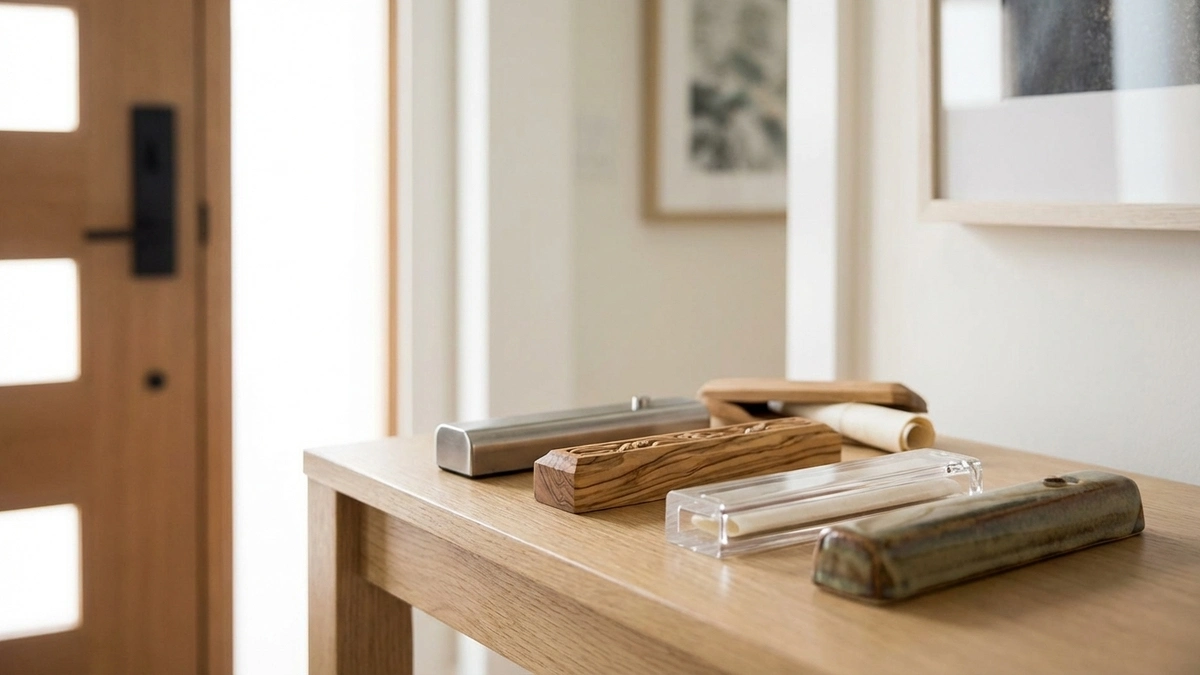
Wood cases are traditional and aesthetically warm. They are well suited to indoor use in dry environments. Wood is not recommended outdoors, as humidity can cause the case to warp or press against the klaf. If you choose wood for an indoor mezuzah, ensure it has a sealed interior that keeps the scroll from direct contact with the wood.
Metal — brass, silver, stainless steel — is durable and resistant to weather. Metal is appropriate for both indoor and outdoor use. Sterling silver cases are a common choice for the main entrance mezuzah, in keeping with hidur mitzvah. For outdoor locations, powder-coated or anodized metal resists rust. Be aware that metal cases conduct temperature extremes, and in very hot climates, direct sun on a metal case can eventually affect the ink on the klaf.
Acrylic and plastic cases allow the klaf to be seen from outside, fulfilling the value of visibility. They are lightweight, affordable, and reasonably weather-resistant for sheltered outdoor locations. They are less suitable for fully exposed outdoor mezuzahs in harsh climates, where UV exposure degrades the plastic over time. For indoor use, clear acrylic is an excellent and halachically sensible choice.
Ceramic cases are beautiful and appropriate for indoor use. They should not be used outdoors — they are brittle, absorb moisture, and can crack in freezing temperatures. Reserve ceramic for interior doorways where the case will not be subject to impact or weather.
The Bedroom: A Special Case Requiring Two Covers
The bedroom, especially when used for sleeping, changing clothes, and intimacy, requires particular attention. Shulchan Aruch (Orach Chaim 40:2) rules that marital relations may not take place in a room with tefillin unless the tefillin are placed in two coverings, at least one of which is not designated specifically for them. On the basis of this principle, many Poskim discuss whether a mezuzah in a room used for intimacy or frequent undress should similarly have additional covering beyond the regular case.
Practical halachic guides, drawing on Magen Avraham, Mishnah Berurah, Aruch HaShulchan and others, present two main approaches: some are more lenient that a single opaque cover can suffice for a bedroom mezuzah, while many recommend arranging what is effectively a second covering in a room used for marital relations or where adults are often unclothed.
In practice, this means that for such bedrooms you either use a case placed inside a secondary enclosure, or place a thick opaque covering over the case during times of intimacy or undress. A transparent glass case counts as one cover; placing an opaque cloth or velvet pouch over it provides a second. Which standard to follow is a matter for personal psak; what follows in this guide reflects a common contemporary practice of adding an opaque cover as an extra layer of respect for the mezuzah in spaces of intimacy and undress.
In many households, when the mezuzah is on the outside of a bedroom and the door is kept closed during times of intimacy or undress, people rely on a single opaque case. When the mezuzah is inside the room, such as leading to a walk-in closet, many are careful to add a second, opaque covering, following the stricter approach based on the laws of tefillin.
In contrast, rooms whose main use is dignified and clothed — living rooms, dining rooms, studies — generally benefit from a visible mezuzah, and in such clean locations many Poskim prefer a case that allows the mezuzah to be recognizable.
Kosher Mezuzah
Kosher Mezuzah matches each case to an appropriately sized scroll and provides the sofer's name, the magiah's name, the date of writing, so you know exactly what you are receiving. The Orthodox Union is the most widely trusted kosher certification agency in the United States, and Kosher Mezuzah's scrolls carry OU endorsement.
We also provide guidance on when mezuzahs need to be checked. Even the finest klaf can become pasul over time due to humidity, heat, or the natural aging of the ink. We recommend having your mezuzahs checked by a qualified sofer every one to two years for outdoor mezuzahs and every three to five years for indoor ones, or whenever you have reason to suspect damage.
Fulfilling the mitzvah of mezuzah properly, with a kosher klaf, a fitting case, and regular checking, is how this mitzvah truly becomes a source of shmirah and berachah. To speak with us about your home's mezuzah needs, visit kmezuzah.com/contact. May your home be filled with the blessings that Hashem promises to those who are careful in this mitzvah, as it says 'lemaan yirbu yemeichem' - that your days may be increased, and may the mezuzah on every doorpost of your home stand as a faithful witness to your family's connection to Hashem.

.svg)
Bring a true Kosher Mezuzah into your home
Fulfill the mitzvah with confidence, beauty, and meaning.
Buy a Mezuzah