
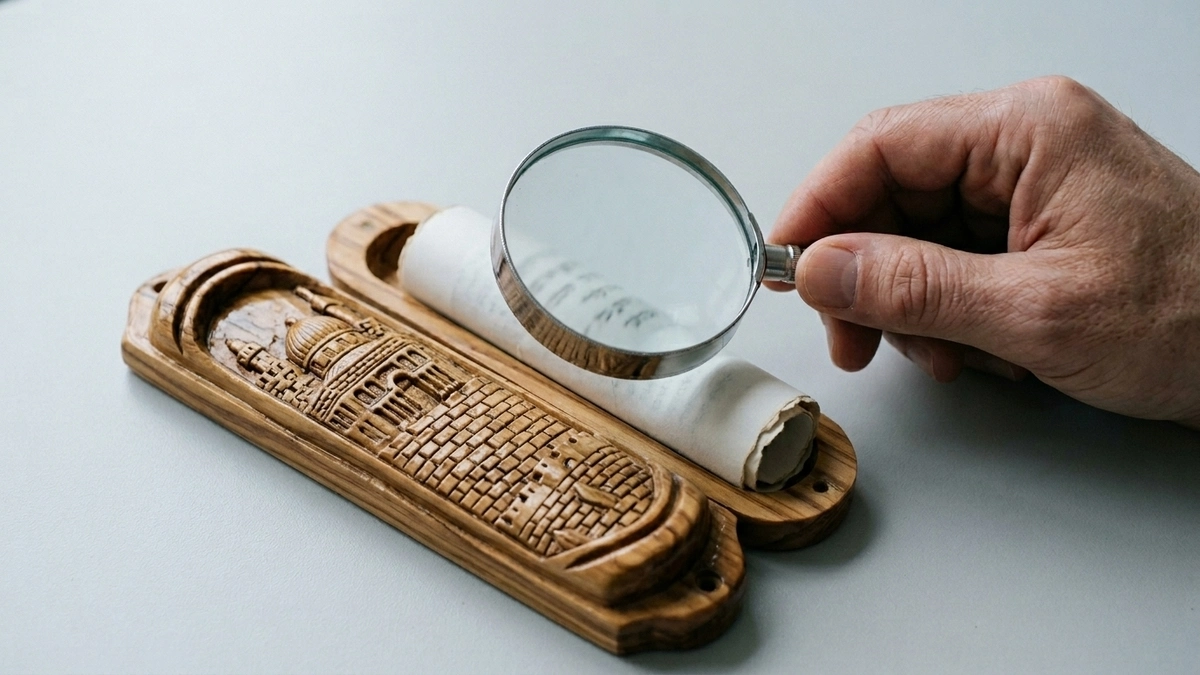
Souvenir Mezuzah Valid: What Halacha Actually Requires
When someone returns from a trip or picks up a mezuzah at a gift shop, an airport stand, or an online marketplace, they often assume that because it looks like a mezuzah, it functions as one.
The question of whether a souvenir mezuzah is valid is not a matter of personal preference or community custom. It is a halachic question with a clear answer, and that answer matters: the vast majority of souvenir mezuzahs are not valid. Understanding why — and what a genuinely valid scroll requires — is essential for every Jewish home. See also Should You Upgrade Your Mezuzah? What Halacha Actually Requires.
Kosher Mezuzah is dedicated to ensuring the proper fulfillment of the mitzvah of mezuzah. If you have questions about whether the mezuzah on your doorpost meets halachic requirements, we encourage you to reach out to Kosher Mezuzah for guidance from those dedicated to ensuring the proper fulfillment of the mitzvah of mezuzah.
Key Takeaways
- A souvenir mezuzah is only valid when it contains a kosher scroll written by a qualified sofer (Torah scribe) with proper intent — the case, country of origin, and place of purchase have no bearing whatsoever on validity
- Most souvenir mezuzahs sold in tourist shops, airport kiosks, and unverified online marketplaces do not contain valid scrolls, meaning affixing them does not fulfill the mitzvah of mezuzah at all
- Printed or machine-produced scrolls are categorically invalid under halacha, regardless of how closely they replicate handwriting — a beautiful case housing a printed scroll is not fulfilling the mitzvah
- Before affixing any souvenir mezuzah scroll, have it examined by a trained magiah (checker) approved by a recognized rabbinic authority, and request written documentation of the sofer's name and certifying body
- Purchasing a mezuzah from a reputable source should always take precedence over convenience — sourcing matters to halachic status, and the same verification standards apply everywhere
- An invalid mezuzah scroll on your doorpost is not a partial fulfillment of the mitzvah — only a fully verified, kosher scroll fulfills the commandment and carries the spiritual significance the mitzvah is meant to convey
Are Souvenir Mezuzahs Ever Valid?
A souvenir mezuzah is valid only when it contains a properly written, halachically acceptable scroll: a kosher klaf (parchment) written by a qualified scribe, with intention for the sake of the mitzvah, with kosher ink, written in the correct order, and with each letter properly formed. These requirements are only some of the many detailed halachic laws that must be followed for a mezuzah scroll to achieve and maintain its kosher status.
The decoration, the country of origin, and the store where the mezuzah was purchased have no bearing on validity. What determines whether a mezuzah fulfills the mitzvah is entirely the scroll held inside it. Most souvenir mezuzahs sold in tourist stores, airport souvenir stands, Judaica retail shops, airport kiosks, and general online marketplaces do not contain valid scrolls, and affixing them does not fulfill the mitzvah at all.
Ensuring a Mezuzah Scroll Is Halachically Valid
The halachic framework governing how the two passages inside the case must be written is extensive. Each letter must be correctly formed, and the many additional technical requirements governing spacing, preparation of the parchment, and the writing process must also be observed. If any of these conditions are missing, the scroll is pasul (invalid), and the mitzvah has not been fulfilled—no matter how impressive or attractive the mezuzah case may appear externally.
Contemporary poskim and kashrut agencies therefore caution that a mezuzah purchased from an unknown or unverifiable source should not automatically be relied upon. In practice, one should look for a scroll that comes from a known scribe and supervising rav whose reliability can be clearly established. A tourist purchase or souvenir often comes with no documentation, no named scribe, and no rabbinic certification, which means it should not be relied upon without further checking.
Why the Case Is Irrelevant to Validity
The halacha about the mezuzah case is instructive here. The Rama (285) teaches that a covering (lid) for the mezuzah is required as a matter of honor for the mitzvah, so that it not be exposed without protection. The Shach and Shulchan Aruch (285:7) established that the scroll should be kept inside a case for this reason. But the Pischei Teshuvah and subsequent poskim make clear that the covering is a hidur (beautification) and a practical protection, not a component of the mitzvah itself.
In the mitzvah of mezuzah, what is held inside the case is the entire mitzvah—the scroll itself, not the decorative case. A beautiful case may hold sentimental or aesthetic value, but it does not confer halachic validity. A hand-carved olive-wood case from Eretz Yisrael containing a printed or invalid scroll does not fulfill the mitzvah at all. Conversely, a plain case holding a properly written, verified scroll fulfills the mitzvah completely. If the scroll does not meet the Torah’s detailed requirements, the mezuzah has no mitzvah value, regardless of how impressive or attractive the case may appear.
Why the Souvenir Mezuzah Situation Is Particularly Problematic
Souvenir mezuzahs raise issues that the homeowner considering the mezuzah marketplace must understand readily. Many scrolls sold as mezuzahs in tourist settings are mass-produced, machine-printed text placed on thin material resembling parchment. Because the halachic validity of a mezuzah depends entirely on the scroll itself, not the case, any shortcut in writing or materials immediately calls the mitzvah into question.
Scrolls purchased from gift shops, airport vendors, or someone who does not believe in the sanctity of the laws simply will not fulfill the mitzvah. A mezuzah purchased from an unverified source requires immediate doubt. The responsible approach, from the moment such a scroll is encountered, is to have it examined by a qualified magiah (checker) before affixing it.
For those who want to ensure that every mezuzah in their home meets the highest halachic standards, our complete halachic placement and buying guide provides detailed, practical guidance on what to look for in a kosher scroll.
Practical Application: How to Evaluate What You Have
If you already own a souvenir mezuzah, the first practical step is to remove the scroll from its case and examine it. A printed scroll is categorically invalid, regardless of how precisely it replicates handwriting.
A kosher-looking scroll with visible variations in letter thickness, slight irregularities natural to human scribal work, and accompanying documentation suggests genuine handwriting. Even so, this alone does not confirm its kashrut. It must still be checked by a qualified magiah trained under recognized rabbinic oversight. Any scroll whose sofer and supervision cannot be traced should be treated as doubtful at best until it is checked and its origin clarified.
The Lubavitcher Rebbe, in initiating his worldwide mezuzah campaign in 1974, stressed on countless occasions that every mitzvah must be fulfilled according to halachic standards, not merely by sincere goodwill. A souvenir mezuzah that was brought home with sincerity but no knowledge can be set right. This principle applies equally: whether the mezuzah was purchased from a reputable Judaica store or brought home from a day-trip excursion is not the relevant question. The relevant question is: does it contain a valid scroll?
Risks similar to those posed by tourist mezuzahs also exist in online marketplace. Purchasing a mezuzah from an unverified online seller carries the same fundamental concern: without verifiable certification and traceability to oversight, the scroll's kashrut cannot be assumed. For guidance on whether to keep or replace your current mezuzahs, Kosher Mezuzah is available to assist you. You are welcome to contact Kosher Mezuzah directly and our team will help you identify whether your scroll meets the standards of OU endorsement.
Practical Steps for Evaluating a Souvenir Mezuzah
If you acquire a mezuzah from an unverified source, the proper course is to take the scroll to a qualified sofer rather than attempting to check it yourself. Handling the parchment directly with bare hands is prohibited; the Mishnah Berurah (147:4) and Magen Avraham caution that contact with the klaf should only be done with washed and guarded hands to avoid disrespecting the sacred Names of Hashem.
A qualified sofer or magiah can examine the scroll to determine whether it is halachically valid. If the scroll appears machine-produced, perfectly uniform, or otherwise suspect, it may be pasul, and the mitzvah is not fulfilled. Request written documentation identifying the sofer, the magiah, and the certifying rabbinic authority. If reliable certification cannot be provided, do not affix the scroll as a mitzvah; treat it at best as a souvenir or symbol, and consult a reputable source, such as Kosher Mezuzah, for a verified replacement.
Kosher Mezuzah is dedicated to ensuring the proper fulfillment of the mitzvah of mezuzah. Every scroll we provide is OU-endorsed, written by a named sofer, checked by a trained magiah, and documented and accountable so you can rely. You can browse our full offering of verified, scrolls from our OU Endorsed process to find the right scroll for your home.
May the mitzvah of mezuzah bring blessings and protection to your home, and may every scroll on your doorpost be genuinely kosher, fully verified, and worthy of the declaration it carries.




.svg)
Bring a true Kosher Mezuzah into your home
Fulfill the mitzvah with confidence, beauty, and meaning.
Buy a Mezuzah