

Mezuzah Placement in an Apartment: What You Need to Know Before You Hang a Single One
Apartment living raises some of the most practical questions about mezuzah placement. Which doorways are obligated? Who is responsible for the building entrance mezuzah? What happens when you share a lobby, a stairwell, or a hallway with neighbors who are not observant? (See who is responsible for shared spaces.) These are real questions, and they deserve real answers rooted in halacha. This article will walk you through apartment mezuzah rules, so you can fulfill the mitzvah fully and with clarity. For a related question, see Who Is Responsible for the Mezuzah at a Building Entrance?.
How Does Mezuzah Placement Work in a Multi-Unit Building With Shared Entrances?
In a multi-unit building, the resident’s own apartment entrance is the first doorway to address. Halachically, that doorway is not canceled by the fact that the building is shared. A Jewish residence is judged as a residence, even when it sits inside a larger apartment building.
At the same time, the building’s shared entrances may create additional mezuzah questions. Shulchan Aruch includes not only “שערי בתים” but also “שערי חצרות” among the entrances that can require mezuzah. That means the main exterior entrance, lobby entrance, or another significant common entryway may have halachic relevance if it functions as a real entrance serving the residences.
But the mezuzah halacha in a multi-unit apartment building are not all automatically identical. Rambam lists structural and residential conditions for a doorway to be obligated in mezuzah, so each entrance has to be evaluated on its own terms. A main entrance that serves as the building’s true access point may be more significant than an inner utility door, service door, or incidental opening.
So the practical halachic approach is this: first determine the status of the apartment’s own front door; then separately analyze the shared building entrances. If the building has multiple regularly used entrances, each may need its own review rather than being lumped together.
What If Other Tenants in the Building Are Not Jewish?
If other tenants in the building are not Jewish, that does not by itself remove the mezuzah obligation from the Jewish resident’s own apartment doorway. However, the presence of non-Jewish tenants can change the analysis of the shared building entrance. The Rema writes that a house jointly shared by a Jew and a non-Jew is exempt, and adds that courtyards of towns where some non-Jews live are exempt from mezuzah. So a common entrance in a mixed-tenant building is not treated as a simple automatic chiyuv (obligation) in the same way one might analyze a private Jewish dwelling or an entrance serving only Jewish residents.
. We cover this in more depth in Can a Non-Jew Put Up a Mezuzah? What the Halacha Actually Says.
That means the correct halachic framing is: mixed occupancy usually affects the common entrance more than the resident’s own apartment door. The apartment door and the building entrance are related, but they are not necessarily governed by the same rule. In a mixed-tenant building, the private unit entrance may still require mezuzah, while the shared entrance may be exempt or may need a more case-specific ruling, depending on how the structure is built, how it is actually used, and the ruling followed by the local rav / halachic authority.
A Practical Guide to Mezuzah Placement in Your Apartment
Mezuzah placement in an apartment follows the same core halacha as in a private home, with several important distinctions that apply to shared spaces, lobbies, and building entrances. Every doorway in your apartment that meets the basic requirements, two proper doorposts, a lintel, a minimum size of four by four amos, and regular use as a dwelling space, requires a mezuzah. If you are uncertain how many doorways that includes, a room-by-room mezuzah count can help you walk through your home systematically. The mitzvah is yours to fulfill from the moment you move in, and fulfilling it completely, on every obligated doorway, is the goal. We cover this in more depth in Mezuzah in Apartment, Dorm Room, or Office.
Start at your front door, the entrance from the hallway or corridor into your apartment, and work inward. Your front door is unquestionably obligated and takes a mezuzah with a bracha. Every interior room that meets the size requirement (four by four amos) and is used as a living space is also obligated. Bathrooms and laundry rooms are generally exempt. Storage closets that are very small or not used as dwelling spaces may also be exempt, though this depends on their specific use and dimensions.
The rule for which side to put the mezuzah is defined by the direction of entry, the right side as you walk into the room or space. For the vertical placement, the mezuzah belongs in the upper third of the doorpost. If the doorpost is unusually tall or irregular, the exact placement should be checked carefully with a competent rav. The question of what to do when the upper third is inaccessible has specific rulings worth reviewing before you make that determination on your own. Similarly, if you have already placed a mezuzah too high on the doorpost, that is a problem that requires correction.
When it comes to interior doorways between rooms, the direction is not always determined simply by calling one room the ‘inner room.’ Where it is unclear which side is primary, halachah looks to the room’s main use and, where relevant, to heker tzir to determine the direction of entry. When multiple rooms are arranged one inside another, each doorway is evaluated independently and each obligated entrance receives its own mezuzah.
For sliding doors and other atypical openings, the placement should be determined by the doorway’s actual halachic direction, not by the hardware alone. If the opening is unusual, these cases should be reviewed individually.
If you have questions about a specific doorway in your apartment, an unusually built frame, a doorway that opens in an uncommon direction, or a room that may or may not meet the size requirement, consult your rav. These are real shailos and they deserve proper answers.
Can a Renter Put a Mezuzah on an Apartment Doorframe Without Damaging It?
In rental apartments, resident may face real installation limits. Metal frames, landlord restrictions, security doors, and no-drill policies often affect how the mezuzah can be mounted. This is a very common apartment concern. A renter may know exactly where the mezuzah belongs, yet still wonder how to attach it without damaging the property. That is why practical installation questions come up so often in apartment mezuzah searches.
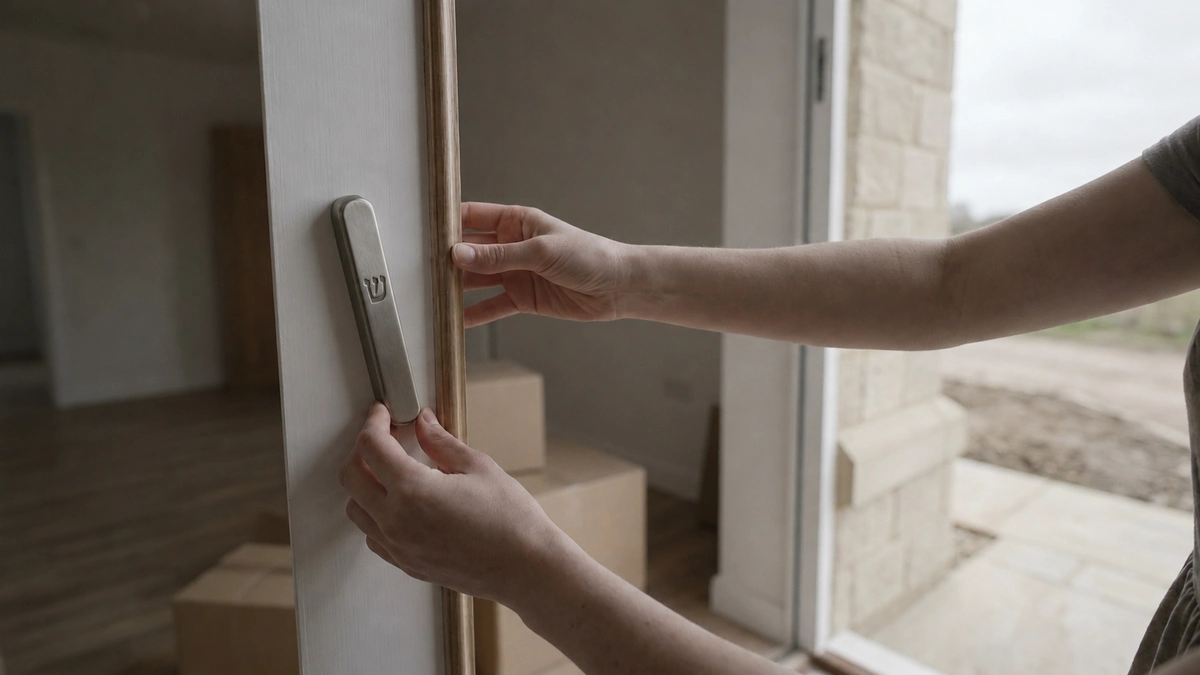
The right approach is to preserve both concerns at once: the mezuzah should be mounted properly, and the renter should use an attachment method that respects the real limits of the property. Adhesive-based installation may sometimes be the most practical path, but the renter should still make sure the mezuzah is being fixed securely and in the correct place on the actual doorway.
What If the Apartment Doorframe Is Metal, Narrow, or Recessed?
Apartment buildings often have doorframes that are harder to use than standard house doorposts. A frame may be metal, too thin, partially blocked, or set deep into the wall, and those conditions can affect how the mezuzah should be placed. If your building has an unusual frame, the question of a mezuzah on an extended doorpost or a mezuzah in a deep door frame may be directly relevant to you.
This is especially common in large buildings, newer developments, and rental units with security doors or decorative trim. A resident may find that the obvious place for a mezuzah is blocked by hardware, that the frame is extremely narrow, or that the doorway is recessed in a way that makes the correct placement less intuitive.
In practice, a difficult apartment frame does not justify placing the mezuzah on any convenient nearby surface. The first step is to determine whether the actual doorway still has a valid placement area despite the metal, narrowness, or recess. If that is not clear, the resident should not guess, but should show the doorway to a competent rav before affixing the mezuzah.
Can You Put a Mezuzah on a Nearby Wall if the Apartment Frame Is Difficult?
When the actual apartment frame is hard to use, residents often wonder whether a nearby wall or adjacent strip can serve instead. A nearby wall may feel like an easy solution, especially in apartments with narrow metal frames or awkward trim. But convenience alone does not determine valid mezuzah placement. The mezuzah belongs on the doorway in the proper place, not merely somewhere close by.
Practically, a resident should not place the mezuzah on a nearby wall merely because the apartment frame is awkward. The correct approach is first to identify the halachically relevant doorway itself and see whether the mezuzah can be mounted there properly. If the valid placement point is uncertain, the resident should get guidance before installation rather than rely on a “close enough” solution.
Apartment Mezuzah Rules for Renters: What Background Halachos Matter?
Although this article focuses on mezuzah placement in an apartment, a few background halachos affect when and how that placement begins. A renter is also obligated in mezuzah, but the timing depends on the type and location of the rental. In the classic halachic framework, a renter outside Eretz Yisrael is exempt for the first thirty days and only becomes obligated afterward, while a renter in Eretz Yisrael is obligated immediately.
Shulchan Aruch also makes clear that in a normal rental, the tenant affixes the mezuzah. In practical apartment terms, ownership of the unit does not by itself make the landlord the one who fulfills the mitzvah for the resident. The resident-tenant is generally the one who must make sure the mezuzah is there once the obligation begins.
If the Apartment Already Had Mezuzahs, Can You Rely on Them?
In many apartments, mezuzahs are already in place when a new tenant moves in. But existing mezuzahs should not automatically be assumed to be usable without checking whether it is still kosher.
This is a very common apartment reality. A new tenant may see mezuzah cases and assume the apartment is already taken care of. But the presence of a case does not prove that there is a kosher scroll inside, that the scroll is still in good condition, or that the placement was done correctly.
In practice, a new tenant should treat existing mezuzahs as unconfirmed until they are checked. The resident should verify that each case contains a kosher klaf, that the scroll has not been damaged, and that the mezuzah was mounted in the proper place and direction. If that cannot be confirmed, the tenant should replace or have the mezuzahs checked rather than assume the apartment is already properly covered.
Common Apartment Mezuzah Placement Mistakes
Most apartment mezuzah mistakes happen when people assume the layout is simpler than it really is. The biggest errors usually come from unclear halachic situations that are never properly evaluated.
One common mistake is assuming that only the apartment’s own entrance matters, without considering whether a shared hallway, lobby, or other common entry raises a separate mezuzah question. Another is assuming that every shared entrance is automatically exempt, when in some cases the details of use, access, and structure may require closer review.
Other frequent mistakes include treating every apartment doorway as identical even when the layout differs, overlooking entrances to porches, laundry areas, or storage spaces that may have their own halachic status, and following what previous tenants did without checking whether the mezuzahs were correctly placed in the first place.
A resident should review the main entrance, interior rooms, and any porches, storage areas, or shared-access points individually, and should not rely automatically on what neighbors or previous tenants did. When the layout or ownership structure is unclear, the safer course is to ask before mounting.
What the Mezuzah Means in a Jewish Home
The mezuzah is affixed to the home so that every entry and exit becomes a moment of emunah and bitachon — a quiet reminder that this home, and all who dwell within it, live under Hashem’s watchful care. In an apartment, where the doorways are many and the shared spaces add complexity, fulfilling the mitzvah properly in every obligated doorway brings kedushah into daily life and is a zechus, a merit, for everyone who lives there.
About Kosher Mezuzah
At Kosher Mezuzah, every mezuzah scroll we provide is written by a vetted sofer STa"M and checked by a qualified magiah (proofreader) before it reaches you. Our scrolls carry produced under a process endorsed by the Orthodox Union, one of the most trusted kosher certification bodies in the world, and each scroll is traceable, you can know who wrote it, who checked it, and when. That level of accountability matters, because the mitzvah of mezuzah depends entirely on the kashrut of the scroll inside the case.
We also understand that mezuzah placement raises real questions, about specific doorways, unusual frames, and shared spaces in buildings with many residents. We are here to help you think through those questions and fulfill the mitzvah correctly. The scroll matters. The placement matters. Both deserve the same seriousness.
If you have questions about the mezuzahs in your apartment or need help ensuring that every doorway is covered correctly, reach out to us at kmezuzah.com and we will be glad to help you fulfill this precious mitzvah with confidence. May your home be a place of kedushah, shalom, and Hashem's blessing in all who enter and depart, b'ezrat Hashem.


.svg)
Bring a true Kosher Mezuzah into your home
Fulfill the mitzvah with confidence, beauty, and meaning.
Buy a Mezuzah