

What If a Mezuzah Was Placed Too High? (Do You Need to Fix It?)
A mezuzah that was placed too high can be a halachic problem, and in some cases it does need to be fixed. In general, the mezuzah must be affixed in the proper height range on the doorpost. If it was placed within that valid zone, the mezuzah remains kosher. If it was placed too close to the top of the doorway, however, the placement may be invalid and it should be repositioned.
If you have questions about your specific doorway, the team at Kosher Mezuzah is available to help you work through it.
What "Upper Third" Actually Means
The upper third refers to the upper portion of the doorpost's usable height, meaning the space between the floor and the lintel. Divide that height into three equal parts. The Shulchan Aruch (Yoreh Deah 289:2) establishes that the mezuzah should be placed at the beginning of the upper third of the doorpost. This does not mean near the top of the doorpost. It means at the point where the upper third begins — in other words, above two-thirds of the way up from the floor, at the lower edge of the top third. This placement is the ideal (lechatchilah) position.
The problem of invalid mezuzah placement height arises when the mezuzah is pushed too close to the lintel, or fixed directly against it. Anywhere within that upper third is generally valid, so long as the mezuzah is still at least one tefach below the lintel. If it was fixed within that top tefach, the placement is invalid and the mitzvah has not been fulfilled, and the mezuzah should be repositioned lower as soon as possible.
The One-Tefach Rule at the Top
The poskim establish that if the mezuzah is fixed within one tefach of the lintel, it should be removed and repositioned lower. Shulchan Aruch (Yoreh Deah 289:2) rules that a mezuzah fixed higher than the beginning of the upper third is only valid if it is at least a tefach below the lintel. In practical terms, a tefach is commonly estimated at roughly 8-10 centimeters, depending on the measurement used. If yours is sitting flush against the lintel or very near it, it should be repositioned. As for whether a new blessing is recited when correcting this kind of placement mistake, that can depend on the posek and the circumstances, so a competent rav should be asked for the practical ruling.
The Halachic Source for Where the Mezuzah Must Be Placed
The halachah requires care not only that the mezuzah be kosher, but that it be affixed in the proper position on the doorway. In cases of incorrect mezuzah height, the mitzvah has not been fulfilled in the ideal way, and in some cases may not be fulfilled at all. The blessing we recite, likboa mezuzah, reflects that the act of affixing the mezuzah in its proper place is the mitzvah itself. Rambam writes explicitly that the blessing is recited at the time of affixing, because the affixing is the mitzvah.
The obligation to place the mezuzah at a specific height is rooted in the Gemara and codified by the major Poskim. The Gemara in Menachot teaches that the mezuzah should be placed at the beginning of the upper third of the doorway. If the mezuzah is fixed higher than the lower section of the top third of the doorway, it is still valid only if it remains at least one handbreadth below the lintel.
For those living in apartments or rental properties, these same rules apply. The type of dwelling does not change the basic halachah of mezuzah placement.
One important nuance concerns very tall doorways. The standard rule remains the upper third. However, the Yerushalmi discusses a very high entrance and describes placing the mezuzah at shoulder height. Because the practical ruling in unusually tall doorways is discussed by later authorities, and practices may differ, a rav should be consulted in such cases. This is a separate issue from the more common scenario in which a mezuzah was simply placed too high by mistake.
What You Should Do If Your Mezuzah Is Too High
To determine if you’ve erred with an invalid mezuzah placement height, the first step is to measure. Take the full height of the doorway, from the floor to the underside of the lintel, and divide it by three. The mezuzah should be placed at the beginning of the upper third of the doorway.
If a mezuzah was placed at an incorrect mezuzah height that’s above that point, too close to the lintel, it should be removed and re-affixed in the correct position. Questions about whether a new blessing is recited when correcting an existing mezuzah can depend on the circumstances and should be asked to a competent rav.
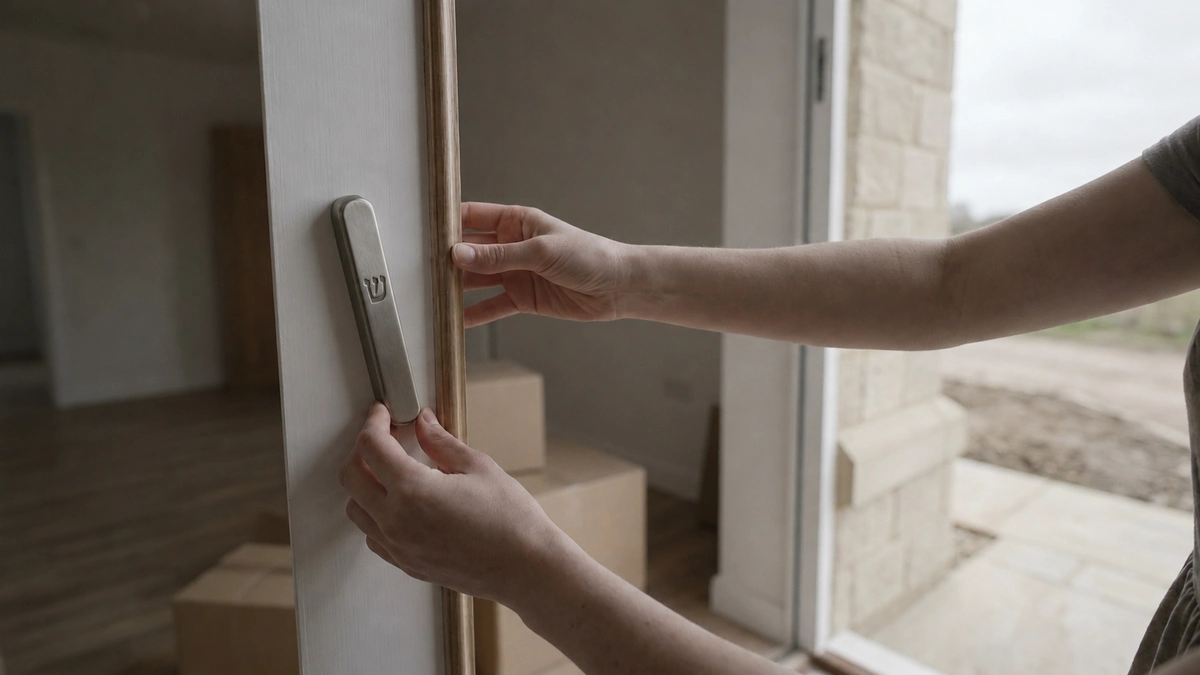
The correction itself should be done carefully. Remove the mezuzah, identify the proper position, and reaffix it securely in the correct place on the doorway.
It is also worth checking that the mezuzah is firmly attached. The Gemara states that if one hangs the mezuzah on a stick or places it behind the door, there is no mitzvah. The mezuzah must therefore be genuinely affixed to the doorway, not merely suspended or resting loosely. Nails, screws, or strong adhesive may all be appropriate if they secure the mezuzah properly. If you are unsure whether your mezuzah is on the right side of the doorpost, that should also be verified at the same time.
If you are correcting multiple mezuzot in your home, remember that the laws of the blessing in such cases have details. Shulchan Aruch records that one who affixes two or three mezuzot may recite one blessing for all of them, but practical questions about timing and interruption are best handled with the guidance of a rav, especially when correcting existing mezuzot rather than installing new ones.
If you need guidance on the mezuzah on an extended doorpost or any unusual doorway in your home, consult a rav or a qualified mezuzah expert before proceeding.
If you are unsure whether your mezuzah was placed correctly, we are here to help. Contact Kosher Mezuzah with a photo or a description of the doorway and we will walk through it with you.
Common Mistakes That Lead to an Invalid Placement
The most frequent error we see is placing the mezuzah too close to the lintel, sometimes even touching it. This often happens when someone assumes that “higher is better” or that the mezuzah should be near the top of the frame. That instinct is understandable, but it is incorrect. The mezuzah does not belong at the very top. It belongs at the beginning of the upper third, and if it is placed higher than that, it must still remain at least one handbreadth below the lintel.
A second common mistake involves misunderstanding very deep or recessed door frames. The halachah states that the mezuzah should ideally be placed in the outer handbreadth of the doorway. However, Shulchan Aruch also makes clear that if one placed it differently, that does not automatically invalidate it, so long as it remains on the actual doorpost. That means the outer handbreadth is the correct and preferred placement, but one should not automatically state that a mezuzah placed deeper in the doorway is invalid in every case.
A third error is assuming that because the mezuzah has been in place for years, it must be fine. Incorrect placement does not become correct over time. If it was placed improperly from the start, the problem remains until it is fixed.
Why the Precise Placement Carries Meaning
The mitzvah of mezuzah is meant to mark the Jewish home with words of Torah and with awareness of Hashem at the threshold of daily life. Precisely because the mitzvah is precious, the halachah gives careful rules for how and where the mezuzah must be affixed. When we take care to fix the mezuzah in the right place — not too high, not too low, securely attached, right-side up, and on the correct side of the doorway — we show respect for the mitzvah and a sincere desire to fulfill it properly. Precision here is not pedantry. It is an expression of yiras Shamayim (fear of Heaven) and of seriousness about the fulfillment of halachah.
For those wondering about the angle of the mezuzah, why it is slanted in Ashkenazic practice, that is a separate discussion rooted in the dispute between Rashi and Rabbeinu Tam. The issue of angle should not be confused with the separate question of height and location, which applies in every community.
What You Need to Remember
A mezuzah placed too high — especially one that is too close to the lintel — should be checked and, if necessary, repositioned. The correct placement is at the beginning of the upper third of the doorway, within the doorway itself, ideally in the outer handbreadth of the post. If your mezuzah needs to be moved, do so carefully and ask a rav if there is any question about the blessing. For unusually tall doorways where the normal upper-third placement creates a special case, consult your rav, as the practical ruling may differ. And always verify that the mezuzah is firmly attached, right-side up, and on the correct side of the doorway, because all of these factors are part of the proper fulfillment of this precious mitzvah.
For homes with multiple doorways, it is worth doing a full walk-through to check every mezuzah. Questions about specific rooms, such as which side of the door between two rooms requires the mezuzah, are common and worth addressing at the same time.
Fulfilling the Mitzvah with Confidence
At Kosher Mezuzah, every scroll we carry has been written by a qualified sofer and reviewed by a qualified magiah (checker). Each mezuzah is OU Endorsed, and we are committed to full transparency about what you are receiving, including the name of the sofer, the date of writing, and the materials used. The Orthodox Union is among the most trusted kosher certification authorities in the world, and their oversight of our process reflects our commitment to halachic integrity.
Proper placement is only one part of the mitzvah. The scroll inside must also be fully kosher, written correctly, on proper klaf (parchment), with kosher dio (ink), and without any errors in the tzurat ha'ot (the form of the letters). We encourage every household to have their mezuzot checked by a qualified sofer at least twice in seven years, as halacha requires. A mezuzah that was once kosher can become pasul (invalid) over time due to heat, moisture, or natural wear.
If you are unsure whether a mezuzah in your home was placed correctly, whether because of height, depth, angle, or any other concern, we are here to help. Our team can assist you in understanding the halacha and ensuring that every doorpost in your home is fulfilling the mitzvah the way it should be. Fulfilling the mitzvah of mezuzah properly is a zechus for the entire household, and we take that responsibility seriously.
If you have a question about your mezuzah placement, contact us at Kosher Mezuzah and we will guide you through it clearly and without pressure.
May your home be a place of Torah, blessing, and the constant awareness of Hashem's presence. May the mitzvah of mezuzah be a source of protection and zechus for your entire family.


.svg)
Bring a true Kosher Mezuzah into your home
Fulfill the mitzvah with confidence, beauty, and meaning.
Buy a Mezuzah