
Business Mezuzah Requirements: Do Stores and Restaurants Need One?
The mitzvah of mezuzah is not limited to the home. Many Jewish business owners assume that a store, restaurant, or office is a purely commercial space, outside the scope of this mitzvah. But halacha has a more nuanced answer, one that every Jewish business owner deserves to understand clearly. Whether you run a small shop on a busy street, a restaurant with a full dining room, or a quiet professional office, the question of whether a mezuzah is required, and how to affix one correctly, is a real and important halachic matter. This article addresses that question directly, with the care and precision the mitzvah deserves.
Key Takeaways
- Jewish-owned businesses including stores, restaurants, and offices generally require a mezuzah based on regular, purposeful daytime use, even though the obligation carries halachic uncertainty.
- Business mezuzah requirements are fulfilled without reciting a blessing, reflecting the careful balance between fulfilling the mitzvah and maintaining the integrity of the blessing when doubt exists.
- A kosher mezuzah must contain a valid parchment scroll written by a qualified scribe and checked by a trained examiner; decorative cases without proper scrolls do not fulfill the obligation.
- The room a doorway serves must meet the minimum halachic size requirement of four by four cubits, and doorways must be used in a dignified manner; restrooms are exempt, and storage spaces are generally still obligated even without constant human presence, since the Shulchan Aruch (Yoreh De'ah 286:1) obligates storehouses.
- Mezuzahs in commercial spaces require examination by a qualified magiah twice every seven years, and more frequently in restaurants or storefronts exposed to heat, humidity, or direct sunlight.
- A mezuzah on a business doorpost serves as a meaningful reminder that the space operates under Torah values of honesty, fair dealing, and reverence for Hashem.
Do Stores and Restaurants Need Mezuzahs?
Business mezuzah requirements depend on how the space is used, who owns it, and whether it meets the basic criteria that create a halachic obligation. The general ruling, as understood from the Shulchan Aruch and the poskim (halachic decisors) who followed, is that most Jewish-owned commercial spaces, including stores, restaurants, and offices, are obligated in a mezuzah, though typically without a blessing. If you are unsure about a specific doorway in your business, reach out to us at Kosher Mezuzah and we will be glad to help you work through it with clarity.
The Short Answer
A Jewish-owned business that is used regularly and has doorways meeting the standard halachic measurements is generally obligated in a mezuzah. The obligation applies even to spaces that are not used for sleeping, because regular, purposeful use during the day creates a form of dwelling under halacha. The blessing upon affixing the mezuzah is typically omitted in commercial spaces due to the uncertainty surrounding the nature of the obligation, but the mezuzah itself should still be affixed.
What the Halachic Sources Actually Say
The starting point for understanding business mezuzah requirements is the Gemara in Tractate Yoma (11a), where the Sages discuss whether storage buildings, animal pens, and similar structures require a mezuzah. The dispute there centers on whether regular human use, even daytime use for work or commerce, is sufficient to create an obligation. The conclusion that emerges from the Gemara and the rishonim (early authorities) is that a space does not need to serve as a sleeping quarters to be obligated. What matters is whether the space has the character of a place where a person conducts meaningful, regular activity.
The Taz (Turei Zahav, a major commentary on the Shulchan Aruch, Yoreh De'ah 286) rules that shops and workshops used only during the day are exempt from a mezuzah. His reasoning is that without overnight use, the space lacks the permanent dwelling character that triggers the full obligation. But other authorities disagree and hold that if merchandise is stored there overnight, the space takes on the status of a storehouse (beit ha'otzar), and a mezuzah is required.
In practice, the widely accepted custom among most poskim today is to treat modern offices, stores, and restaurants as places that require a mezuzah, but without reciting a blessing (bracha) at the time of affixing. This approach reflects the principle that when there is a halachic doubt about the obligation, we are cautious: we affix the mezuzah to avoid neglecting the mitzvah entirely, but we withhold the blessing to avoid a bracha l'vatala (a blessing made in vain). This is the approach recorded in many contemporary halachic guides, and it reflects the careful balance between fulfilling the mitzvah and maintaining the integrity of the blessing. If your business operates as a shared office or co-working space, the question of who bears the obligation becomes more layered — see our dedicated guide on shared office mezuzah requirements for a detailed breakdown.
The requirement that a room be at least four cubits by four cubits (approximately 6.5 by 6.5 feet) also applies here. A very small storage closet or a narrow passage that does not meet these measurements may be exempt. Similarly, spaces that are regularly used in an undignified or unclean manner, such as restrooms, are exempt from a mezuzah entirely, since halacha does not permit placing a mezuzah in a degrading environment.
How This Applies to Your Business in Practice
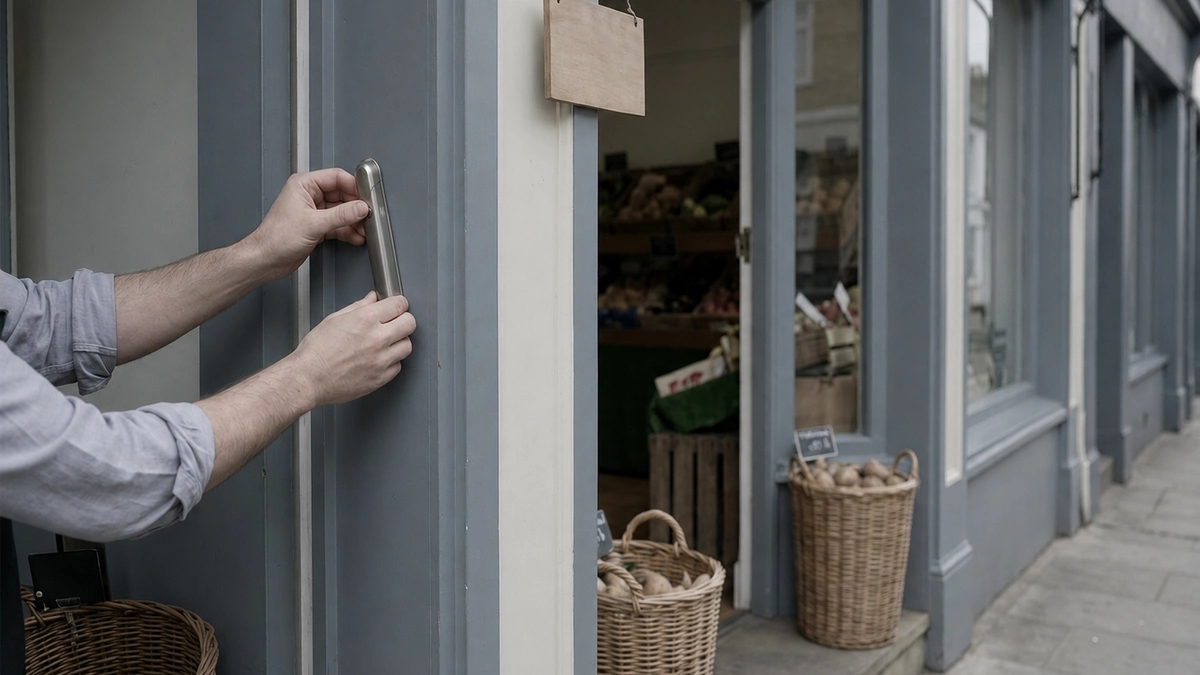
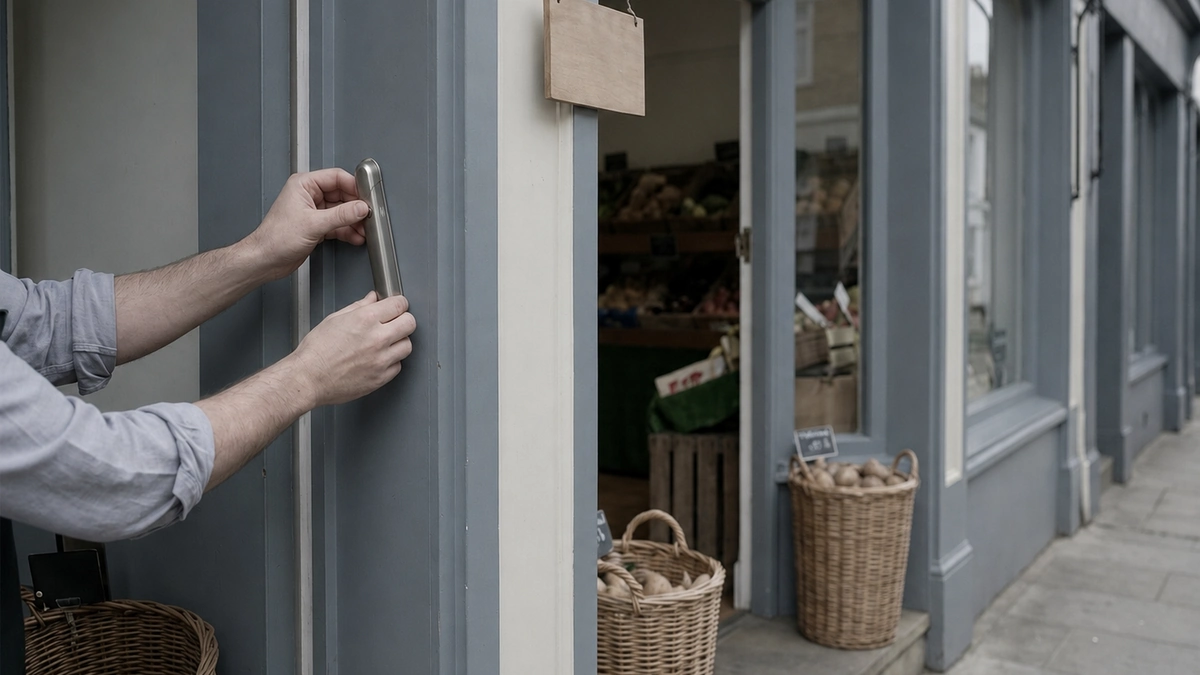
For most Jewish business owners, the practical takeaway is straightforward. If you own or have a long-term lease on a store, restaurant, café, or office, you should affix mezuzahs on the doorways that meet the halachic criteria, without a blessing. This applies to the main entrance of the space, the entrance to a private office within it, a stock room used regularly, or a dining room that customers and staff use throughout the day.
A restaurant or café with a clear entrance doorway, a kitchen area used regularly during the day, and a back storage room where goods are kept overnight would typically require a mezuzah on the main entrance and may require one on the stock room as well, since merchandise is kept there overnight. Each doorway should be evaluated based on its own conditions: its size, its use, and its cleanliness.
A few specific situations deserve attention. If the business is a partnership between a Jewish owner and a non-Jewish partner, the obligation may be affected by the non-Jewish co-ownership of the space. The Rema (Shulchan Aruch, Yoreh De'ah 286:1) rules that a space actually shared in use by a Jew and a non-Jew is exempt from mezuzah; this exemption turns on who uses the space rather than merely on who holds an ownership stake, and because the details of a specific business partnership can vary, this is a question to bring to a rav rather than assume either way. If the business space is rented, rather than owned, the obligation still applies, Jewish law does not limit the mezuzah requirement to property owners. For businesses located within a larger building, the question of who is responsible for the main building entrance is a separate and important one — our article on building entrance mezuzah responsibility addresses this directly.
Spaces used primarily for storage with no regular human activity during the day may be exempt, while spaces that employees pass through, work in, or manage inventory within regularly are more likely to carry an obligation. When in doubt, affixing a mezuzah without a blessing is almost always the more responsible choice. If you are unsure how to evaluate a specific doorway in your business, contact Kosher Mezuzah and we will assist you in applying the halacha to your situation.
A Note on the Bracha
Because the obligation in commercial spaces carries some halachic uncertainty, the widely followed practice is to affix the mezuzah silently, without a blessing. This is not a sign that the mitzvah is being treated lightly. Rather, it reflects a careful respect for both the mitzvah itself and the integrity of blessings in Jewish law. The mezuzah should still be a kosher scroll, properly written by a qualified sofer (Torah scribe), and affixed in the correct position on the doorpost.
Mistakes That Affect Proper Fulfillment
One of the most common errors we see is business owners affixing a mezuzah case with a decorative or non-kosher scroll inside, assuming that the physical case is what matters. The obligation is entirely on the klaf (parchment scroll), not the case. A beautiful case housing an invalid scroll fulfills nothing. Every mezuzah affixed in a business must contain a kosher klaf written by a qualified sofer, checked by a trained magiah (halachic mezuzah examiner), and confirmed to be free of errors.
Another frequent mistake is neglecting to check the mezuzahs in a business at the intervals required by halacha. Mezuzahs should be examined by a qualified magiah twice in every seven years. In commercial spaces, where the mezuzah may be exposed to heat, humidity, or direct sunlight, as is common in restaurants and storefronts, checking may need to happen more frequently, as these conditions can cause the ink on the klaf to crack or fade, rendering the mezuzah pasul (invalid).
Finally, many business owners simply skip the mitzvah altogether, assuming it applies only to homes. As we have seen from the halachic sources, this assumption is not accurate. Neglecting the mezuzah in a business that carries an obligation, even a doubtful one, means forgoing a daily connection to Hashem and the protection that comes with faithfully fulfilling His mitzvot.
The Mezuzah as a Reminder in Every Space We Inhabit
The mitzvah of mezuzah carries a message that extends naturally into the world of commerce. The Rambam explains that one who sees the Name of Hashem on his doorpost is reminded of the truth of emunah (faith) and of our obligation to Hashem in all areas of life. A Jewish business is not simply an economic enterprise, it is a place where Torah values of honesty, fair dealing, and reverence for Hashem are expressed in action. Affixing a mezuzah at the entrance of a business is a quiet but meaningful declaration that this space, too, is under the watchful care of HaKadosh Baruch Hu.
There is also a dimension of zechus (merit) in fulfilling this mitzvah carefully in a place of business. Many people enter through those doors, customers, employees, and passersby. A kosher mezuzah on a business doorpost is a small but real expression of the owner's commitment to living as a Jew in every arena of life, not only within the walls of home and shul. The same spirit applies to other non-residential spaces where Jews gather — if you're wondering how the obligation extends to synagogues, community centers, or other public buildings, our guide on public building mezuzah requirements covers the key halachic considerations.
The Key Ruling in Brief
Jewish-owned businesses, including stores, restaurants, and offices, are generally obligated in a mezuzah based on their regular, purposeful use throughout the day. The mezuzah is affixed without a blessing due to the halachic uncertainty surrounding the nature of the commercial obligation. Each doorway must lead into a room meeting the basic requirements: a minimum size of four by four cubits, regular use, and a dignified environment. Non-kosher scrolls, decorative-only cases, and unchecked mezuzahs do not fulfill the mitzvah. When in doubt about any specific doorway, consulting a rav or a trusted halachic resource is the right step.
How Kosher Mezuzah Can Help You Fulfill This Mitzvah Properly
At Kosher Mezuzah, every scroll we carry has been written by a trained sofer and examined by a qualified magiah before it reaches your door. Our process is endorsed by the Orthodox Union's mezuzah program, which adds an additional layer of verification that gives buyers genuine confidence in the kashrut of what they are affixing. We believe that fulfilling this mitzvah correctly, in a home, a business, or any obligated space, begins with a scroll you can trust. Browse our full selection of kosher mezuzah scrolls in our mezuzah shop to find the right scroll for every doorway in your business.
We also understand that the laws of mezuzah in commercial spaces can feel complex. Whether your question involves a restaurant with multiple doorways, an office suite with shared entrances, or a retail space with unusual architectural features, we are here to help you think through the halacha carefully and ensure that every doorway is handled with the seriousness it deserves. Our goal is not simply to sell a mezuzah, it is to help you fulfill the mitzvah with integrity.
Remember that even a validly affixed mezuzah becomes pasul (invalid) over time if not examined periodically. We encourage all business owners to schedule regular checking of their mezuzahs with a qualified magiah, and we are happy to assist with that process as well.
Take the Next Step
If you have questions about which doorways in your business require a mezuzah, or if you need a kosher scroll that meets the standards described in this text, contact Kosher Mezuzah and we will be glad to assist you.
May the mezuzah on your doorpost be a source of bracha and shmirah (blessing and protection) for all who enter, and may the fulfillment of this mitzvah bring you and your household continued zechus before Hashem.



.svg)
Bring a true Kosher Mezuzah into your home
Fulfill the mitzvah with confidence, beauty, and meaning.
Buy a Mezuzah