
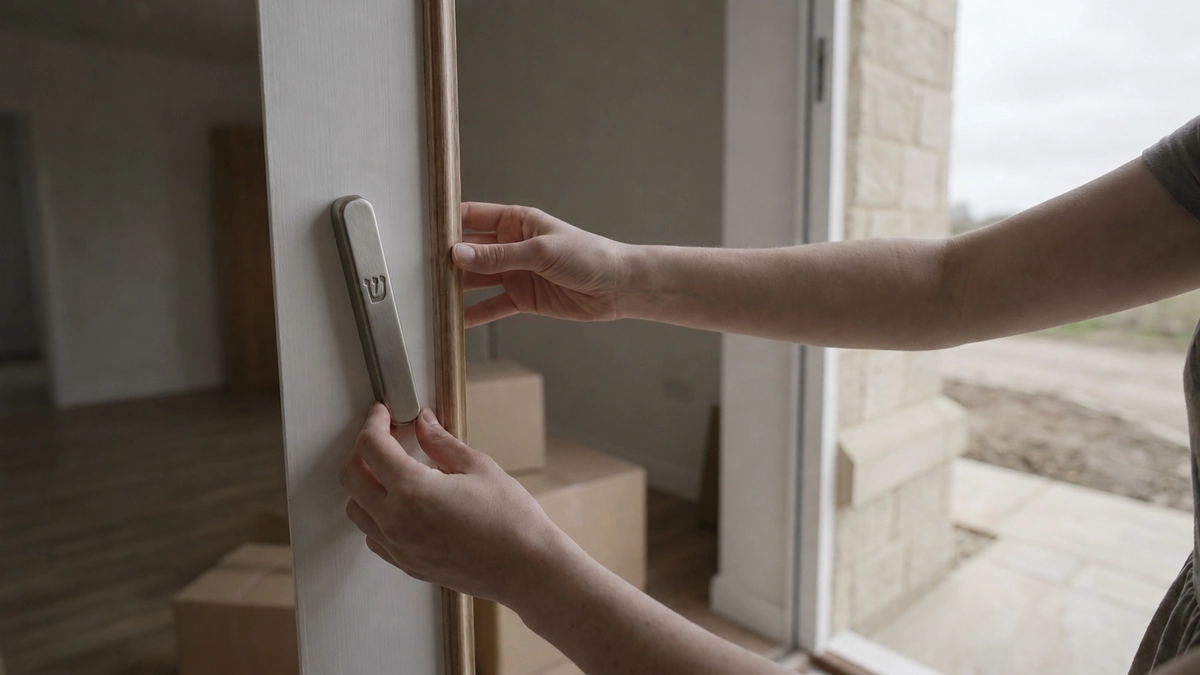
New Home Mezuzah Guide: When and How the Obligation Begins
Moving into a new home is one of life's most meaningful transitions, and for a Torah-observant Jew, it carries a responsibility that begins before the boxes are unpacked. The mitzvah of mezuzah is not simply a custom or a decoration. It is a halachic obligation that takes effect the moment you become a resident, and how you fulfill it, and when, matters greatly. This article will walk you through exactly what the halacha requires when you move into a new home: when to put up your mezuzahs, what blessing to recite, whether you can take your mezuzahs with you when you leave, and several common mistakes to avoid. Our goal is that by the time you finish reading, you will know precisely what to do and feel confident doing it right.
Key Takeaways
- Affix mezuzahs in your new home immediately upon moving in—do not wait for settling in, a housewarming party, or the perfect cases to arrive.
- A new home mezuzah must be written by a vetted sofer (Torah scribe), verified by a magiah (examiner), and properly attached to meet halachic requirements; printed or defective scrolls do not fulfill the mitzvah.
- Recite one blessing before affixing the first mezuzah and complete all rooms in one uninterrupted session to cover the entire home with a single blessing.
- When you move out, you are generally forbidden to remove mezuzahs unless the next resident is a non-Jew or you immediately replace them with kosher alternatives—leaving doorposts bare creates spiritual danger.
- Consult your rabbi about doorways of unclear dimensions, bathrooms, closets, and other spaces to determine which rooms require a new home mezuzah, as each case depends on halachic criteria.
- Affix mezuzahs on the right doorpost (as you enter), positioned within the outer handbreadth (tefach) of the doorpost and at the start of the top third of the frame, at a slight slant (Ashkenazic custom) or vertically (Sephardic custom).
Moving to a New Home: Mezuzah Rules You Need to Know
When Does the Obligation Begin?
The mitzvah of mezuzah in a new home takes hold once you begin residing in or using the home, not at the housewarming party, not after the furniture arrives, and not after you have settled in for a few days. Poskim differ on the precise moment that triggers the obligation -- some point to when you acquire the home, others to when you first use it, and others to when you actually begin living there -- but they agree on the practical bottom line: one should not wait. (One narrow exception: a renter outside Eretz Yisrael has a thirty-day grace period before the mezuzah obligation applies; a renter in Eretz Yisrael, and a homeowner in either case, should affix immediately.) As the sources state directly, "One should not wait for a housewarming (Chanukat HaBayit) to fix the mezuzah, fix it immediately upon moving in." The word immediately is not metaphorical. It reflects the gravity of dwelling, even for one night, without this mitzvah in place. If you are still deciding which mezuzah to bring to each doorpost, the halacha does not wait for that decision to be resolved. Act promptly, and questions about specific doorways can be addressed as you go. If you are unsure about what you need for your new home, you are welcome to contact Kosher Mezuzah for guidance.
The Halachic Basis: What the Torah and Poskim Say
The mitzvah of mezuzah comes from the Torah itself, from the passages of Shema and V'Haya Im Shamo'a in Devarim. The Rambam and Shulchan Aruch codify it as a constant obligation, one that applies to every Jewish home, in every generation. The deeper meaning of this mitzvah is illuminating. As one halachic commentary explains, affixing a mezuzah is not merely placing parchment on a doorpost. It is, in essence, a declaration of Hashem's Oneness embedded in the very structure of the home, akin to reciting Kriyat Shema (the Shema) aloud, but expressed through writing fixed permanently at the entrance. Just as Kriyat Shema is a verbal proclamation of Hashem's unity, the mezuzah makes that same proclamation part of the home itself. This is why the parchment is called a "mezuzah", the word for doorpost, because through proper affixing, the sacred text becomes joined to the entrance, not merely placed nearby.
For this reason, the poskim stress that a mezuzah hanging loosely or placed behind a door without being properly fixed is pasul (invalid) and does not fulfill the mitzvah. The Gemara in Menachot (32b) states explicitly: "If he hung it on a staff, it is invalid... it is a danger and there is no mitzvah." Proper attachment, with nails or strong adhesive, with the mezuzah right-side up and oriented correctly, is not optional. It is the mitzvah itself.
There is also a profound reason why we do not recite Shehecheyanu specifically on affixing the mezuzah. The blessing Shehecheyanu is said on the new home itself, not on the mezuzah separately. When you move in and fix your mezuzahs for the first time in that home, you may recite Shehecheyanu in connection with the joy of your new home, but the mezuzah carries its own blessing: "...asher kid'shanu b'mitzvotav v'tzivanu likvoa mezuzah" (who has sanctified us with His commandments and commanded us to affix a mezuzah).
Practical Steps When Moving Into a New Home
When you move into a new home, the process of affixing mezuzahs should be handled with care and intention. Before anything else, you will need to know how many mezuzahs your new home requires. Walk through each room and identify every doorway that meets the halachic criteria, a doorpost with a proper lintel, a minimum height of ten tefachim (handbreadths), and a minimum width of four tefachim. Rooms that are regularly used for dwelling are obligated: storage rooms or rooms not yet in use may have a different status.
When you begin affixing, recite the blessing "likvoa mezuzah" before the first mezuzah and then proceed through all the rooms without interruption or unnecessary conversation between them. One blessing covers all the mezuzahs in the home, provided you complete them in a single uninterrupted session. The mezuzah must be rolled from the end of the text toward the beginning, and placed with the word Shema facing outward toward the doorway opening. It must be positioned on the right side of the doorpost as you enter, within the outer handbreadth (tefach) of the doorpost, at the start of the top third of the doorpost's height, with a slight slant (per Ashkenazic custom) or vertically (per Sephardic custom).
Initially, the mitzvah is best performed by the homeowner himself (mitzvah bo yoter mib'shlucho, it is more praiseworthy to perform a mitzvah personally than through an agent). That said, one may appoint an agent to affix mezuzahs on his behalf if necessary. A woman is halachically qualified to affix a mezuzah: a minor or a non-Jew may not do so.
If you moved your belongings into the apartment but have not yet slept there, the poskim discuss whether the obligation has begun. Some hold that the moment you move your items in, the space functions as a beit ha'otzar (storage house) and the obligation applies: others disagree. To avoid any doubt, affix the mezuzahs as soon as possible after beginning to use the space. Whether you are purchasing a housewarming mezuzah gift for someone else or setting up your own home, the same principles apply. For guidance on your specific situation, we encourage you to reach out to Kosher Mezuzah.
What Happens to the Mezuzahs When You Leave?
This question is one of the most overlooked, and most halachically serious, aspects of mezuzah in a new home. The rule is firm: when you move out, you are generally forbidden to take your mezuzahs with you. The Shulchan Aruch rules that removing mezuzahs upon leaving exposes the next occupant's home to spiritual danger, and the poskim state that there is genuine sakana (danger) in doing so. This prohibition applies to mezuzahs that belong to you. A mezuzah borrowed from a gemach (free-loan society) remains the gemach's property and should be returned to them rather than left in the home, since it was never yours to leave behind.
There are, however, important exceptions. If the incoming resident is a non-Jew, you are not only permitted to remove your mezuzahs, some poskim hold it is an obligation to do so, to prevent disrespect to the sacred text. If you need your mezuzahs for your next home and no other mezuzahs are available, you may remove them, but only on condition that you replace them with other kosher mezuzahs immediately upon removal. You may not leave the doorposts bare, even briefly.
If the home already has mezuzahs in place when you move in, affixed by a previous tenant or the landlord, you do fulfill the mitzvah by living there with them in place. The poskim rule that no blessing is recited in such a case, since you did not perform the act of affixing the mezuzah yourself. The opportunity to recite the blessing arises only if you take the mezuzahs down to have them checked and then re-affix them personally. In practice, consult your rav.
Common Errors to Avoid
Several mistakes appear frequently when families move into a new home, and each one affects the proper fulfillment of the mitzvah. The first is waiting too long. Many families arrive at their new home and intend to hang mezuzahs "soon", after settling in, after the right cases arrive, after Shabbos. This delay is a halachic problem. The obligation does not pause for convenience.
The second common error is affixing a mezuzah that is not properly kosher. In today's market, it is not rare to find scrolls that appear to be handwritten but are in fact printed, or scrolls with significant errors in the text. A mezuzah with a pasul (invalid) scroll does not fulfill the mitzvah at all, regardless of how beautiful the case is. The scroll, the klaf (parchment) and dio (ink), must be written by a qualified sofer (Torah scribe) and checked by a magiah (halachic mezuzah examiner). Purchasing from a reliable source with verifiable certification is not a luxury: it is a halachic requirement.
A third mistake involves rooms that are used irregularly. Some families skip mezuzahs on bathrooms, walk-in closets, or laundry rooms without asking a rav whether those spaces are obligated. Each case depends on the size, use, and structure of the room, and deserves a proper halachic ruling.
The Deeper Meaning of Mezuzah in a New Home
There is something deeply fitting about the first act performed in a new home being the affixing of a mezuzah. Our sages teach that the mezuzah is not merely a reminder, it is, in a sense, the spiritual identity of the home. When the Shema is fixed at the entrance, the home becomes a place where the Oneness of Hashem is declared at every crossing of the threshold. The mezuzah inspiration drawn from this mitzvah runs deep: every time you walk through the door, you and your family are surrounded by a reminder of Emunah (faith) and Bitachon (trust in Hashem).
This is why the poskim emphasize kavanah, intention, when affixing a mezuzah. You are not installing a fixture. You are performing a mitzvah that, according to the sources, reflects the very nature of Jewish homemaking: a home whose walls, in a spiritual sense, bear witness to the presence of the Ribono Shel Olam.
Key Takeaways
The mitzvah of mezuzah in a new home is one that requires both promptness and precision. Affix your mezuzahs as soon as you move in, do not wait for a housewarming or until you feel fully settled. Use only mezuzahs written by a qualified sofer on proper klaf, verified by a magiah, so that you are genuinely fulfilling the mitzvah and not merely going through the motions. Recite one blessing before the first mezuzah and proceed through all rooms without interruption. When you eventually move out, do not remove your mezuzahs unless you are replacing them immediately or the next resident is a non-Jew. And when any question arises, about a particular room, a doorway's dimensions, or the status of mezuzahs left by a previous tenant, ask your rav.
Fulfilling the Mitzvah with Confidence
At Kosher Mezuzah, every scroll we provide is written by a vetted sofer and examined by a qualified magiah, with OU Endorsed writing and checking and full traceability from the scribe's quill to your doorpost. We understand that when a family moves into a new home, the last thing they need is uncertainty about whether their mezuzahs are truly kosher. Our process is designed to give you complete confidence, not just in the scroll's appearance, but in its halachic integrity.
We also know that questions come up. A doorway that seems borderline, a room whose status is unclear, a scroll that has been in place for years without being checked, these are real concerns, and they deserve real answers. Every mezuzah scroll in a private home should be inspected by a qualified magiah twice in seven years; the more lenient twice-in-fifty-years standard applies only to a mezuzah in a public or communal building, not to a private home's mezuzah regardless of climate control. If you have recently moved in and are not certain your mezuzahs are still kosher, having them checked is the right step.
Whether you are setting up your first home or your fifth, we are here to help you fulfill the mitzvah properly. You are always welcome to contact us with your questions, no question is too small when it comes to this precious mitzvah. May your new home be filled with bracha and shalom, and may the mezuzah at your doorpost be a source of zechus for all who dwell within.
May Hashem bless your new home with shalom, and may the mitzvah of mezuzah bring protection and kedushah to all who enter.



.svg)
Bring a true Kosher Mezuzah into your home
Fulfill the mitzvah with confidence, beauty, and meaning.
Buy a Mezuzah