
Do Decorative Doorways Need a Mezuzah? When Design Changes the Rule
The Torah commands us to affix a mezuzah to our mezuzot — our doorposts (Devarim 6:9). The Gemara in Menachot and the Rishonim derived from this that not every opening qualifies. A doorway is only obligated in a mezuzah when it has the tzurat hapetach — the proper form of a doorway — meaning two doorposts and a lintel above them. This is ruled in the Shulchan Aruch (Yoreh De'ah 287:1).
But that is only the structural requirement. There is a second requirement that is just as important: the doorway must have been made for the purpose of entry and exit. The Rif and Rambam both imply this clearly. A doorway built only for support — holding up a ceiling or a floor above — does not automatically obligate a mezuzah. A doorway built only for decoration faces the same analysis.
The Gemara in Yoma (11a) discusses the famous gates of Mechoza, where the archways functioned as entrances to the city. The Chazon Ish draws a careful distinction: an arch that supports the building and genuinely serves as the designated entry into a dwelling is obligated. An arch that supports a ceiling inside an apartment, with no real entrance function, is not. This distinction — function of entry versus function of support or beauty — is the axis around which all these cases turn.
The halacha also considers whether an opening is even capable of functioning as a doorway. The Gemara in Menachot (33b) discusses pischei shimai - unfinished or ruined doorways lacking a proper lintel or ceiling - which are exempt. Furthermore, the Pischei Teshuvah (Yoreh De'ah 286:13) cites the Chamudei Daniel, ruling that an opening made purely for beauty (noy) rather than for entry is exempt. A complete halachic doorway must at least be fit for a door, even if no door hangs there. A similar idea appears in the Gemara in Eruvin (11b) regarding tzurat hapetach in the laws of eruvin: a doorway form must be sturdy enough to hold a door and requires heker tzir - recognition of the hinge - to be defined as a proper entrance. For the full discussion, read How a Crown Heights Kosher Restaurant Made the Mezuzah Part of Opening Day.
How This Applies in Real Homes
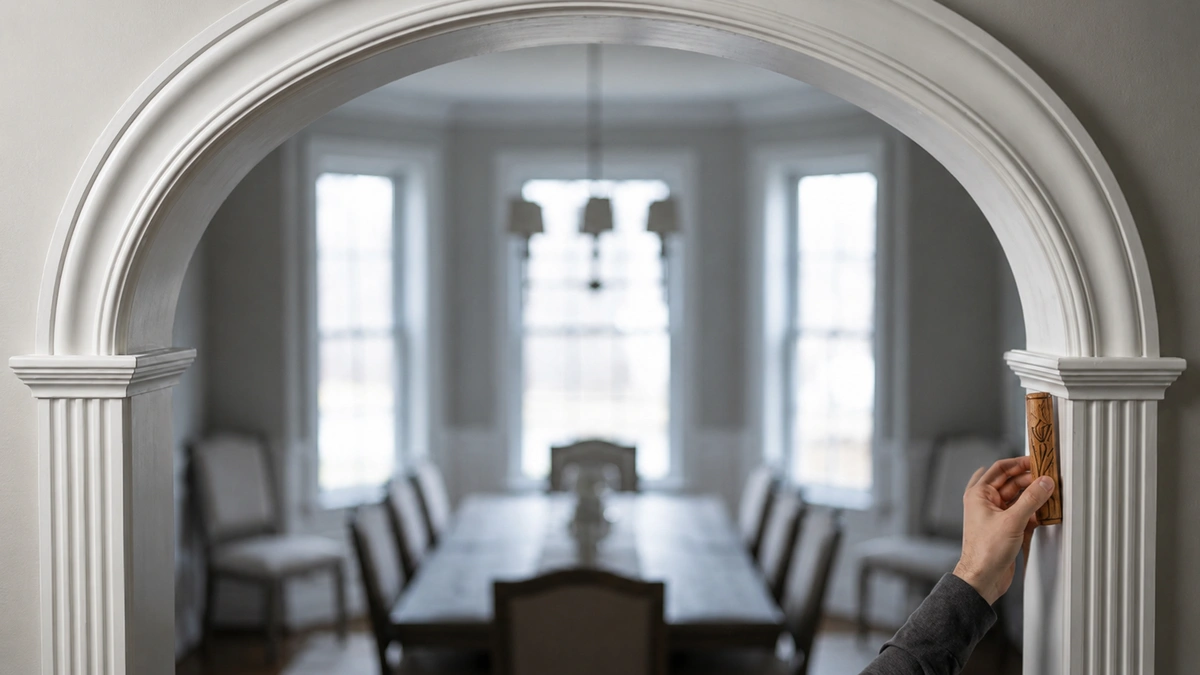
A purely decorative arch with no door and no entry function. If an arch was built only to beautify a room — a decorative frame around an opening in a wall between two connected spaces — and its design purpose is purely aesthetic, it is likely exempt. The ruling of the poskim is stated plainly: a doorway made for beauty or for structural strength alone does not require a mezuzah. One should still consult a rav before removing or withholding a mezuzah, because the facts on the ground matter greatly.
An arch or open passageway that is also used for regular entry. If the same arch is how you regularly walk from one room to another — even without a door — the halacha treats it differently. A doorless opening is still potentially obligated: the Shulchan Aruch (YD 286:15) rules that a house is obligated even when it has no doors, while citing a view that exempts. Because the Rambam holds that a house must have doors to be obligated, one affixes the mezuzah without a blessing in doorless openings. The Shach, Chayei Adam, and the Ben Ish Chai all share this concern. The arched shape itself does not exempt an opening: the Shulchan Aruch (Yoreh De'ah 287:2) rules that an arched opening is obligated when its straight doorposts are ten tefachim high.
A doorway built for two purposes — beauty and function. This is perhaps the most common real-life scenario. The porch entry has a decorative arch, but it is also the main way you enter from outside. Or a wide columned opening was designed to look elegant, but people walk through it constantly. The poskim rule that in a case of dual purpose, one should affix the mezuzah without a blessing. A rav should be consulted when the dual-purpose nature is unclear.
Structural pillars or columns on one side. When a building rests on pillars, and the space between the pillars serves as the entrance to the building, the Chazon Ish distinguishes based on whether those pillars feed into the building's living space or merely support the structure above. If the pillars define the entry into a dwelling space, the opening may be obligated. If they simply hold up a canopy or overhang with no enclosed space to enter, there is likely no obligation. Each case must be evaluated individually.
What if there is only one doorpost? The Rishonim dispute this. Rabbi Meir in the Gemara obligates a mezuzah even with one doorpost, but only when that single post is on the right side of entry. The Sages require two doorposts. The Shulchan Aruch (Yoreh De'ah 287:1) rules like the Sages: a doorway is only obligated in a mezuzah when it has two doorposts and a lintel. The Gemara (Menachot 34a) makes clear that even Rabbi Meir obligates only when the single doorpost stands to the right of one entering - a post on the left side alone does not obligate according to anyone. When only one doorpost exists, a rav should be consulted.
Common Mistakes to Avoid
Assuming that if a doorway looks like an entrance, it must require a mezuzah. That is not always true. A breakfast nook entry and a bedroom doorway may look identical, but halachically they may be treated very differently based on how and why the opening was built.
Assuming that if there is no door, there is no obligation. The primary halacha obligates even a doorless opening when it functions as a real entrance. Not hanging a mezuzah on an open, regularly used doorway simply because it has no door is an error that should be corrected.
Bypassing rabbinic guidance altogether. Decorative and structural doorways are among the more complex mezuzah cases in practical halacha. A brief conversation with a posek or halachic decisor can resolve years of uncertainty quickly and cleanly.
About Kosher Mezuzah
At Kosher Mezuzah, our mission is to make it possible for every Jewish home to fulfill this mitzvah fully and with confidence. Every scroll we carry is written by a vetted sofer and checked by a trained magiah, so that each scroll's halachic reliability can be responsibly relied upon under the guidance of competent rabbinic authorities. You can see the actual image of your scroll, know who wrote it, and verify that it meets halachic standards — because transparency is not an extra feature, it is the foundation of trust. Our entire process is endorsed by the Orthodox Union.
We understand that questions about decorative doorways, open arches, and structural openings come up in real homes all the time. Halacha does not always give a simple yes or no, and that is why we work alongside poskim and encourage our customers to consult their rav for edge cases. Our role is to make sure that when a doorway is obligated, the mezuzah you place there is genuinely kosher. If you have questions about a specific doorway in your home — decorative, structural, or otherwise — please reach out to us. We are here to help. When you are ready to place a scroll you can rely on, browse our mezuzah scrolls here.
Conclusion
A decorative doorway mezuzah obligation does not arise automatically from the presence of an arch or ornamental frame. The obligation depends on whether the opening was built to function as a place of entry and whether it has the proper tzurat hapetach — two doorposts and a lintel. Doorways built solely for beauty or structural support are generally exempt. Doorways built for dual purposes — beauty and function — should receive a mezuzah without a blessing. Any specific case involving an unusual or primarily decorative opening should be brought before a competent rav.


.svg)
Bring a true Kosher Mezuzah into your home
Fulfill the mitzvah with confidence, beauty, and meaning.
Buy a Mezuzah