


Do Renters Need a Mezuzah Right Away When Moving In?
Moving into a rental apartment raises a question that many people face but few stop to look up: when exactly does the obligation to affix a mezuzah begin? The answer depends on where you live, how long you plan to stay, and a halachic (Jewish legal) framework that goes back to the Gemara. Understanding this timing is not just a technical matter. It shapes how you prepare for your move, how you fulfill the mitzvah properly, and how you protect your home from day one. This article will answer the question of renter mezuzah timing clearly, so you can act with confidence.
Key Takeaways
- Outside of Eretz Yisrael, renters are exempt from the mezuzah obligation for the first 30 days when the length of the stay is not yet fixed; the recommended practice in that case is to affix it immediately without a blessing and recite the blessing after 30 days. If the lease is signed upfront for 30 days or more, the obligation and the blessing apply immediately.
- In Eretz Yisrael, the renter mezuzah obligation begins immediately upon moving in with no waiting period, reflecting the spiritual significance of settling the Land.
- The mezuzah obligation rests with the resident, not the landlord, making it the renter's responsibility to ensure proper affixing and compliance regardless of ownership.
- A kosher mezuzah must be handwritten by a qualified sofer on proper parchment and must be checked by a magiah—printed or decorative scrolls do not fulfill the mitzvah.
- When leaving a rental, renters cannot remove mezuzahs if the next tenant is Jewish; the incoming tenant should compensate for scrolls the previous renter purchased.
- Every room in a rental meeting halachic requirements (four amot by four amot with a proper doorway) requires its own mezuzah, just as it would in an owned home.
Do Renters Need a Mezuzah Right Away When Moving In?
Renter mezuzah timing depends on one key factor: where you are renting. Outside of Eretz Yisrael (the Land of Israel), a renter is exempt from the obligation of mezuzah for the first 30 days. After 30 days, the obligation applies fully. In Eretz Yisrael, however, a renter is obligated to affix a mezuzah immediately upon moving in, with no waiting period at all. If you are unsure how this applies to your specific situation, reach out to us and we can help you navigate the details. We cover this in more depth in Mezuzah in Exile. Related reading: Each Mezuzah Is Its Own World.
The Halachic Basis: Why Is There a 30-Day Rule?
The source for this distinction is the Gemara in Menachot (44a), which states that one who stays in an inn in Eretz Yisrael, or who rents a house outside of Eretz Yisrael, is exempt from mezuzah for 30 days. The reasoning is rooted in the nature of the obligation itself. The Gemara in Bava Metzia (101b) establishes clearly that the mezuzah is "Chovat HaDar", the obligation of the resident, not the landlord. This means the person who lives in the space carries the mitzvah, regardless of whether they own it.
The exemption for the first 30 days in the Diaspora reflects the halachic category of "dirat arai", temporary dwelling. A dwelling that one has not yet committed to for a full month is not yet considered a permanent residence in the full halachic sense. Most Rishonim (early halachic authorities), including Rambam, Rashi, and Tosafot, hold that a renter's obligation is Rabbinic in nature, since the resident does not own the property. However, some prominent later authorities, most notably the Shaagat Aryeh, argue that after 30 days, the obligation rises to the level of Torah law. The practical outcome is the same: after 30 days outside of Eretz Yisrael, a renter is fully obligated, and a mezuzah must be affixed.
In Eretz Yisrael, the immediate obligation reflects the mitzvah of Yishuv Eretz Yisrael, settling the Land. As the Arukh HaShulchan (Yoreh Deah 286:49) explains, the enactment was designed so that a renter, once obligated to affix a mezuzah, would be reluctant to end the lease and leave the Land, since a mezuzah may not be removed from a home where the next Jewish tenant will live. This reinforces the sanctity of dwelling in Eretz Yisrael itself.
How This Plays Out in Practice
For renters outside of Eretz Yisrael, the 30-day rule applies when the length of the stay is not yet fixed for 30 days or more. In that case, you are not technically required to affix a mezuzah on the first night, though many contemporary poskim recommend affixing the mezuzah immediately, or as soon as possible, even without a berachah (blessing), and reciting the berachah once the 30 days pass. If, however, the lease is signed upfront for 30 days or longer, the Arukh HaShulchan (Yoreh Deah 286:49) rules that the obligation is immediate, and the mezuzah should be affixed with a berachah right away, with no waiting period.
For renters in Eretz Yisrael, there is no delay. The mezuzah goes up on the doorposts as soon as you move in, and a berachah is recited at that time.
Every room in a rented apartment that meets the halachic requirements, four amot by four amot (Shulchan Aruch Yoreh Deah 286:13), with a proper doorway, requires its own mezuzah, just as it would in an owned home. Our article on mezuzah when moving walks through which doorways in a typical home require a mezuzah and how to do a proper walk-through before moving day.
One important practical note: the Shulchan Aruch (Yoreh Deah 291:2) rules that when a renter leaves, he may not take the mezuzahs with him if the next tenant is Jewish. The Gemara in Bava Metzia (102a) states that removing a mezuzah from a Jewish home is dangerous and can bring bad fortune. If the renter paid for the mezuzahs, the incoming tenant is expected to compensate him. This means you should plan from the beginning to leave your mezuzahs in place when you move out, and budget accordingly.
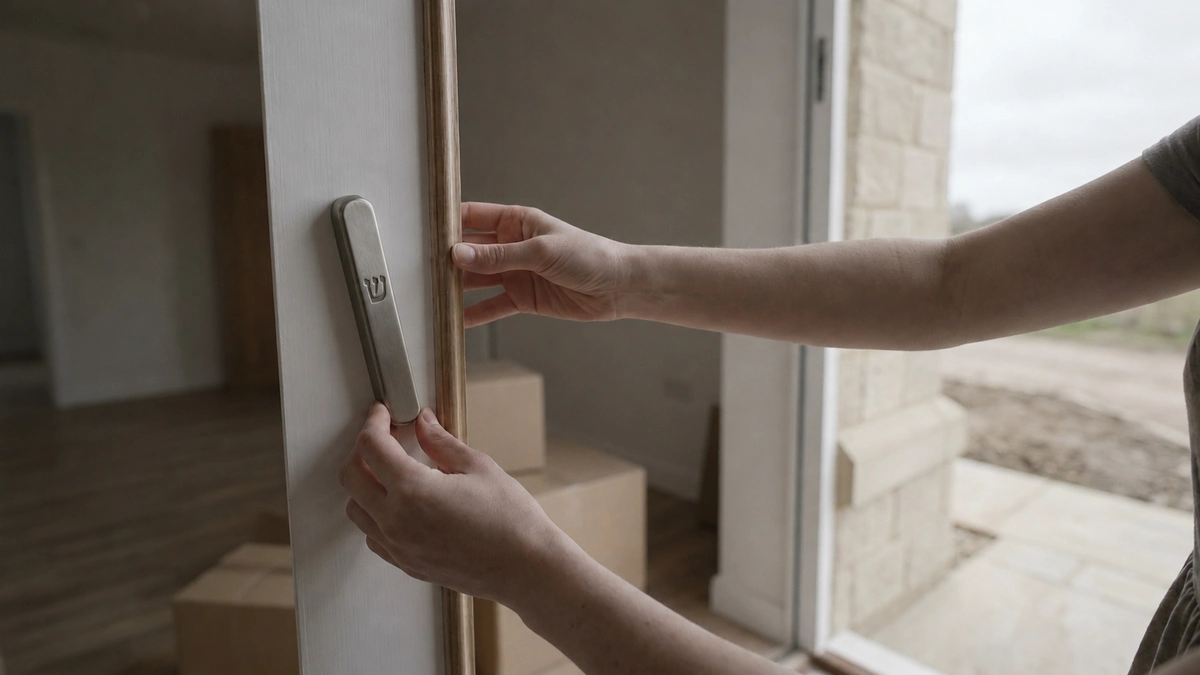
Do not wait for a "housewarming" celebration to affix your mezuzahs. The sources are clear: the mitzvah should be fulfilled upon moving in, not at a later gathering. If you need guidance on mezuzah when moving into a new space, we have detailed resources to help.
A Word About What Goes on Your Doorpost
The 30-day rule and the obligation to affix immediately are only meaningful if the mezuzah being affixed is actually kosher. A mezuzah scroll must be handwritten by a qualified sofer (scribe) on klaf (parchment) with dio (halachically approved ink), following all the laws of STaM, the written tradition governing Torah scrolls, tefillin, and mezuzot. A printed scroll, a decorative insert, or a souvenir mezuzah does not fulfill the mitzvah at all, regardless of when it is hung. The halachic writing laws that govern a kosher mezuzah are not optional details: they are the foundation of the mitzvah itself.
If you are buying mezuzahs for a new rental, this is not the place to cut corners. The mezuzah is the declaration of Hashem's sovereignty over your home. It must be kosher to do its job, spiritually and halachically. Be cautious about souvenir mezuzah scrolls that appear decorative but are not written to halachic standards.
Common Mistakes Renters Make
The most frequent mistake is assuming the landlord has already taken care of the mezuzah. The Gemara is explicit: the mezuzah is the renter's obligation, not the landlord's. Even if mezuzahs are present in the apartment from a previous tenant, they may not be kosher, they may not have been checked recently, they may have been written to a lower standard, or they may not have been properly affixed. A magiah (halachic mezuzah examiner) should check any mezuzah you did not purchase yourself before you rely on it.
A second mistake is delaying the entire obligation because of the 30-day rule. If the lease length is not yet fixed, the preferred practice is to affix immediately, even without a berachah, and then recite the blessing once 30 days pass. But if the lease was signed for 30 days or more from the start, the obligation and the blessing apply right away, with no delay. Waiting a full month before doing anything at all is not the recommended approach.
A third mistake involves rooms that are not yet in use. If certain rooms are closed off and not yet being used for any purpose, they are not yet obligated. Lock them until you begin using them. Once you begin storing items or sleeping in a room, it becomes obligated. For guidance on what happens when a room's function changes, see our article on changing room use.
The Deeper Meaning of Mezuzah in a Rental
There is something worth pausing on here. The Gemara's framing, that the mezuzah is the obligation of the resident, not the owner, carries real meaning. It is not the walls or the deed that make a space into a Jewish home. It is the presence of the person who lives there, and the presence of Hashem's words on the doorpost. The Tur writes that even though the mezuzah brings protection (shemira) to the home, the kavanah (intention) of the person affixing it should be solely to fulfill the command of Hashem. The protection follows: the mitzvah comes first.
Whether you are renting for a year or for a decade, your home is a Jewish home. The mezuzah is not a landlord's decoration. It is your declaration.
Key Takeaway
Renter mezuzah timing follows a clear rule: outside of Eretz Yisrael, there is a 30-day waiting period before the full obligation applies only when the lease length is not yet fixed; the recommended practice in that case is to affix the mezuzah immediately without a berachah and then recite the blessing after 30 days. If the lease is signed for 30 days or more upfront, the obligation and the blessing apply immediately. In Eretz Yisrael, the obligation begins the moment you move in. Every room in the rental that meets halachic requirements needs its own mezuzah. When you leave, the mezuzahs must remain for the next Jewish tenant. And none of this means anything if the mezuzah scroll itself is not kosher.
Fulfilling the Mitzvah with Confidence: A Note on Kosher Mezuzah
At Kosher Mezuzah, every scroll we offer is handwritten by a qualified sofer on kosher klaf, checked by a trained magiah (halachic mezuzah examiner), and produced under a process endorsed by the Orthodox Union. We do not sell printed scrolls or decorative inserts. When you place a mezuzah from us on your doorpost, you can be confident that the scroll is valid and that you are fulfilling the mitzvah properly.
We understand that renters face unique questions, about timing, about which doorways are obligated, about what to do when moving out. Our mezuzah FAQ addresses many of these questions directly, and our team is always available to assist. Whether you are buying your first mezuzah or re-examining scrolls you have had for years, halachic reliability matters.
If you are looking for a meaningful housewarming mezuzah gift for someone moving into a new rental, the same standard applies, the greatest gift is a mezuzah that is genuinely kosher.
If you have questions about your specific rental situation, please contact us and we will be glad to assist you in fulfilling the mitzvah with care.
Yehi ratzon she'tishrei Shechinah b'veitecha, May it be Hashem's will that His Presence rest in your home.



.svg)
Bring a true Kosher Mezuzah into your home
Fulfill the mitzvah with confidence, beauty, and meaning.
Buy a Mezuzah