

Does a Mezuzah Protect You? What Halacha Actually Teaches
Many people want a clear answer to a practical question: does mezuzah protect? Jewish sources do speak about mezuzah in terms of guarding and protection, but halacha presents that idea with important boundaries. A mezuzah is not a charm that works automatically. It is a mitzvah, and the way Torah sources describe its protective role is tied to proper halachic fulfillment. See also Fake Mezuzah Scroll. See also Mezuzah in Times of Crisis.
The more accurate Torah answer is both reassuring and careful: a mezuzah is a mitzvah, and the sources describe a real dimension of divine guarding connected to that mitzvah. But the mezuzah protection meaning in halacha is not superstition. It is tied to a kosher scroll, proper placement, and a person’s faithful fulfillment of Hashem’s command. Related reading: Mezuzah Anxiety and Trust in Mitzvot.
More broadly, mezuzah can be understood within a larger Torah view of mitzvot and the human person. Chazal teach that the 248 positive mitzvot correspond to a person’s limbs, and the 365 prohibitions correspond to the body’s sinews. Later Torah literature develops this idea further, explaining that mitzvot are not external rituals alone, but acts that shape and sustain the whole person. In that sense, the protective quality associated with mezuzah belongs to a wider Torah pattern: mitzvot attach a person to Hashem and bring spiritual benefit to the life of the one who performs them properly.
Does Mezuzah Protect Automatically? What Halacha Says
So, does mezuzah protect automatically? Classical sources say that mezuzah is associated with guarding, but not in the sense of an object that works on its own regardless of how it was written, placed, or understood.
The Talmud in Menachot teaches that the mezuzah is placed in the outer handbreadth of the doorway so that it protects the house. In Avodah Zarah, Onkelos explains that unlike a human king, who sits inside while servants guard him from the outside, the Holy One guards His servants while they dwell within. The Tur also writes that the house is guarded through the mezuzah, which is why it is placed so that the whole house is within its guarding.
That is strong language, and it should be taken seriously. Still, halacha never describes mezuzah as a mechanical device. The protection spoken of by Chazal is part of the mitzvah, not separate from it. A mezuzah that is invalid, carelessly placed, or treated like a lucky object is not what these sources are describing. The halachic discussion begins with obedience, not with folklore.
Is Mezuzah a Segulah? Understanding Mezuzah Protection Meaning
Many people ask, is mezuzah a segulah? In everyday Jewish language, people often use that word to describe actions or mitzvot associated with blessing and protection. But if the term is used here, it needs to be explained carefully.
The safest halachic way to say it is this: mezuzah is first and foremost a mitzvah. Because it is a mitzvah, and because Chazal and later halachic sources describe it in terms of guarding, people sometimes refer to it as a segulah. But that does not mean it is a magical object, nor does it mean that the outer case itself has independent power.
Rambam speaks very sharply against turning mezuzah into an amulet for personal benefit. His concern is not with denying that mezuzah is protective. Rather, his concern is with reducing a holy commandment that expresses God’s unity, love, and service into a kind of spiritual gadget. That distinction matters. The real mezuzah protection meaning is not that a person hangs an object and expects results. It is that Hashem gave a mitzvah for the doorway, and Torah sources associate that mitzvah with divine guarding. For a related question, see The Spiritual Meaning of the Mezuzah.
Mezuzah Spiritual Protection Halacha: The Core Sources
When people hear the phrase mezuzah spiritual protection halacha, they often think only in terms of danger coming from outside the home. But Rambam describes another kind of protection: protection from forgetfulness, spiritual sleep, and sin. The mezuzah protects by placing awareness of Hashem at the threshold of daily life. A person passes it again and again, and the home itself becomes a setting for remembrance, restraint, and yirat Shamayim.
When Mezuzah Protects: Mezuzah Protection Conditions
If someone asks when mezuzah protects, halacha points first to the actual fulfillment of the mitzvah. This is where the mezuzah protection conditions become essential.
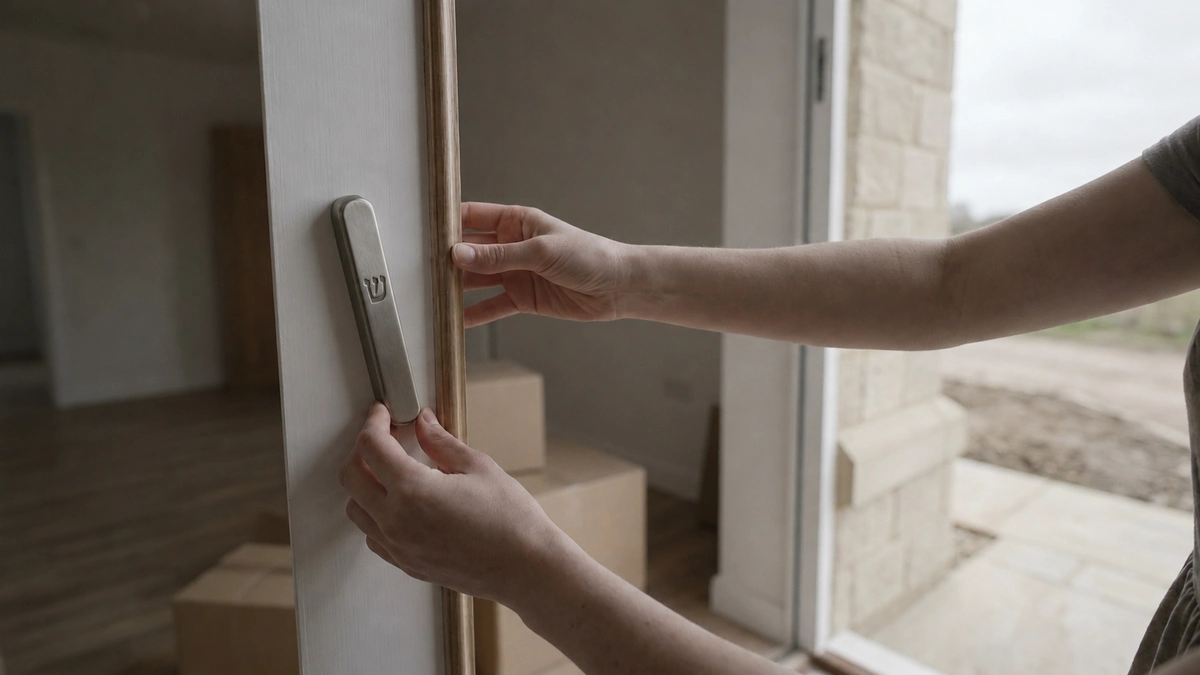
A mezuzah must contain a kosher scroll. The text must be written correctly, by someone qualified to write stam, on proper parchment, with proper ink, and according to halachic requirements. It must be affixed on a doorway that is actually obligated in mezuzah, and it must be placed in the correct location and position on the doorpost.
These are not side details. They are the halachic substance of the mitzvah. If the scroll is invalid, if letters are cracked or missing, if the mezuzah is not placed correctly, then the person may have an object on the doorpost, but not a properly fulfilled mitzvah. And when the sources speak about guarding, they are speaking about mezuzah within the framework of halacha.
Halacha also requires maintenance. The Shulchan Aruch rules that a private mezuzah should be checked twice in seven years. That alone shows that mezuzah is not treated as a one-time act with permanent automatic effect. It must remain kosher. It must continue to be what the Torah and halacha require it to be.
So if the question is when mezuzah protects, the responsible answer is: when the mitzvah is fulfilled properly, when the mezuzah is kosher, and when it is treated as a mitzvah rather than as superstition.
The Deeper Mezuzah Protection Meaning
The deepest mezuzah protection meaning is not only about external safety. It is also about the spiritual life that the mezuzah creates inside the home and inside the person.
Rambam writes that when a person encounters the mezuzah on entering and leaving, he remembers God’s unity and wakes up from his involvement in temporary matters. That is one of the most powerful explanations of the mitzvah. The mezuzah is not only a sign on the doorway; it is a repeated call to return to what is true and lasting.
This means that mezuzah protects in more than one sense. It is connected in the sources to divine guarding over the home. But it also protects the inner world of the Jew by constantly interrupting forgetfulness. It reminds a person that the home is not merely a shelter, but a place shaped by Torah, by covenant, and by awareness of Hashem.
In this light, the mezuzah’s spiritual protection includes both guarding and remembrance. The mezuzah protects not only because the sources speak of God as guarding the home, but because it trains those who live there to move through life with greater faithfulness and spiritual clarity.
Key Takeaway: Does Mezuzah Protect?
Yes, the sources do describe mezuzah as connected to guarding and protection. That part should not be erased or explained away. But the fuller halachic answer is more careful than a simple slogan.
If the question is does mezuzah protect, the answer is that divine guarding is associated in the sources with the mitzvah of mezuzah. If the question is mezuzah a segulah, the answer is that one must speak carefully and never reduce mezuzah to a charm. And if the question is when mezuzah protects, the answer is tied to the real mezuzah protection conditions of halacha: a kosher scroll, proper placement, regular checking, and a sincere approach to the mitzvah.
That is the balanced Torah view. Mezuzah is not empty symbolism, and it is not superstition. It is a sacred commandment placed on the doorway of Jewish life, carrying both remembrance and guarding. When approached with care, reverence, and halachic integrity, it becomes what the Torah intended: a holy sign on the home, and a constant reminder that Jewish life stands under the presence and care of Hashem.
About Kosher Mezuzah
At Kosher Mezuzah, every scroll we provide has been written by a vetted sofer (scribe) and checked by a qualified magiah (halachic examiner). Our process is OU endorsed providing an additional layer of accountability. We believe that genuine fulfillment of this mitzvah requires knowing exactly what is on your doorpost, who wrote it, who checked it, and whether it meets the halachic standard our sources describe. Our frequently asked questions address the most common concerns about purchasing and maintaining a kosher mezuzah.
If you have a mezuzah that has never been checked, or if you are unsure whether the scrolls in your home are genuinely kosher, we encourage you to consult a rav and have them examined. A mezuzah cannot protect what it cannot halachically fulfill. We are here to help you take that step, not as a commercial transaction, but as a partnership in the proper fulfillment of a mitzvah that our tradition holds very dear. You can also find stories and insights about the mezuzah that deepen appreciation for this precious mitzvah.
If you have any questions about your mezuzot or would like guidance on ensuring they are halachically valid, contact us directly, we are honored to help you fulfill this mitzvah with the clarity and confidence it deserves. Yehi ratzon milfanei Avinu shebashamayim sheyishmor aleinu uval bateinu b'zechus mitzvat mezuzah, may it be the will of our Father in Heaven to guard over us and our homes in the merit of the mitzvah of mezuzah.


.svg)
Bring a true Kosher Mezuzah into your home
Fulfill the mitzvah with confidence, beauty, and meaning.
Buy a Mezuzah