

Is Putting Up a Mezuzah a Personal or Communal Responsibility?
The question of mezuzah responsibility is one of the most practical issues in Jewish law, and also one of the easiest to misunderstand. When a Jewish family moves into a home, who is responsible for mezuzah? Does the obligation rest on one individual, on the household as a whole, or on some wider communal body? And when the entrance is shared — such as in an apartment building, courtyard, or multi-family property — who is responsible for making sure the mitzvah is actually fulfilled?
These are not abstract questions. They come up every time someone moves into a new apartment, rents a house, shares a home with roommates, or uses a common entrance that serves multiple Jewish residents. In each of these situations, mezuzah responsibility halacha depends on how Jewish law defines the connection between the resident, the dwelling, and the doorway. Once that framework is clear, the practical rulings become far easier to understand.
Mezuzah Responsibility Halacha: The Basic Rule
The central rule is that mezuzah responsibility is tied to dwelling in the home. In halachic terms, the obligation is connected to the person or household living in the space, rather than to the building in the abstract. That means the people who actually reside in the home are the ones who must make sure a kosher mezuzah is affixed where required.
This is why mezuzah is discussed as a mitzvah of residence. A doorway is not obligated simply because it exists as part of a structure. It becomes relevant because it serves as the entrance to a Jewish living space. In practical terms, if you live in a home that requires a mezuzah, the mitzvah is yours to fulfill. You cannot assume that the landlord, a previous tenant, or some undefined “community” has already taken care of your obligation for you.
Who Is Responsible for Mezuzah According to the Sources?
The Torah commands, “You shall write them on the doorposts of your house and on your gates.” That language already points toward the home as a lived space. The Rambam makes the principle explicit by stating that mezuzah is an obligation of the inhabitant. This is the clearest foundation for answering who is responsible for mezuzah in ordinary cases.
The Talmud adds another important point: women are included in the mitzvah as well. In Kiddushin 34a, the Gemara rejects the idea that women should be exempt and explains that the verse promises long life, which obviously applies to women no less than to men. So the obligation is not limited to a male homeowner or head of household. Mezuzah responsibility belongs to the Jewish residents of the dwelling.
That helps clarify the larger question of mezuzah obligation individual vs community. The starting point is not an institution and not a public board. The starting point is the dwelling and the people who live there.
Mezuzah Obligation Individual vs Community in a Private Home
In a private home, the answer is straightforward. If one person lives alone in a house or apartment, that person is responsible for ensuring that every doorway that requires a mezuzah has one properly affixed. If a family lives there, the obligation belongs to the household living in the space. In either case, mezuzah responsibility is personal in the sense that it follows the residents.
This does not mean that every family member must separately perform the act. One mezuzah is affixed for the doorway, not one per person. But it does mean that the residents cannot shift the duty elsewhere. If they are the ones dwelling there, they are the ones responsible to make sure the mitzvah is fulfilled.
Shared Obligation Mezuzah in a Family or Roommate Setting
The issue becomes a little more nuanced when several people share one home. In that setting, there is a real shared obligation mezuzah question: if multiple Jewish residents use the same dwelling, how is the mitzvah assigned?
The practical answer is that the obligation belongs to the household that lives there. If one resident properly affixes the mezuzah for the home, that act can fulfill the need of the shared household. But no one should conclude from that that the others have no concern at all. As long as they live in the dwelling, they share responsibility for seeing that the home is not left without the required mezuzot.
So the duty is shared in practice, even though the act itself does not need to be repeated by every person in the home. This is an important distinction, and it helps avoid two opposite mistakes: assuming every resident must do the mitzvah separately, or assuming no resident needs to worry because someone else will probably handle it.
You can explore the full framework of who the obligation falls on in our dedicated guide on this topic.
Communal Mitzvah Mezuzah and Shared Entrances
Shared entrances create the strongest version of the mezuzah obligation individual vs community question. What about the lobby door of a building, a courtyard gate, or another entrance used by multiple residents? Here the halachic sources teach that some shared entrances can indeed require a mezuzah.
The Talmud and Rambam discuss gates of courtyards, alleyways, towns, and similar openings, and explain that they can be obligated because they serve homes that are themselves obligated in mezuzah. That is the proper way to understand communal mitzvah mezuzah. It does not mean that the community as an abstract entity carries a totally separate mitzvah detached from individual homes. Rather, it means that a shared entrance may require a mezuzah because it functions as the gateway to the homes of Jewish residents. Questions about mezuzah and roommate situations can become complicated, and consulting a rav for your specific case is always advisable. Questions about shared apartment mezuzah responsibility deserve careful halachic attention, particularly in buildings with mixed Jewish and non-Jewish residents.
Who Is Responsible for Mezuzah in a Rental?
One of the clearest applications of mezuzah responsibility halacha is the case of a renter. Jewish law places the obligation on the tenant, not on the landlord who owns the property but does not live there. The Talmud states that the renter must prepare and affix the mezuzah, and later halachic rulings preserve that rule.
This matters because many people assume ownership automatically determines responsibility. In mezuzah law, that is not generally the case. The decisive factor is dwelling. Since the renter is the one living in the house or apartment, the renter is the one who must ensure that the mitzvah is fulfilled.
That also explains why renter questions are often so common in practice. The person moving in may feel temporary, but once the rental is a real dwelling, the issue is no longer theoretical. The obligation is tied to the lived reality of the space.
Common Mistakes About Mezuzah Responsibility
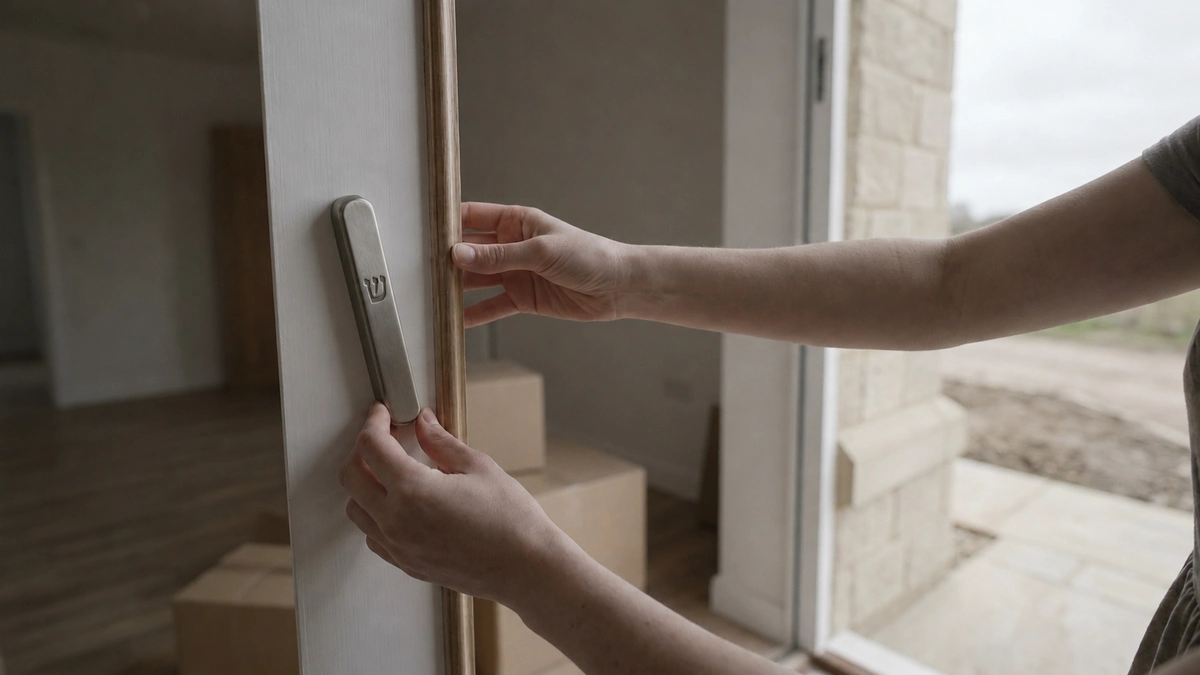
A common mistake is assuming that if a mezuzah case is already on the door, the obligation has automatically been handled. In reality, the resident still needs to know whether the mezuzah inside is kosher and whether it is appropriate for that doorway. A mezuzah case by itself is not enough.
Another mistake is assuming that all shared spaces are exempt. Some are exempt, but some are obligated, especially when they function as entrances to Jewish dwellings. This is exactly why shared building cases often need careful attention.
Another common error is delay. Because the mezuzah obligation is renewed every moment a home lacks one, procrastination is not a neutral act. For as long as a doorway lacks a mezuzah, the mitzvah remains unfulfilled during that entire time.
A third mistake is treating the issue too simply by asking whether mezuzah is personal or communal and stopping there. The more precise question is not which slogan fits best. The better question is: who lives here, what doorway is being used, and how does this entrance function in relation to the dwelling? Once that is answered, the halachic picture usually becomes much clearer.
Why Mezuzah Responsibility Still Matters So Much
This discussion matters because a mezuzah is not just a symbol placed on a doorway for decoration or custom, it’s a real mitzvah that marks the home as a place shaped by Torah. The Rambam also explains that mezuzah serves as a reminder when a person enters and leaves the house. That gives the mitzvah a deeply personal dimension even in cases where the doorway itself is shared.
The obligation follows Jewish dwelling because the home itself is meant to be a place where awareness of Hashem is carried into ordinary daily life. That is why the question of who is responsible for mezuzah is not merely technical. It touches the way a Jewish home is defined.
The Practical Bottom Line on Mezuzah Obligation Individual vs Community
So who is responsible for mezuzah? In an ordinary private dwelling, the resident or household is responsible. In a rental, the renter is responsible. In a shared home, the people who live there must ensure that mezuzot are properly in place. And in a shared entrance or building gate, the obligation may apply because that entrance serves Jewish homes, even if one person handles the installation on behalf of the group.
That is the most accurate way to frame mezuzah obligation individual vs community. The obligation is rooted in the dwelling and in the people who live there, but some entrances are shared and therefore involve shared practical responsibility. So the right answer is not purely “individual” or purely “communal.” It is that mezuzah responsibility follows Jewish residence, and the practical duty must be carried out wherever that residence is expressed through the doorway.
In more unusual cases — especially mixed-ownership properties, buildings with Jewish and non-Jewish residents, uncertain layouts, or shared structures with unusual access patterns — the details should be reviewed with a competent rabbi. But for most readers, the rule is clear: if you live in the home, you must make sure the mezuzah obligation is not left undone.
How Kosher Mezuzah Helps You Fulfill This Mitzvah With Confidence
At Kosher Mezuzah, we understand that the obligation is personal, which means the responsibility of ensuring your mezuzah is truly kosher is also personal. Every scroll we provide is handwritten by a vetted sofer (Torah scribe) and reviewed by a qualified magiah (halachic mezuzah examiner). Our process is endorsed by the Orthodox Union, and we provide clear documentation of who wrote each scroll, who checked it, and what materials were used, so you can fulfill the mitzvah with genuine confidence, not just assumption.
If you are uncertain about which doorways in your home require a mezuzah, or you have questions about who must put up a mezuzah in your specific situation, we are here to help you work through it with halachic clarity and without pressure. The mitzvah of mezuzah is precious, and we want to help you fulfill it as it deserves to be fulfilled.
Reach out to us with any questions about your home's mezuzot, we are glad to help ensure that every doorpost in your home fulfills this mitzvah properly. May the zechus (merit) of the mezuzah bring shemirah (protection) and berachah (blessing) to your home and all who dwell within it.



.svg)
Bring a true Kosher Mezuzah into your home
Fulfill the mitzvah with confidence, beauty, and meaning.
Buy a Mezuzah