

Handwritten Mezuzah: What Every Buyer Must Understand Before Purchasing
The handwritten mezuzah is not a preference or a custom of the more meticulous — it is a fundamental halachic requirement, and without it, no mitzvah has been fulfilled at all.
Whether a homeowner is purchasing a mezuzah for the first time or replacing scrolls that have hung for years, this question must be answered honestly: is this scroll a genuine handwritten mezuzah?
Kosher Mezuzah is dedicated to ensuring the fulfillment of the mitzvah of mezuzah with authenticity, and that begins with understanding what the Torah itself requires. If you are ready to fulfill this mitzvah properly, you are welcome to browse our OU Endorsed, handwritten mezuzah scrolls and find the right scroll for your home.
Key Takeaways
- A handwritten mezuzah is not optional — it is a fundamental halachic requirement rooted in Torah law, and a printed mezuzah or photocopied scroll fulfills no mitzvah whatsoever
- The classic halachic codes require a mezuzah to be handwritten by a qualified sofer on kosher parchment (klaf), with proper ink, and written lishmah (for the sake of the mitzvah). These requirements are drawn from the broader laws of writing Sifrei Torah, tefillin, and mezuzot in the Shulchan Aruch (Yoreh De’ah 271, 285, 288) and from the Rambam’s Hilchot Tefillin uMezuzah
- The sofer (scribe) writing the mezuzah must be a fully qualified, Torah-observant Jew — his credentials, kavvanah, and yiras Shamayim directly determine whether the scroll is halachically valid
- Every handwritten mezuzah scroll should be checked by a trained magiah (proofreader) to confirm that each letter meets the precise halachic form required, and today it is best to buy only scrolls that come with reliable documentation from a recognized certifying authority
- Mezuzahs must be inspected periodically — typically twice every seven years — since ink can crack over time and render a once valid scroll pasul
- The mitzvah of handwritten kosher mezuzah transforms the threshold of a Jewish home into a place of kedushah, an outcome that no mechanical reproduction or printed mezuzah can ever achieve
Why Mezuzah Scrolls Must Be Handwritten
A printed mezuzah scroll is halachically invalid. This is not a chumra (stringency) adopted by a particular community. It is the ruling of the Shulchan Aruch, the foundational code of Jewish law that governs observance for all Torah-observant Jews. A mezuzah that was typeset, printed, or photocopied, no matter how beautiful its letters appear, has not fulfilled the mitzvah of mezuzah. The home in which it hangs remains, in halachic terms, without a valid mezuzah.
The Halachic Source for a Handwritten Mezuzah
The Torah commands us in Parshas Va'eschanan and Parshas Eikev to write certain portions on the Shmah on the doorposts of our homes. The Gemara in Maseches Menachos (32b) derives through a gezeirah shavah (verbal analogy) that the word "kesivah" (writing) in the context of mezuzah carries the same meaning as it does in the context of a get (bill of divorce) and a Sefer Torah. Just as a Sefer Torah must be written by the hand of a qualified sofer scribed with proper intention and ink on parchment, so too must a mezuzah scroll.
The Shulchan Aruch codifies these requirements by applying the laws of writing Sifrei Torah and tefillin to mezuzah: the parshiyos must be written by hand, with proper ink, on klaf taken from a kosher animal and prepared and written lishmah. The detailed rules appear primarily in Yoreh De’ah 271 for Sifrei Torah, and in 285 and 288 for mezuzah itself, which together establish the standard for a kosher mezuzah scroll. The Rambam, in Hilchot Mezuzah within the section on Tefillin, Mezuzah, and Sefer Torah, likewise treats mezuzah as a written sefer with strict requirements for its form and writing. While there is broad agreement that a mezuzah must be handwritten on kosher klaf with proper ink and lishmah, the Rishonim and Acharonim do debate certain details—for example, how far the requirement of klaf lishmah extends and in which cases more lenient views may be relied on b’di’avad.
The Gemara in Menachos (32b) also rules that a mezuzah requires sirtut—scored lines serving as a guide for the writing. The Tur and later poskim discuss how this requirement is applied in practice and how strictly it is treated. All agree that a mezuzah should not be written without proper sirtut, and Pischei Teshuvah cites R. Akiva Eiger stressing the importance of this requirement. However, the precise status of a mezuzah that has already been written without sirtut in every possible case is the subject of halachic discussion, and one should consult a competent rav for rulings on doubtful or situations. What is clear is that sirtut is a serious halachic standard, not a mere aesthetic preference.
Beyond the requirement of ruling, the Gemara and later authorities establish that the parchment must be prepared lishmah, for the sake of the mitzvah. The Rosh holds this as a biblical standard (d'oraisa) and the Rambam concurs. While the Shulchan Aruch follows the lenient view of the Rambam in cases of urgent need, the lechatchilah (ideal) standard is that every stage of the mezuzah's creation, from the preparation of the klaf to the final letter of the text, must be performed with the proper intention of fulfilling the Divine command. A printed scroll, lacking the act of genuine kesivah, cannot take on this status.
The Mechaber (following the Rambam) notes that when one fulfills mezuzah properly, the doorway itself becomes a constant encounter with the verses of Shema – including ‘Ve’ahavta’. Each time a person passes, he is reminded of Hashem’s unity, so the mitzvah functions like a standing mention of that at the entrance to his home.
Practical Application: What Kosher Requires in Practice
When purchasing a handwritten mezuzah, there are several practical factors that every buyer must understand. First, the sofer (scribe) must be a fully qualified, Torah-observant Jew who writes with yiras Shamayim (fear of Heaven) and the proper kavvanah (intention); a mezuzah written by someone who is halachically disqualified is invalid. Because the halachic status of the scroll depends so much on the sofer’s integrity and knowledge, provenance and reliable certification are extremely important in practice.
Second, the scroll must conform to the rules of tzurat ha’ot (the proper form of each letter). Every letter in the Torah has a precise halachic form, and a letter that deviates from that can render the entire mezuzah pasul. For this reason, it is standard and strongly advisable for a trained magiah (proofreader) to examine the scroll after writing, not only to catch spelling errors, but to verify that every letter is halachically complete.
Third, the materials matter. The klaf must be made from the skin of a kosher animal and prepared according to halachic standards. These are not merely context-specific requirements or matters of aesthetics concerns. They are halachic conditions without which the scroll is pasul regardless of how carefully the letters were formed.
When selecting a scroll, a buyer should look for documentation that identifies the sofer by name, confirms the date of writing, specifies the materials used, and includes a oversight from a recognized halachic authority. The Orthodox Union mezuzah certification, one of the most trusted Torah-standards certification bodies in the world, provides oversight for products that meet rigorous halachic requirements. At Kosher Mezuzah, each scroll we provide carries OU endorsement and is accompanied by this level of verified documentation, because we believe every family is entitled to know what they are purchasing and affixing.
Whether you follow Ashkenaz Beis Yosef script, the Arizal script, or Sefardic script, the requirement of handwritten kesivah is identical across all valid customs. For a fuller explanation of what distinguishes these traditions from each other while sharing the same foundational requirements, see our guide on the differences between Ashkenaz, Sefardi, and Arizal mezuzah scrolls.
If you would like guidance on selecting the right handwritten scroll for your home, our team is available to assist. You are welcome to reach out through our contact form and we will help you find a scroll that meets both your minhag and the highest halachic standards.
Common Mistakes: What Buyers Must Know
One of the most serious and widespread problems in the marketplace today is the sale of printed scrolls that are marketed as fulfilling the mitzvah of mezuzah with authenticity. These scrolls may be attractively designed, housed in elegant cases, and sold at prices that make them appear legitimate. Yet they are halachically worthless. A home with only a printed mezuzah on its doorpost has no mezuzah at all, and the mitzvah has not been fulfilled for a single moment.
A related mistake is assuming that a low-cost scroll is still valid as long as it "looks handwritten." Some commercially sold scrolls are produced by a process that mimics handwriting but is in fact a mechanical reproduction. Without proper documentation from a vetted sofer and a recognized certifying body, a buyer cannot determine validity from appearance alone. The clarity and beauty of the writing may draw notice, but you can learn more about why clear and precise writing is essential to mezuzah authenticity. Visual quality alone does not confirm that the scroll was written by hand.
Another error is purchasing a mezuzah without verifying the sofer's credentials. The integrity of the sofer is inseparable from the validity of the scroll. A sofer who lacks proper training, or who did not write with the appropriate yiras Shamayim (fear of G-d), introduces serious questions about the scroll that cannot be resolved after the fact. This is why Kosher Mezuzah ensures each mezuzah scroll meets the highest halachic standards by sourcing only from verified, named sofrim whose work has been independently checked by a qualified magiah.
It is also a mistake to purchase a mezuzah once and assume it will remain valid indefinitely without checking. Ink can crack and letters can deteriorate over time. The halacha requires periodic checking of mezuzahs, typically twice in seven years under ordinary conditions, and more frequently in environments with heat, moisture, or heavy use.
The Kedushah of Handwritten Kesivah
The requirement that a mezuzah be handwritten is not a technicality. It reflects the nature of the mitzvah itself. As noted above, the Sages teach that the mezuzah scroll does not merely hang beside the doorpost. It becomes the doorpost. The parchment and its writing, when joined to the entrance with proper kavvanah, transforms the threshold of a Jewish home into a place of kedushah (holiness). This transformation can only occur when the text has been written by a human hand, guided by kavvanah, in fulfillment of the Divine command.
The mezuzah is, as the Sages of the Talmud understood it, a form of Krias Shema (the recitation of the Shema) fixed upon the home. Rather than the verbal recitation of Shema, in which a person publicly declares Hashem's Oneness through speech, the sofer makes the writing of the mezuzah an act of deliberate declaration. When a sofer writes each letter with intention, he is performing an act of avodas Hashem (service of Hashem) that endows the parchment with meaning it cannot acquire through any mechanical process.
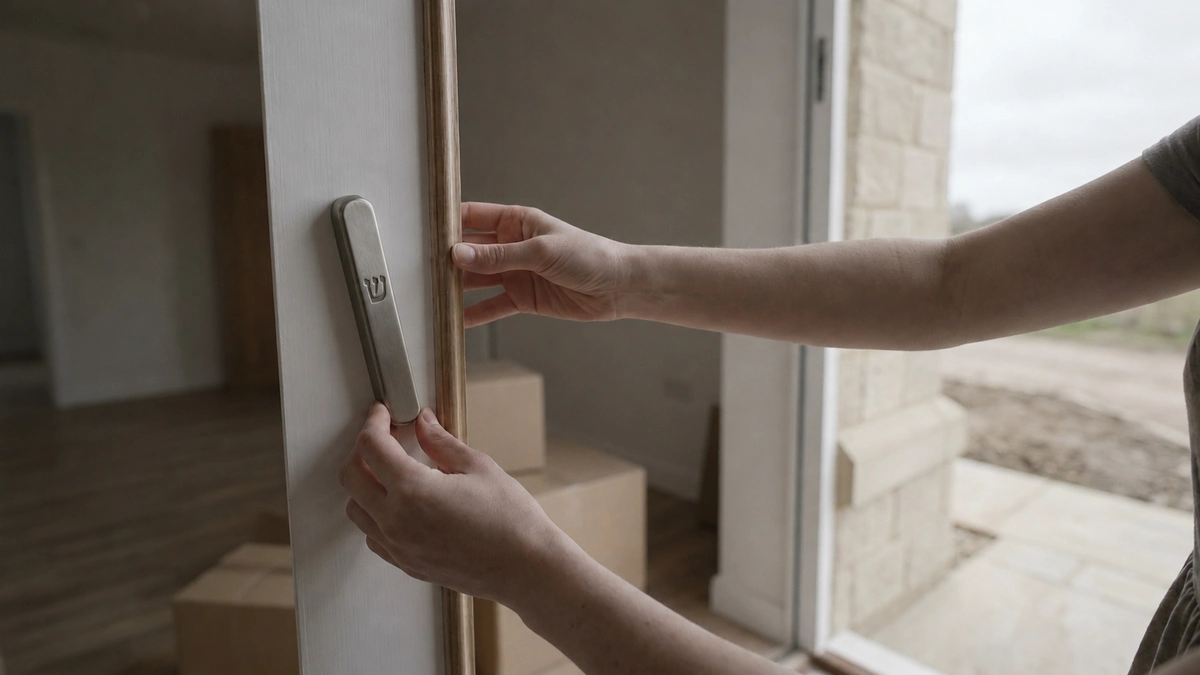
The handwritten scroll, affixed with intention, brings the declaration of Hashem's Oneness into the very structure of the home. The mezuzah should be a reminder of kedushah and protection for your home, and that reminder can only exist when the mitzvah has been fulfilled according to its true requirements.
For answers to common questions about what makes a mezuzah kosher, including questions about handwritten scrolls, certification, and the magiah, our detailed FAQ provides clear, halachically grounded guidance. We encourage you to learn as much as possible before purchasing, because fulfilling this mitzvah with clarity is itself an expression of the love of Hashem that the mezuzah is meant to declare.
The Clear Ruling and Your Responsibility
A handwritten mezuzah, written by a qualified sofer on kosher klaf, with proper ink, sirtut, and lishmah, is not optional – it is the halachic definition of a valid mezuzah. Ideally, it should also be checked by a trained magiah and come from a source that provides clear, reliable documentation. A printed or photocopied scroll, or a scroll written in violation of these core halachic requirements, does not fulfill the mitzvah and must be replaced. Every Jewish home deserves a genuine mezuzah, and that begins with understanding what "genuine" actually requires from a writing and verification standpoint.
Fulfill the Mitzvah With Confidence — Kosher Mezuzah
Kosher Mezuzah has been dedicated to ensuring the proper fulfillment of the mitzvah of mezuzah for over forty years. Every scroll is handwritten in Israel by a vetted sofer who has passed a rigorous halachic examination, double-checked by two expert examiners, and OU-endorsed — so that every handwritten scroll you affix is genuinely kosher and fully verified. Each mezuzah comes with a unique QR code providing complete transparency: the sofer who wrote it, the examiners who reviewed it, the materials used, and when the scroll is next due for inspection. Kosher Mezuzah does not sell secondhand or returned scrolls. Every mezuzah that leaves the warehouse is new, certified, and ready to fulfill the mitzvah properly. To explore our OU-endorsed mezuzah scrolls, visit kmezuzah.com/mezuzah-scrolls.
If you have questions about handwritten mezuzah requirements, certification, or the specific scroll right for your home, the Kosher Mezuzah team is available through the contact form at kmezuzah.com/contact.
May the mitzvah of mezuzah bring blessings and protection to your home, and may every scroll you affix be genuinely written by hand, with the full intention and care the Torah commands.



.svg)
Bring a true Kosher Mezuzah into your home
Fulfill the mitzvah with confidence, beauty, and meaning.
Buy a Mezuzah