


Should You Buy a Mezuzah Online or In Store? A Practical Halachic Guide
Where you buy your mezuzah matters more than most people realize. Not because the location itself is halachically significant, but because where you shop directly affects whether you can verify that what you are purchasing is actually kosher. That question, is this mezuzah truly kosher?, sits at the heart of fulfilling this mitzvah properly. This guide will help you understand what to look for, what to avoid, and how to make a confident, well-informed choice wherever you choose to shop.
Key Takeaways
- Whether you buy a mezuzah online or in store, the critical factor is verifying that the scroll is genuinely kosher—knowing the sofer, magiah, materials, and supervising authority before purchase.
- A beautiful mezuzah case means nothing halachically; the mitzvah is fulfilled only through a properly written, examined, and valid scroll, not the case itself.
- Online purchasing from a verified, transparent vendor is fully appropriate, while in-store shopping from an unverifiable source offers no inherent safety advantage.
- A pasul (invalid) scroll is not a minor issue but an ongoing violation of a Torah obligation, as the mitzvah of mezuzah is fulfilled continuously, moment by moment.
- Avoid common mistakes: purchasing based on appearance or low price alone, trusting certification marks without verification of the endorsing authority, or delaying a proper scroll to save money.
Should You Buy a Mezuzah Online or In Store?
Whether you buy a mezuzah online or in store, the single most important factor is your ability to verify that the scroll is genuinely kosher. The physical location of the purchase is secondary. What matters is transparency, knowing who wrote the scroll, who checked it, what materials were used, and whether a reliable halachic authority stands behind it. If you can answer those questions confidently, the channel through which you purchased it is far less important. Browse our mezuzah shop listing to see what verified, transparent purchasing looks like in practice. We cover this in more depth in Satmar Grand Rebbe Aron Affixes Mezuzah at New Heritage Silver Super Store in Wi.
The Halachic Foundation: Why the Scroll Is Everything
The mitzvah of mezuzah is fulfilled through the scroll, the klaf (parchment), not the case. A beautiful case with an invalid scroll does not fulfill any mitzvah. The scroll must be written by a qualified sofer (scribe) who is Torah-observant, skilled, and writes with proper kavanah (intention). It must be written in ksav ashuris (the traditional scribal script) with kosher dio (ink) on properly prepared klaf. Every letter must have the correct form, known as tzurat ha'ot. Even one disqualifying error renders the entire scroll pasul (invalid), and the mitzvah goes unfulfilled.
This is not a minor concern. As classical halachic authorities emphasize, one who has a mezuzah that is not written properly or not fixed properly violates a Torah obligation continuously, moment by moment. Unlike Tzitzit or Tefillin, which are time-bound mitzvot, mezuzah is a constant, unbroken obligation. The Minchat Chinuch (Mitzvah 423) even raised the question of whether a person must spend beyond the standard halachic threshold, one fifth of their assets, because missing the mitzvah of mezuzah is an ongoing violation rather than a one-time omission. The Shulchan Aruch (Yoreh Deah 291:1) similarly emphasizes the strict obligation to check a private home's mezuzot twice every seven years so as not to nullify the mitzvah (a communal mezuzah, such as on a shul or public building, is checked twice every fifty years).
The standard set by the classical authorities is demanding precisely because the mitzvah itself is constant. This means the standard you apply when purchasing must be equally serious.
What Verification Actually Looks Like
When you purchase a mezuzah, whether from a local Judaica store or an online vendor, there are specific pieces of information you should be able to obtain without difficulty. You should know the name of the sofer who wrote the scroll. You should know the name of the magiah (halachic mezuzah examiner) who checked it. You should know the date it was written, the type of klaf used, and whether a recognized halachic authority has reviewed the vendor's overall process. An image of the actual scroll you are receiving is a meaningful additional step.
When a vendor cannot provide these details, or provides vague assurances without specifics, that opacity is itself a warning sign. The market, unfortunately, contains scrolls that are machine-printed, poorly written, or unchecked, sold as if they were handwritten and kosher. This problem exists in both physical stores and online marketplaces. The channel is not the safeguard. Accountability is.
For a deeper look at what to ask before making a purchase, see our guide on what to ask before buying a mezuzah.
The Real Risks of Online Mezuzah Shopping
Online mezuzah shopping carries specific risks that every buyer should understand. Large general marketplaces, including major e-commerce platforms, frequently list mezuzah scrolls with no verifiable information about the sofer, no certification, and no accountability if the scroll turns out to be invalid. Price alone is not a guide. A scroll priced low may simply be a printed imitation. But a scroll priced higher on an anonymous platform carries the same risks if verification is absent.
The risks compound when buying in bulk or purchasing as a gift. A person might acquire several scrolls that appear kosher, affix them throughout a home, and fulfill none of the mitzvot. This is not a theoretical concern, it is a documented reality in the market for STa"M (Sifrei Torah, Tefillin, and Mezuzot).
There are also subtler risks. A scroll may be written by a sofer whose yiras Shamayim (fear of Heaven) or training is in question. The ksav (script) may have technical deficiencies that are difficult to detect without trained examination. An online image of a scroll may not reflect what is actually shipped. Each of these is a reason to require more from any vendor, not less, when purchasing online.
Buying In Store Is Not Automatically Safer
It is tempting to assume that walking into a local Judaica shop guarantees a kosher product. It does not. Many physical stores carry scrolls of unverified origin, stock pre-packaged mezuzahs without documentation, or simply lack the expertise to answer detailed halachic questions about what they are selling. A store's physical presence signals nothing about the kashrus of its inventory without specific, verifiable information.
What a physical store can offer, when it is a reputable one, is a human relationship. You can ask questions directly, request documentation, and potentially speak with someone knowledgeable. But these same conversations can and should happen with a trustworthy online vendor. The format of the interaction is less important than the substance of the answers.
If a local store can tell you who wrote the scroll, who checked it, and under whose supervision, and if they can show you the relevant documentation, then buying there is entirely appropriate. Apply the same standard online and you will be in an equally strong position.
Common Mistakes That Affect Fulfillment of the Mitzvah
The most common error is purchasing based on appearance alone. A beautiful case in a well-lit display does not say anything about the scroll inside. Related to this is purchasing based on price without asking why the price is what it is. Scrolls that are priced far below market reflect something, whether it is inferior materials, unqualified writing, or the use of printed rather than handwritten text.
A second common mistake is assuming that any certification mark on packaging is meaningful. Legitimate certification requires an endorsing authority that has reviewed the vendor's process in a structured and ongoing way, not simply approved a logo for use. When evaluating certification, verify who issued it and what specifically they reviewed.
A third mistake is delaying the purchase of a proper scroll to save money, intending to upgrade later. Each day a home goes without a kosher mezuzah, or with a pasul (invalid) one, the mitzvah is absent. The Talmud (Shabbat 133b) establishes the broader principle of hiddur mitzvah, that one should seek to fulfill mitzvot beautifully, based on "this is my Hashem and I will beautify Him" (Exodus 15:2); this principle applies to the mitzvah of mezuzah as it does to a Sefer Torah, lulav, shofar, and tzitzit. That standard does not mean the most expensive option, but it does mean a genuine, properly written one. For a fuller picture of what drives mezuzah pricing, see our mezuzah price guide.
The Deeper Meaning Behind the Mitzvah
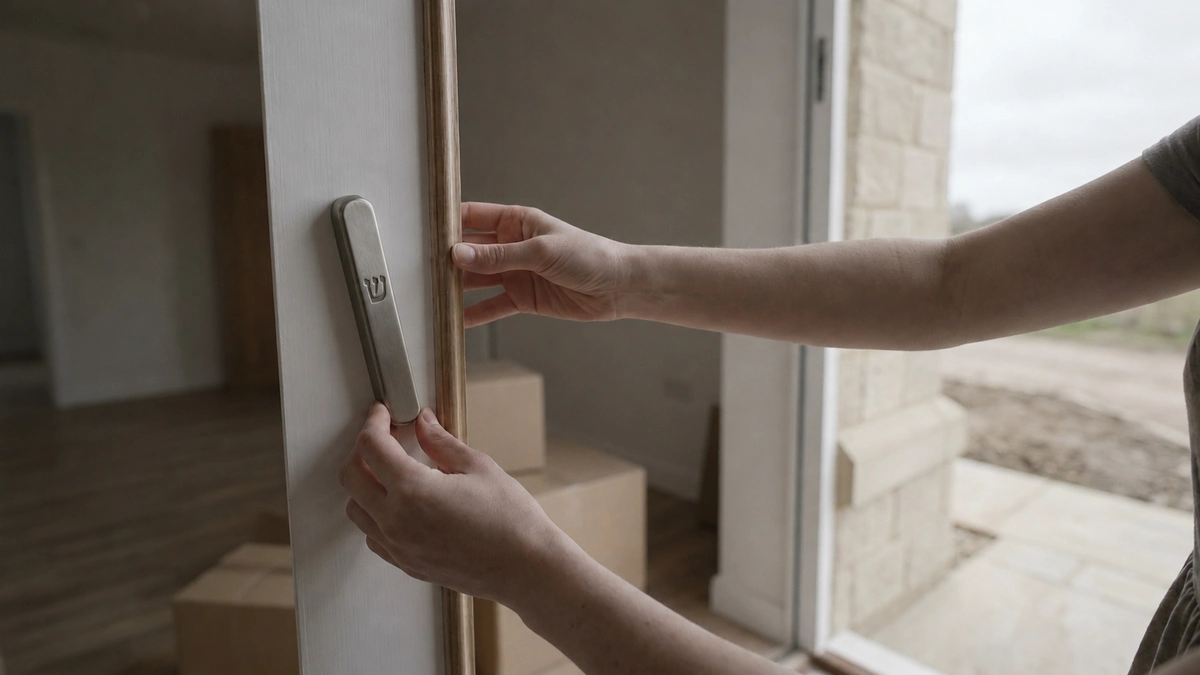
The affixing of a mezuzah is not simply a protective act or a cultural marker. The classical authorities explain that mezuzah and Kriyat Shema (the recitation of Shema) share a common purpose: both are declarations of Hashem's Oneness. The Shema proclaims it in speech: the mezuzah proclaims it in writing on the very structure of the Jewish home. This is why the scroll is placed at the entrance, so that the declaration of Echad (Oneness) is present at every threshold, accompanying every entry and exit.
When the scroll is genuinely kosher, written with proper intention, checked with care, and affixed correctly, the home becomes a place where Hashem's presence is acknowledged. When the scroll is invalid, that declaration is absent, regardless of how the case looks. This is why the Lubavitcher Rebbe, in his worldwide mezuzah campaign of 1974, stressed repeatedly that everything must be in strict adherence to halacha, kosher mezuzos that are properly checked and affixed. The protection and the blessing flow from fulfillment of the mitzvah, not from the act of hanging a case.
Key Takeaways
Whether you buy a mezuzah online or in store, your obligation is to verify that the scroll is genuinely kosher before you affix it. Verification means knowing the sofer, the magiah, the materials, and the supervising authority, not just trusting a price point or a physical storefront. Online purchasing from a verified, accountable vendor is fully appropriate: in-store purchasing from an unverifiable source is not safer by default. The mitzvah of mezuzah is fulfilled continuously, moment by moment, which means a scroll that is pasul is not a minor issue, it is an ongoing absence of the mitzvah. Seek a beautiful, kosher scroll from a source that can answer your questions with specifics, and consult your rav if you have any doubt about a particular scroll or vendor.
A Word About Kosher Mezuzah
At Kosher Mezuzah, every scroll we carry is written by qualified sofrim (scribes) and examined by a trained magiah. We provide the name of the sofer, the name of the magiah, the date of writing, and the materials used, along with an image of your actual scroll. Our process is endorsed by the Orthodox Union (OU), which endorses Kosher Mezuzah as a vendor, reflecting their confidence in our overall standards of verification and accountability.
We believe that fulfilling the mitzvah of mezuzah properly requires that you, the buyer, be fully informed. A private home's mezuzah scroll should be checked by a qualified magiah approximately every three and a half years (twice every seven years, per Shulchan Aruch Yoreh Deah 291:1), as conditions such as heat, humidity, and general aging can affect the klaf and dio over time. A communal mezuzah is checked less often, twice every fifty years. If your scrolls have not been checked recently, or if you are unsure about their kashrus, please do not wait.
If you have questions about a specific scroll, a particular doorway, or any aspect of the mitzvah, we encourage you to reach out to us, and always to consult your rav for guidance on individual circumstances. Fulfilling the mitzvah of mezuzah with clarity and confidence is something we are here to help you do.
May every doorpost in your home be a declaration of Hashem Echad, and may your household be blessed with shmirah (protection), bracha (blessing), and shalom (peace). Yehi ratzon that the mitzvah of mezuzah bring zechus to you and your family in all your comings and goings.


.svg)
Bring a true Kosher Mezuzah into your home
Fulfill the mitzvah with confidence, beauty, and meaning.
Buy a Mezuzah