
What Counts as a Doorway for a Mezuzah? (Halachic Definition Explained)
Key Takeaways
- What counts as a doorway for a mezuzah is defined by the tzurat hapetach: two upright doorposts and a lintel above, built specifically for the purpose of entry and exit
- A decorative arch or structural support beam does not create a mezuzah obligation, since it was never intended as a functional entry point
- The absence of a door does not eliminate the mezuzah obligation — it typically means affixing the mezuzah without a blessing rather than skipping it entirely
- A doorway with only one doorpost is generally exempt, though specific configurations — such as a right-side post with a lintel and a continuation on the left side — may require fixing without a blessing
- Special cases like archways, sliding door frames, and multiple sequential doorways each carry their own halachic rules, all hinging on whether the opening meets the core definition of a valid doorway
- When in doubt about whether a specific opening qualifies, consult a rav — ruling incorrectly can mean either missing the mitzvah or reciting a blessing in vain
The Halachic Basis: What the Sources Require
The Gemara in Menachot (33a-34a) is the primary source for the laws of mezuzah placement. From there, the Rishonim and later poskim derived the specific requirements that define a halachically valid doorway. Three structural elements are central to this discussion.
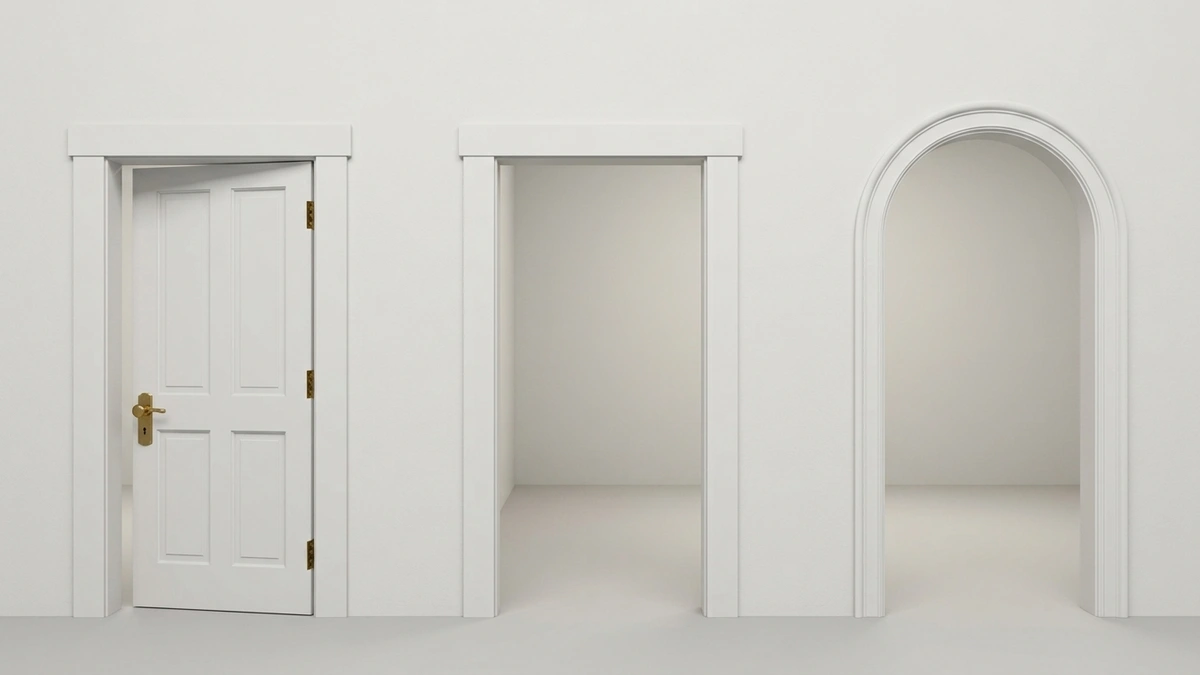
Two doorposts and a lintel. The basic requirement, as stated clearly in the Shulchan Aruch (Yoreh Deah 287:1), is that a doorway must have two upright doorposts and a lintel connecting them above. If there are doorposts but no lintel, the opening is generally not obligated, even if there is a door in the frame — though if the edge of the ceiling itself spans the opening and can serve as the lintel, one affixes a mezuzah without a blessing. The lintel does not need to physically touch the doorposts — it only needs to be aligned across from them. It can even be a protrusion of the ceiling itself that serves this purpose. If a protrusion in the ceiling was made for a different reason — such as to cover AC piping — most poskim hold that one fixes a mezuzah there without a blessing.
The purpose of the doorway. This is where many people are surprised. Not every physical frame obligates a mezuzah. The poskim rule that a tzurat hapetach only creates an obligation when it was built for the purpose of narrowing the space so that people enter through it specifically. If the frame or archway was built for another purpose — to beautify the room, or to support the building structurally — it is generally not considered a doorway. A building on pillars, or a concrete beam left after a wall was opened for structural reasons, does not require a mezuzah. Because the "doorway" was never intended as an entry point, if it was built for two purposes — both for beauty and for entry — one fixes a mezuzah without a blessing.
Doors are not strictly required. This is a well-known dispute among the Rishonim. The Rambam (Hilchot Mezuzah 6:1) holds that a doorway is only fully obligated when a door can be hung in it. The Rosh and Ra'avad disagree, holding that the Gemara's mention of "hanging doors first" was only to determine the right side via the heker tzir (hinge indicator), not as an actual requirement. The Shulchan Aruch cites both views, and the primary ruling that follows is that a doorless opening is obligated. Because the Shach, Chayei Adam, and Ben Ish Chai are all concerned with the Rambam's view, the practical ruling is to fix the mezuzah without a blessing if there is no door in the frame.
One doorpost or two? The Gemara records a dispute. Rabbi Meir obligates a mezuzah even when there is only one doorpost, while the Sages exempt it. The Rishonim ruled that the Sages' opinion is strong, and accordingly, this is how we rule today. Per the Shulchan Aruch (Yoreh Deah 287:1), if a doorpost exists only on the right side with a lintel above, and the other side is simply a continuing wall, the Rishonim dispute the matter and one fixes a mezuzah without a blessing. If the doorpost is only on the left, the opening is exempt entirely.
Practical Application: How This Works in Real Homes
Standard interior doorways — those with two upright posts and a horizontal lintel above, built to be used as an entryway — are obligated with a blessing. This applies whether or not a door is hung in the frame, so long as the frame structure is present and the opening was built for entry — though, as explained above, when there is no door, many poskim advise affixing the mezuzah without a blessing out of concern for the Rambam's view. Even a doorway formed by the wall itself, without any wood or metal frame added, is obligated in the same way.
Aluminum sliding door frames do not require a specific minimum thickness. The halacha does not require doorposts to be of any particular width, height, or the minimum frame for a sliding door is considered a valid doorway structure, and if it otherwise meets the requirements, a mezuzah is fixed there.
Archways. An arched opening — one that curves at the top rather than having a flat lintel — is a common question. The Shulchan Aruch addresses this in Siman 287: an arch is obligated provided the opening is at least four tefachim (handbreadths) wide and the curve begins at a height of at least ten tefachim from the ground. In an archway, the mezuzah is placed on the right side in its standard position — at the beginning of the upper third of the doorway's height, as the Shulchan Aruch (Yoreh Deah 289:2) rules.
Multiple doorways in sequence. If a home has an entrance to a lobby, and then a doorway from the lobby to the stairwell or inner rooms, both doorways are actually obligated. The Rambam (Hilchot Mezuzah 6:10) rules that a house with multiple doorways requires a mezuzah on each of them, even if one regularly uses only one of them. An entrance used only extremely rarely may be exempt in some opinions, and in that case one fixes without a blessing.
Partially closed doorways. If a doorway has been permanently closed on one side, with at least a tefach (approximately 8 to 9.6 centimeters, depending on the opinion followed) remaining, the mezuzah is fixed at the edge of the closed portion.
Doorways built only for exiting are not obligated. The halacha ties the obligation to the direction of entry — a door built only as an exit point, which is not used to enter, does not require a mezuzah.
Common Errors to Avoid
Assuming a decorative arch obligates a mezuzah. A decorative arch built purely for aesthetics, with no function as an entryway, does not obligate a mezuzah according to most poskim. Placing a mezuzah there with a blessing could actually constitute a brocha levatala (a blessing said in vain), which is a serious halachic concern.
Skipping doorways that lack traditional wooden doors. Some people assume that because a room doesn't have a door, the mezuzah can be skipped. As explained above, this is generally not the case — the absence of a door typically means fixing without a blessing, not eliminating the obligation entirely under most opinions.
Misidentifying the right side. The mezuzah always goes on the right side of the entrance as you walk into the room or space. In a doorway with only one structural post, or where the right and left sides are ambiguous, the direction of primary use determines which side is "right." When a mezuzah becomes pasul or is placed incorrectly, the wrong understanding before affixing any scroll can lead to needing to revisit every doorway.
About Kosher Mezuzah
At Kosher Mezuzah, we believe that fulfilling the mitzvah properly begins before the scroll ever touches the doorpost. It starts with knowing which doorways are obligated, understanding the tzurat hapetach clearly, and then ensuring that the mezuzah scroll itself is written by a qualified sofer and verified by a reliable magiah. Our scrolls are OU Endorsed (OU STaM), written on klaf parchment with ink that meets the highest standards, and accompanied by documentation identifying the sofer and magiah by name.
We also encourage you to have your mezuzahs checked periodically. A scroll that was originally kosher can develop issues over time — cracked letters, fading, missing ink. The mezuzah requires ongoing attention, not just proper placement at the outset.
If you have questions about which doorways in your home require a mezuzah, or if you would like guidance on ensuring your scrolls are truly kosher, reach out to us — we are here to help you fulfill this mitzvah with clarity and confidence.
When you are ready to ensure the scroll on your doorpost is one you can rely on, browse our mezuzah scrolls here.
Conclusion
A doorway is obligated in a mezuzah when it has two doorposts and a lintel, and was built for the purpose of entry and exit. Because the Rishonim dispute whether a door is required, the absence of a door generally does not eliminate the obligation in practice — one fixes the mezuzah without a blessing. If only one doorpost is present, the ruling depends on the configuration: a doorpost on the right side with a lintel above calls for fixing without a blessing, while a doorpost only on the left side leaves the opening exempt. When in doubt about any specific opening, consult a rav — the details of tzurat hapetach are nuanced, and ruling incorrectly can mean either missing the mitzvah or saying a blessing in vain.


.svg)
Bring a true Kosher Mezuzah into your home
Fulfill the mitzvah with confidence, beauty, and meaning.
Buy a Mezuzah