
Do Guest Rooms Need a Mezuzah? A Clear Halachic Guide
The guest room mezuzah requirement is one of the most commonly asked questions we receive at Kosher Mezuzah. A family prepares a spare bedroom for visiting family, builds a basement guest suite, or converts a study into an extra room, and the question arises: does this room need a mezuzah? It is a practical question with real halachic weight, and the answer depends on how the room is used, who uses it, and whether the doorway meets the basic conditions for the mitzvah. This article will walk you through the halacha clearly, so you can fulfill the mitzvah with confidence and without confusion.
Key Takeaways
- Guest rooms require a mezuzah if they are set aside for dignified human dwelling, regardless of how frequently they are used by visitors, according to halachic law based on the principle of beit dirah.
- The doorway must meet minimum halachic dimensions (10 tefachim in height, 4 tefachim in width), and the room itself must be at least four amot by four amot (Shulchan Aruch, Yoreh De'ah 286:13), to obligate a mezuzah; consult a rabbi if your doorway or room falls short, or if the room serves dual purposes like storage.
- A guest room mezuzah should be covered to preserve the dignity of the sacred scroll, following the ruling of the Rama.
- Every mezuzah scroll must be hand-written by a qualified sofer (Torah scribe) and examined by a trained magiah (examiner) to be considered valid and fulfill the mitzvah properly.
- Checking your mezuzah scrolls twice every seven years (Shulchan Aruch, Yoreh De'ah 291:1) is essential to ensure they remain kosher, as scrolls that crack, fade, or develop errors over time no longer fulfill the obligation.
Do Guest Rooms Need a Mezuzah?
A guest room mezuzah is generally required. If the room is used for dignified human dwelling, even occasionally, and its doorway meets the basic physical requirements, the mitzvah of mezuzah applies. This is true whether the room is a spare bedroom, a guest suite, or an extra room that hosts visitors throughout the year. Because there is real halachic nuance here depending on how the room is used, we encourage you to reach out to Kosher Mezuzah if you have questions about a specific room in your home.
The Halachic Basis: What Makes a Room Obligated?
The Gemara in Yoma (11a) teaches that the mitzvah of mezuzah applies to a beit dirah, a place of dignified dwelling. This is the foundational principle. A room is obligated when it serves as a genuine living space for a person, not merely a utility space or storage area.
The Shulchan Aruch (Yoreh De'ah 286) draws directly from this principle. A room that is regularly used for human habitation, including sleeping, resting, or lodging guests, is considered a beit dirah and requires a mezuzah. The fact that a room is used only sometimes, or only by guests, does not remove this status. What matters is whether the room is set aside for dignified human use.
The Beit Yosef explains that even a room used for marital intimacy is considered a dignified dwelling and is obligated in mezuzah. The Rama rules accordingly, noting that a bedroom's mezuzah should be covered, out of respect for the sacred text. This ruling applies equally to a guest bedroom, the room retains the character of a beit dirah, and the obligation stands.
The exemptions in halacha are reserved for rooms that are not dignified dwelling spaces: bathrooms, washrooms, and rooms regularly used for undignified purposes. The Shulchan Aruch rules that such rooms are exempt from the mezuzah obligation. But a well-appointed guest room, where a person sleeps, dresses, and lives during their stay, does not fall into this category at all. Related reading: Do Yeshiva Dorm Rooms Need Mezuzahs? What Every Student Must Know.
What This Looks Like in Practice
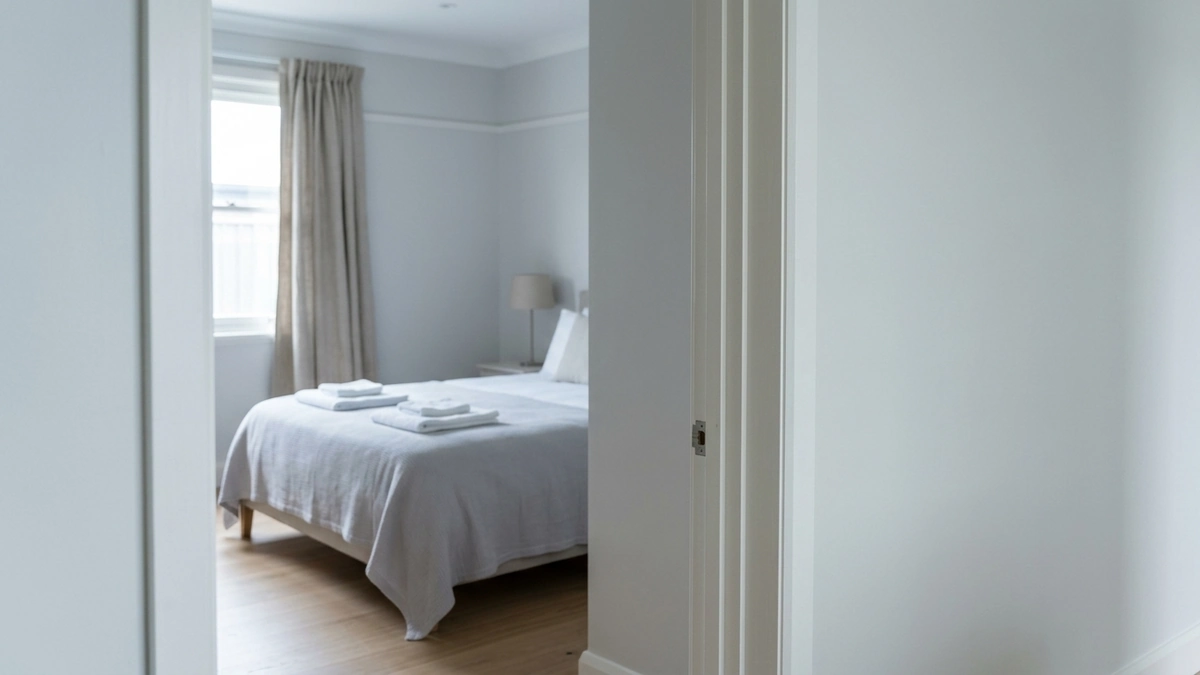
For most Jewish homes, a guest room is simply a bedroom that is used by visitors instead of family members. It has a bed, perhaps a closet, and a proper door. That room is obligated in mezuzah just as any other bedroom in the house. The temporary or occasional nature of the guests does not reduce the room's status as a beit dirah - a principle that also applies to communal housing mezuzah requirements, where shared living spaces raise similar questions.
But, there are a few practical details worth knowing. First, the doorway must meet the minimum halachic measurements, a height of ten tefachim (roughly 40 inches) and a width of four tefachim (roughly 12–16 inches, depending on the halachic authority used for the conversion), to be obligated. If the doorway does not meet these dimensions, a rabbi should be consulted about whether a mezuzah is placed with or without a blessing.
Second, if the room functions as both a guest room and a storage space, meaning guests only stay there occasionally and the room is primarily used for boxes, luggage, or equipment, its status may be closer to a beit ha'otzar (storage room), which carries a different ruling. A room used primarily for storage may still require a mezuzah, but the blessing over affixing it may be in question. In such cases, the common practice is to affix the mezuzah without reciting a blessing - a similar approach to the one used for shared office mezuzah requirements, where mixed-use spaces create comparable halachic uncertainty.
Third, if the room has no guests for extended periods but remains set up and furnished as a bedroom, it retains its obligated status. A room does not lose its beit dirah character simply because it sits empty for a few months - the same logic addressed in dorm room mezuzah requirements, where seasonal vacancy is a common concern.
We encourage you to walk through your home carefully and assess each room honestly. If you are uncertain about a specific doorway or room type, contact Kosher Mezuzah and we will help you think through the situation clearly.
Common Mistakes to Avoid
One of the most frequent errors we see is homeowners skipping the guest room entirely because they assume it "doesn't count" since it is not used every day. This is a misunderstanding of the halacha. The obligation is not based on how frequently the room is used but on whether it is designated for dignified human dwelling.
A second common mistake is placing the mezuzah incorrectly on the doorpost of a bedroom without covering it. The Rama rules that a mezuzah in a bedroom should be covered to preserve the dignity of the sacred scroll. This applies to guest rooms as well. A proper mezuzah case (bayit) that fully encloses the klaf (parchment) is sufficient for this purpose.
A third mistake is purchasing a mezuzah scroll that has not been properly inspected. Every mezuzah placed in a Jewish home, including the guest room, must be written by a qualified sofer (Torah scribe) and checked by a trained magiah (halachic mezuzah examiner). A scroll that was never examined, or that was produced by machine, does not fulfill the mitzvah regardless of where it is placed.
The Deeper Meaning Behind Every Doorway
The Tur (Yoreh De'ah 285) writes something beautiful: a human king sits inside his palace while his servants guard him from without. But for the Jewish home, Hashem guards us from outside, and that is why the mezuzah is placed at the outer handbreadth of the doorpost, so that the entire home rests within its shelter. This protection, the Tur emphasizes, is real, but our intention in affixing a mezuzah must be to fulfill the commandment of our Creator, not merely to seek protection.
Every room in a Jewish home where a person dwells carries this spiritual reality. The guest room is no exception. When a family member or visitor enters that room, they are entering a space that is meant to be marked by the presence of Hashem's words. The Tur (Yoreh De'ah 286) records that the Maharam of Rothenburg affixed a mezuzah to his beit midrash after a harmful spirit had frightened him there during his afternoon rest, and the disturbance ceased once the mezuzah was in place. That same protection is connected to every doorway, including the one your guests walk through.
The Ruling summarizing
A guest room that is set aside for dignified human use requires a mezuzah, just like any other bedroom. The occasional or temporary nature of its occupants does not affect the obligation. The doorway must meet minimum halachic measurements, and if there is genuine uncertainty, such as a room used partly for storage, a rabbi should be consulted before or after affixing the scroll. The mezuzah in a bedroom should be covered. And every scroll must be written by a qualified sofer and examined by a qualified magiah to fulfill the mitzvah properly.
Fulfilling the Mitzvah with Confidence
At Kosher Mezuzah, every mezuzah scroll we offer is written by experienced sofrim (Torah scribes), and examined by a qualified magiah before it leaves our hands. The process is endorsed by the Orthodox Union (OU) We provide the name of the scribe, the name of the examiner, the date of writing, and the materials used, so that you know exactly what you are placing on your doorpost. This level of traceability is not just good practice: it is what gives buyers the confidence that the mitzvah is being fulfilled properly.
Checking your mezuzah scrolls periodically is also part of fulfilling the mitzvah. The Shulchan Aruch (Yoreh De'ah 291:1) rules that an individual's mezuzah must be checked twice every seven years. A scroll that has cracked, faded, or developed errors over time may no longer be kosher, and a room with a pasul (invalid) scroll is effectively without a mezuzah. We recommend having your scrolls checked by a qualified magiah twice every seven years (roughly every three and a half years), or immediately if you notice physical damage to the case or scroll.
If you have questions about a specific room in your home, or if you are ready to ensure your guest room, and every doorway in your home, is properly fulfilled, contact Kosher Mezuzah and we will be glad to assist you. May every doorway in your home be a source of zechus (merit) and blessing for all who enter. Yehi ratzon, may it be Hashem's will that your home be a true beit dirah for His presence.


.svg)
Bring a true Kosher Mezuzah into your home
Fulfill the mitzvah with confidence, beauty, and meaning.
Buy a Mezuzah