
Do Yeshiva Dorm Rooms Need Mezuzahs? What Every Student Must Know
When a bachur (yeshiva student) moves into a dorm room for the first time, the question comes up quickly: does this room need a mezuzah? The answer matters, not just as a matter of halacha, but as a matter of fulfilling a mitzvah properly every single day he lives there. This article will answer that question clearly, explain the halachic reasoning behind it, and help students, parents, and yeshiva administrators know exactly what is required.
Key Takeaways
- Yeshiva dorm rooms where students sleep and eat are fully obligated in a mezuzah with a blessing, as they function as genuine personal dwellings.
- Students become responsible for mezuzah placement after 30 days of residence outside Israel, or immediately in Eretz Yisrael, even as renters rather than owners.
- Classrooms, study halls, and dining halls require a mezuzah without a blessing, but only dorm rooms carry the full obligation due to their private, personal dwelling status.
- Any mezuzah must be handwritten by a qualified sofer on proper kosher parchment and checked by a trained examiner—printed scrolls and unverified items are invalid and do not fulfill the mitzvah.
- Proper mezuzah placement requires affixing it at an angle on the right side of the doorpost, at the beginning of the upper third of the doorpost's height, and existing mezuzahs should be inspected regularly to verify kosher status.
Do Yeshiva Dorm Rooms Need Mezuzahs?
Yeshiva dorm room mezuzah requirements are real and binding: a dormitory room where students sleep and eat is obligated in a mezuzah with a blessing (b'vracha). This is the ruling drawn from the relevant halachic sources and confirmed by contemporary poskim (halachic decisors). If you are a student, a parent preparing a son or daughter for yeshiva, or an administrator responsible for student housing, this is the ruling you need to know. If you have any doubt about a specific room or situation, reach out to us at Kosher Mezuzah and we will help direct you to the appropriate guidance.
The Halachic Basis: What Makes a Room Obligated
The obligation of mezuzah applies to a room that functions as a genuine dwelling. The Gemara in Yoma (11a–11b) teaches that the Torah's word bayit (house) means a place of honor and human habitation. A room is obligated when it serves as a place where a person actually lives, where he sleeps, eats, and spends meaningful time. A yeshiva dorm room fits this definition precisely. The student lives there, sleeps there, and often keeps his personal belongings there. It is his home for the duration of the zman (semester or term).
The Shulchan Aruch and the rulings of leading poskim confirm that dormitory rooms in yeshivas, where students dwell on a regular basis, carry a full mezuzah obligation, recited with a blessing. This stands in contrast to classrooms and study halls, which are obligated without a blessing, or bathrooms and bathhouses, which are exempt entirely because they are not places of honor. Related reading: Do Guest Rooms Need a Mezuzah? A Clear Halachic Guide.
It is important to note that the obligation applies even though the student does not own the room and is merely a renter or a temporary resident. Halacha requires a tenant to affix a mezuzah just as an owner does. In the Land of Israel, a tenant is obligated immediately upon moving in. Outside of Israel, the standard ruling is that a renter becomes obligated after thirty days, though the poskim note that one who wishes to affix the mezuzah with a blessing sooner may do so. Since most yeshiva students reside in their dorm rooms for well beyond thirty days, the obligation is clear. See also Mezuzah in Apartment, Dorm Room, or Office. We cover this in more depth in One Student, 26 Mezuzahs, and a Jewish Network Across China.
Classrooms, Study Halls, and Dining Rooms in a Yeshiva
Not every room in a yeshiva carries the same level of obligation. Understanding the distinctions helps students and administrators fulfill the mitzvah correctly.
Classrooms and study halls (batei midrash) in a yeshiva or cheder are obligated in a mezuzah, but without a blessing. The reason is that while they are used daily and students spend many hours there, they are primarily places of work and learning rather than places of personal dwelling. The poskim rule that they have an element of obligation, since Torah scholars consider such spaces their home for the day, but the full requirement of dwelling is not met, so the blessing is omitted. For a broader look at how these distinctions apply across an entire educational institution, see our guide on school mezuzah requirements.
Dining halls in yeshivas are similarly obligated without a blessing. They serve a regular function and are used by the student body consistently, but they are communal spaces rather than personal dwellings.
The dorm room, by contrast, is where each student personally resides. It is private, personal, and used for sleep. This elevates it to the level of a true dwelling, which is why the blessing is recited when the mezuzah is placed.
Who Is Responsible for Providing the Mezuzah?
One of the most common practical questions in student housing mezuzah situations is: who is supposed to provide the mezuzah, the yeshiva or the student? This question comes up frequently, and the answer depends on the nature of the arrangement.
As a general rule, the obligation rests on the person who is dwelling in the space. If the yeshiva administration provides mezuzahs for all dormitory rooms as part of their institutional responsibility, the student's obligation is fulfilled. But, if the yeshiva does not provide them, the student himself becomes responsible for affixing a kosher mezuzah to his room. Parents should clarify this with the yeshiva before the zman begins.
It is not sufficient to assume that a mezuzah already on the doorpost is kosher. A mezuzah that has not been checked within the last several years may be pasul (invalid) due to cracking of the ink, fading of letters, or other damage. An invalid mezuzah does not fulfill the mitzvah, even if it looks fine from the outside. This is true whether the mezuzah was placed by a previous student, by the institution, or by the current student himself.
Reach out to Kosher Mezuzah if you need guidance on checking or replacing a dorm room mezuzah before the new zman.
Common Errors Students and Families Make
There are a few mistakes that come up repeatedly in this area, and they are worth addressing directly.
The first is assuming that because the dorm room is temporary, no mezuzah is needed. This is incorrect. A dwelling that will be used for thirty days or more requires a mezuzah. A yeshiva dorm room is not a hotel or a short-term rental, it is a genuine, ongoing place of residence. This is distinct from a true short-term stay — learn more about the guest room mezuzah obligation and where the line is drawn.
The second error is purchasing an inexpensive, mass-produced scroll without verifying that it is actually handwritten by a qualified sofer (scribe). Many scrolls sold online or in souvenir shops are printed rather than written by hand, which makes them completely invalid for the mitzvah. Only a scroll written by a G-d-fearing Jewish sofer using kosher klaf (parchment) and dio (ink), according to the detailed requirements of halacha, can fulfill the obligation.
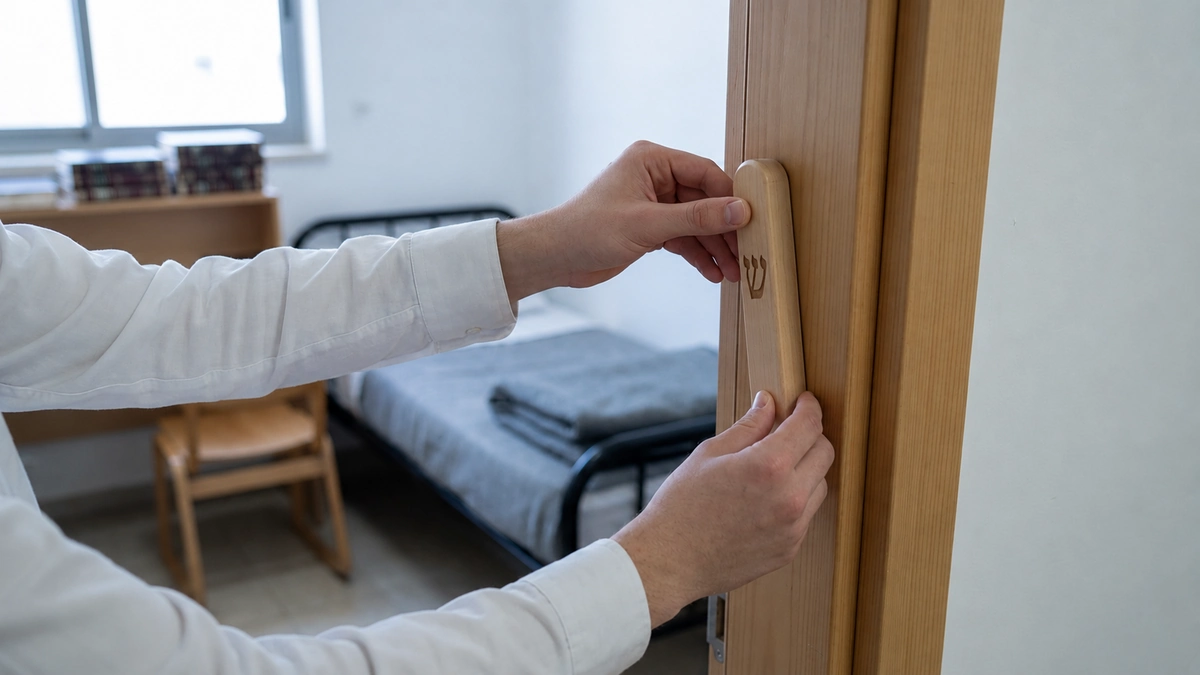
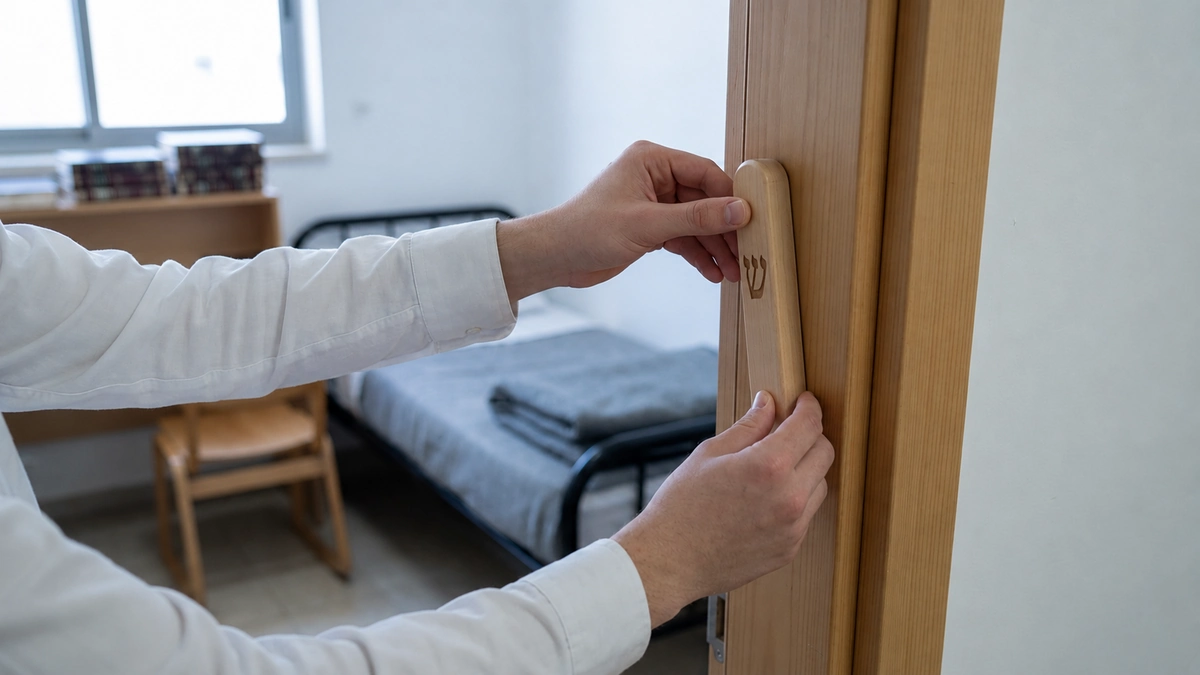
The third mistake is neglecting to check the placement. The mezuzah must be affixed at the beginning of the upper third of the doorpost's height (roughly two-thirds of the way up, and at least a handbreadth below the top of the doorframe), on the right side as one enters the room. It should be placed at an angle, with the top tilted toward the inside of the room and the bottom tilted toward the outside, following the widely accepted ruling that satisfies both major opinions. If the case is simply taped or placed loosely, it may not be properly affixed according to halacha.
The Deeper Meaning for a Yeshiva Student
For a bachur entering a yeshiva, the mezuzah on his dorm room door carries a meaning that goes beyond technical obligation. The mezuzah declares that even this small room, far from home, in a new city, at a new stage of life, is a Jewish home under the protection of Hashem. Every time the student enters or leaves, the mezuzah reminds him that his connection to HaKadosh Baruch Hu does not depend on where he is. The Shema Yisrael written inside the klaf affirms Hashem's oneness and His presence in every place a Jew dwells.
The Rambam writes that reflecting on the mezuzah upon entering and leaving one's home reminds a person of the oneness of Hashem and helps protect him from sin. For a yeshiva bachur navigating the challenges of growth in Torah, this daily reminder carries genuine spiritual weight. Fulfilling this mitzvah properly, with a kosher scroll, correct placement, and a blessing, gives the student a zechus (spiritual merit) that accompanies him throughout his time in yeshiva.
Key Takeaway
A yeshiva dorm room where students sleep and eat is obligated in a mezuzah with a full blessing. The obligation applies to the student as a renter once he has lived there for thirty days, or immediately in Eretz Yisrael. Classrooms and dining halls require a mezuzah without a blessing. It is essential to verify that any mezuzah in place is actually kosher, written by a qualified sofer on proper klaf, and not simply assumed to be valid. The responsibility belongs to whoever is dwelling in the room, unless the yeshiva has assumed that responsibility formally.
How Kosher Mezuzah Helps Students and Families Fulfill This Mitzvah
At Kosher Mezuzah, we understand that yeshiva students and their families want to fulfill this mitzvah correctly without guesswork. Every mezuzah scroll we offer is handwritten by a trained and vetted sofer, and checked by a qualified magiah (halachic mezuzah examiner). Our process is endorsed by the Orthodox Union's mezuzah program. Each scroll comes with documentation that allows you to know who wrote it, who checked it, and that it meets the halachic standards required for a full and proper fulfillment of the mitzvah.
We also know that mezuzah scrolls require periodic checking. Even a scroll that was perfectly kosher when it was placed can develop problems over time, cracking ink, faded letters, or physical damage. Students and families are encouraged to have dorm room mezuzahs inspected regularly, particularly when a new student moves into the room. A mezuzah that cannot be verified should be replaced rather than relied upon.
If you are preparing for a new zman, moving into a dorm room, or helping a son or daughter do so, contact Kosher Mezuzah to ensure that every doorpost is covered with a mezuzah that is genuinely kosher.
May the mezuzah on every dormitory door be a source of shmirah (protection), blessing, and connection to Hashem for every student who passes through it. יהי רצון שתשרה שכינה במעונותיכם, may the Divine Presence dwell in your dwelling places.



.svg)
Bring a true Kosher Mezuzah into your home
Fulfill the mitzvah with confidence, beauty, and meaning.
Buy a Mezuzah