
Garage Mezuzah: Do Garage Doors, Porches, or Gates Need One?
Key Takeaways
- A garage mezuzah is required when the garage entrance meets the halachic definition of a doorway: two doorposts, a lintel or overhead structure, sufficient interior dimensions, and functions as a genuine passageway into your home or courtyard
- The interior door connecting the garage to the living space almost always requires a mezuzah with a full brocha — don't overlook it
- The rolling mechanism of a garage door is not the deciding factor; what matters is whether the structure has the halachic form of a proper entrance (tzurat hapetach)
- Porches and outdoor gates are evaluated individually — enclosed, regularly used structures that serve the home are likely obligated; wide-open or purely decorative entryways are generally exempt
- When there is doubt about reciting a brocha, affix the mezuzah without one; when there is doubt about the obligation itself, consult a rav before leaving any doorway uncovered
- Only a valid scroll fulfills the mitzvah — an invalid scroll means the obligation has not been met at all, which is why a scroll should be written by a vetted sofer and checked by a trained magiah; an unchecked scroll cannot be presumed valid
The Core Halachic Test: What Makes a Doorway Obligated?
For any entrance to require a mezuzah, the Shulchan Aruch (Yoreh De'ah 286) establishes that it must function as a genuine entry point into a space that is used for dwelling or regular human activity. The opening must have two doorposts (as required by the Shulchan Aruch, Yoreh De'ah 287:1; where there is only one doorpost, opinions differ and a rav should be consulted), a lintel or some form of overhead structure, and a minimum width of four handbreadths according to many poskim (though this is debated), and height of ten. The space it leads into must also be made specifically to allow people to enter, not merely for structural support, decoration, or another incidental purpose.
This last point is important for gates and arches. The poskim rule that if a structure was built for the purpose of narrowing an opening so that people pass through it specifically, it functions as a proper entrance and is obligated. But if it was built for beauty, structural reinforcement, or some other non-entry purpose, it is exempt. A decorative arch over a garden path, for example, would typically be exempt. A gated entrance to a courtyard that people regularly use to enter the property is a different matter entirely.
What the Halacha Says About Garages
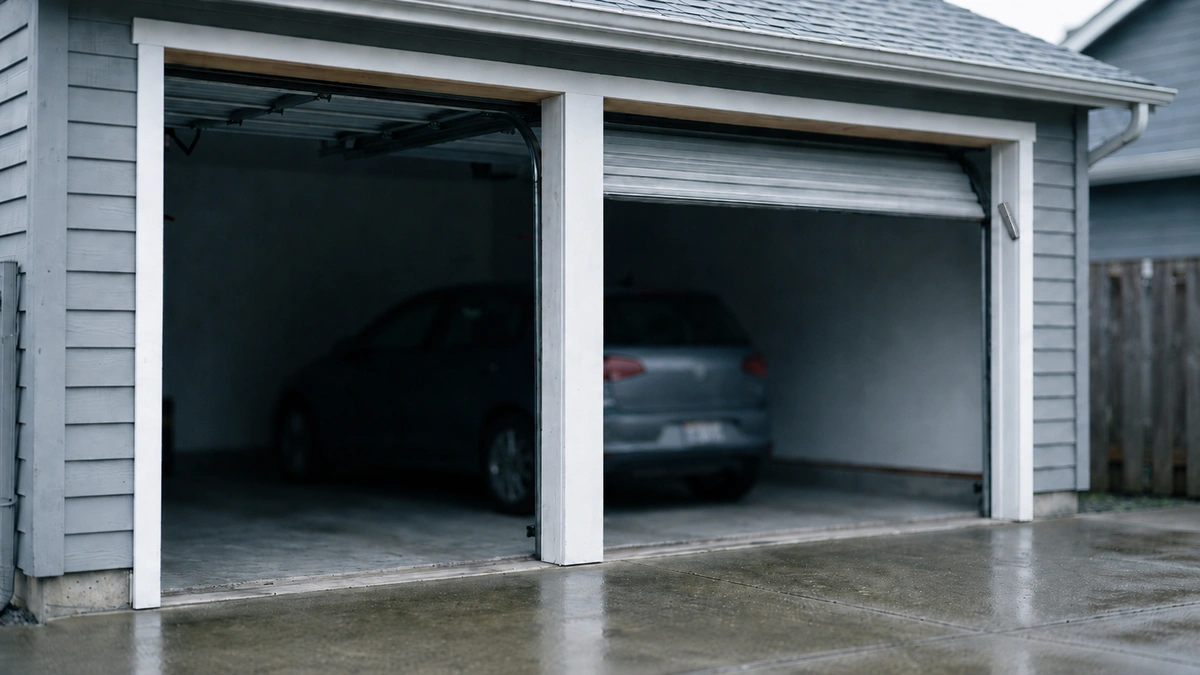
A garage that is fully enclosed, has two doorposts, a lintel, and is regularly used — whether for parking, storage, or as a regular passageway into your home — meets the basic criteria for a beit sha'ar or a room in its own right. If your garage connects directly to your home, it functions as a gatehouse. Two doors are actually involved in most scenarios: the large exterior garage door and the interior door leading from the garage into the home. The interior door almost certainly requires a mezuzah, placed on the right side as you enter the home from the garage. This is a standard doorway and its obligation is clear — affix it with a brocha.
The exterior garage door is more nuanced. If the garage is fully enclosed, has two doorposts and a lintel, and is regularly used as a passageway into the home, it is obligated. A mezuzah is placed without a brocha because the poskim question whether an overhead door that rolls up and lies flat qualifies as a halachic door at all, and whether the structure fully satisfies the tzurat hapetach requirement. If the garage is used purely for vehicles with no regular human activity — no entry into the home, no regular human presence — some authorities exempt it. Consult your rav based on how your garage is actually used.
Porches: Open, Closed, or Somewhere in Between
Porches require careful analysis because they vary so widely. A fully enclosed porch with walls on all sides, a proper doorway, and a roof is treated similarly to any other room, and the entrance to that porch from outside — as well as the entrance leading from the porch into the home — should both be evaluated. If the interior porch meets the minimum dimensions and is used regularly, both doorways are likely obligated: the interior one with a brocha, the exterior one given the uncertainty surrounding a sukka-like or semi-outdoor structure, without a brocha in most cases.
An open porch — one that has a roof but no walls, or only partial walls on one or two sides — is generally exempt. An exedra, which is described in the Gemara as a three-walled structure without a full door, is exempt — though if it has even a partial wall on its fourth side, it becomes obligated (Shulchan Aruch, Yoreh De'ah 286:6). However, when such structures genuinely serve as functional entryways to the house, their status becomes more complex and may require rabbinic consultation. The practical advice for these cases is to affix a mezuzah without a brocha if you are uncertain whether the porch genuinely serves the home, and to consult a rav when the structure does not fit neatly into a defined category.
What About Gates and Outdoor Entrances?
A gate at the entrance to your property — whether a garden gate, a driveway gate, or a gate in a fence or wall — is evaluated based on whether it serves as a genuine entry point to a courtyard or property that contains a dwelling. The Gemara in Yoma (11a) and the Shulchan Aruch are clear that courtyard gates serving a home are obligated. The ruling follows from the fact that the gate serves the enclosed home: the Shulchan Aruch (Yoreh De'ah 286:1) lists courtyard gates among the places obligated in mezuzah, alongside the doorways inside. A freestanding gate leading to a property where someone lives is hence obligated in many cases, though in practice such gate mezuzahs are commonly affixed without a brocha because of the halachic uncertainties involved.
A gate that was not built specifically to create an entry point, or that serves a largely decorative function, would typically be exempt. Similarly, a gate made entirely for security without any tzurat hapetach — no proper doorframe, two posts and a lintel — may also be exempt. If the gate is much more like two fence posts with a chain connecting them than a doorway with a halachically valid connecting piece, the structure does not create a halachic obligation. A simple chain-link fence opening with no posts and no lintel would be exempt. When in doubt, affix without a brocha only after confirming the scroll you are placing is genuinely valid.
Common Mistakes That Lead to Missed Obligations
One of the most frequent oversights is the omission of the interior garage-to-home door. Homeowners carefully consider the exterior garage question but never consider the secondary door leading from the garage into the kitchen or hallway. That second door is, almost without exception, a standard obligated doorway — four walls, a proper entrance, used for regular entry — and should be checked first.
Another common error is assuming that any doorway without a traditional hinged door is automatically exempt. The Shulchan Aruch (Yoreh De'ah 286:15) rules that a doorway does not require a swinging door, only a proper tzurat hapetach — though since some poskim do require a door, common practice is to affix without a brocha in such a case. A garage, a storage room, even an open arch can be obligated if it has the minimum structural elements and serves the home. Additionally, placing a mezuzah on gates or decorative archways that are truly decorative, ornamental pillars, or structural beams with no real entry function is an error — this is an unnecessary expense that some poskim also caution against out of respect for the mezuzah, and it creates confusion about where real obligations lie. Understanding the underlying logic — that the obligation follows function — prevents these mistakes rather than multiplying them.
About Kosher Mezuzah
At Kosher Mezuzah, every scroll we offer has been written by a vetted sofer and verified by a trained magiah. Our entire process is OU Endorsed (OU STaM). Each mezuzah comes with full traceability — the sofer's name, the checking record, and when and what materials were used. We also strongly encourage periodic checking of your mezuzahs. The Shulchan Aruch (Yoreh De'ah 291:1) rules that a private individual's mezuzahs should be inspected twice in seven years (communal mezuzahs, twice in fifty years); later poskim advise more frequent checking in climates with significant heat, cold, or moisture. A scroll that has become pasul — even one that was originally beautiful and kosher — provides no fulfillment of the mitzvah. Checking is not an extra chumra; it is part of properly fulfilling the obligation.
If you have questions about which doorways in your home require a mezuzah — including your garage, porch, or gate — we are here to help. If you are ready to ensure every doorpost is properly covered, browse our mezuzah scrolls here.
Conclusion
A garage mezuzah is required when the entrance has two doorposts, a lintel or overhead structure, sufficient interior dimensions, and functions as a genuine passageway into your home or courtyard. The interior door connecting the garage to the living space almost always requires a mezuzah with a full brocha. Porches and gates are evaluated based on how enclosed they are, whether they have a proper tzurat hapetach, and whether they genuinely serve the home. When there is doubt about whether to make a brocha, affix without one. When there is doubt about whether an obligation exists at all, consult a rav — and do not leave obligated doorways uncovered.



.svg)
Bring a true Kosher Mezuzah into your home
Fulfill the mitzvah with confidence, beauty, and meaning.
Buy a Mezuzah