
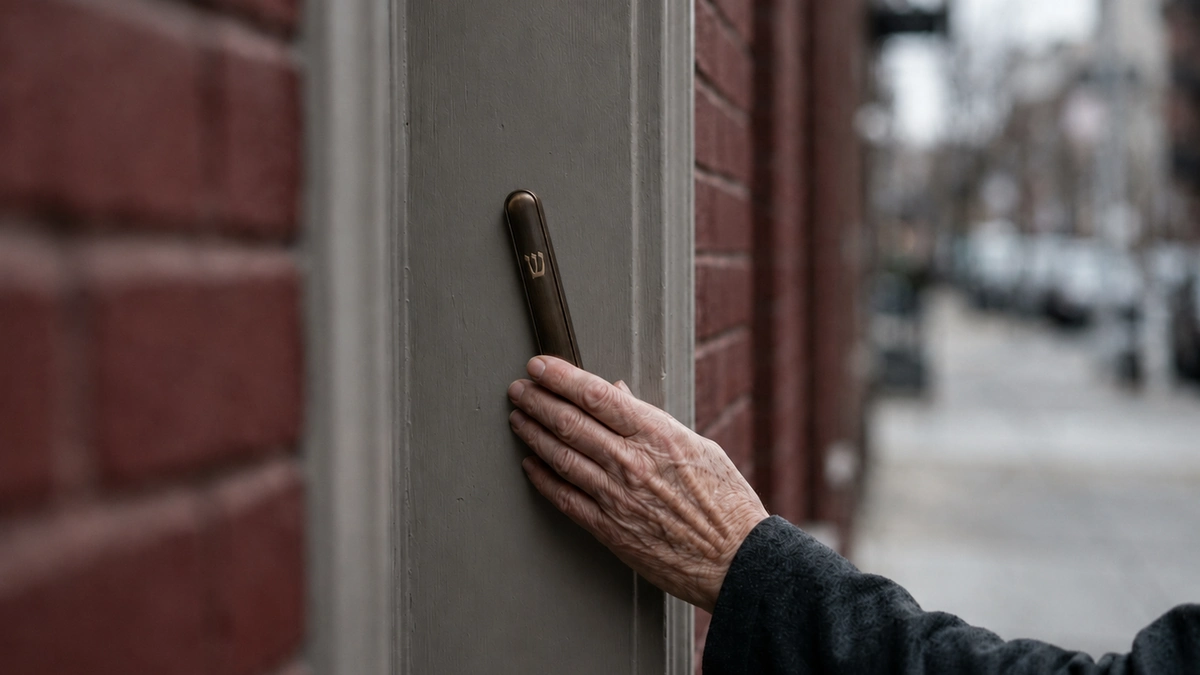
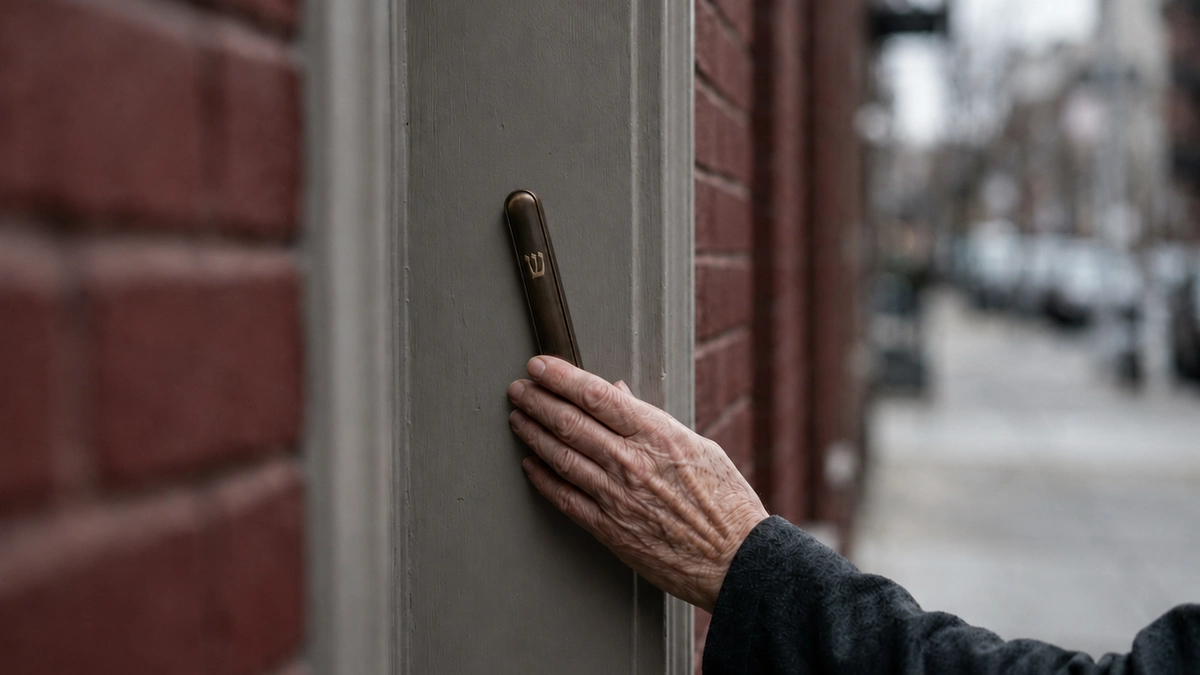
Who Is Responsible for the Mezuzah at a Building Entrance?
The mezuzah on a shared building entrance is one of the most practically common, and most commonly overlooked, halachic questions in apartment living. Who puts it up? Who pays for it? What if a neighbor refuses? These questions come up in buildings all over the world, from Jerusalem to Brooklyn to Los Angeles. The answer is grounded in clear halachic sources, and understanding it will help you fulfill this precious mitzvah properly and with confidence. Related reading: Who Is Responsible for Checking Mezuzahs in Shared Buildings?.
Key Takeaways
- Building entrance mezuzah responsibility is shared collectively by all Jewish residents in the building, not the landlord or management alone.
- The lobby entrance and stairwell passages require mezuzahs based on halachic law, as these are passageways leading to private dwellings.
- All Jewish tenants must share in the cost of the building entrance mezuzah, though halacha does not fix an exact formula for the split, and halacha permits bringing a non-compliant neighbor to a rabbinical court if needed.
- Shared entrance mezuzahs, as a communal mezuzah, must be checked twice every fifty years to ensure they remain kosher (Shulchan Aruch, Yoreh De'ah 291:1), while a private mezuzah is checked twice every seven years, as neglected communal mezuzos are prone to becoming invalid.
- The building entrance mezuzah must be affixed on the right side as one enters; placement questions should be resolved by consulting a rabbi or qualified Torah scribe rather than guessing.
- A properly maintained mezuzah on a shared entrance serves as a communal declaration of the sanctity of the Jewish home and provides spiritual protection for every resident who passes through.
Who Is Responsible for a Mezuzah in a Building Entrance?
Building entrance mezuzah responsibility falls on every resident in the building, collectively. The entrance door to the lobby and the passage from the lobby to the stairwell both require a mezuzah, and that obligation belongs to each tenant or homeowner individually, not to the building management alone. The halacha is clear: shared spaces that serve as a passageway into private dwellings carry a mezuzah obligation, and every neighbor is a stakeholder in fulfilling it. Note that if the building is co-owned or co-occupied with a non-Jewish resident, this changes the picture: Ashkenazic practice (Rema, Yoreh De'ah 286:1) exempts a residence shared between a Jew and a non-Jew from the mezuzah obligation, while Sephardic practice requires a mezuzah there without a blessing, so this scenario should be raised with a rav. If you are unsure about your building's situation, you are welcome to contact Kosher Mezuzah for guidance on how to proceed.
The Halachic Basis: Why a Shared Entrance Requires a Mezuzah
The obligation to affix a mezuzah applies not only to the door of a private apartment but to every entrance through which a person passes on the way to a dwelling. This principle is stated in the Shulchan Aruch (Yoreh De'ah 286) and is rooted in the Gemara: every gate leading toward a person's home is obligated in a mezuzah, including the courtyard gate and even the gate of a city or province when it serves as an approach to houses.
The Rambam (Hilchos Mezuzah 6:7-8) teaches that a beit sha'ar (gatehouse) is exempt from mezuzah on its own, but becomes obligated once a dwelling that requires a mezuzah opens through it, and that when ten structures lead one into the other, all of them are obligated so long as the innermost one is obligated. This is the halachic model that applies to a modern apartment building lobby: it is a beit sha'ar, a passageway to private homes. The entrance door to the lobby and the door from the lobby to the stairwell both fall under this category and require a mezuzah.
The Rishonim, the classical medieval halachic authorities, debated whether a courtyard or shared space is obligated in a mezuzah for its own sake or only because it leads to private dwellings. The Rosh, Tosafot, and the Ramban all hold that a courtyard is obligated for its own sake, provided it has some element of dwelling connected to it. In practice, the halacha follows the view that obligates, as stated in the Gemara and codified by the Shulchan Aruch. A building lobby clearly qualifies: it is enclosed, it is used for regular passage, and it leads directly to private homes.
How This Applies in a Real Apartment Building
In a building with multiple Jewish tenants, the lobby mezuzah obligation falls on each resident individually. This is not merely the responsibility of a building committee or a landlord, it is a personal halachic obligation shared by all Jewish residents. In practice, this means the following. Contemporary poskim rule that stairwells in buildings with multiple tenants are obligated in a mezuzah, and that each tenant must contribute to the expense.
In practice, this means the following. All Jewish residents should share the cost of the mezuzah for the lobby and stairwell, though halacha does not mandate an exact formula for the split — the details can be worked out among residents or with a rav's guidance. If one resident refuses to participate, the others may purchase and affix the mezuzah themselves, and according to some authorities, they may seek rabbinical guidance to resolve the dispute. If two neighbors both want the zechus (spiritual merit) of personally fulfilling this mitzvah, they should purchase the mezuzah together and have one of them affix it with a blessing, so both share in the act.
The text of the mezuzah scroll itself, the parshiyot of Shema and Vehaya, is the same in every kosher mezuzah and does not vary by community. What can vary is scribal custom in the writing or questions of placement; where residents follow different customs on these points, a rav or sofer should be consulted rather than deciding by majority vote. A rav should be consulted for cases where customs diverge significantly. If you need help determining the right mezuzah for a shared entrance in your building, contact Kosher Mezuzah and we will help you find the right solution.
Common Errors to Avoid
One of the most common mistakes is assuming that a building entrance mezuzah is "someone else's responsibility", the landlord's, the building manager's, or the shul's. In halacha, it is not. Every Jewish tenant in the building holds a share in the obligation, and leaving the entrance without a mezuzah means that everyone passing through is not fulfilling the mitzvah as they should.
A second error is failing to check whether the mezuzah on a shared entrance is kosher. Because shared mezuzos are often purchased communally and not monitored by any single person, they are particularly prone to being left unchecked for years. The halacha requires a private mezuzah to be checked twice in seven years, while a communal mezuzah such as a building entrance is required to be checked twice in fifty years (Shulchan Aruch, Yoreh De'ah 291:1); many communities check more often out of caution. Either way, a mezuzah that is pasul (invalid) on a building entrance means that every resident is effectively missing the mitzvah each time they enter. Make sure someone takes responsibility for having the lobby mezuzah checked on schedule. For a deeper look at how shared building mezuzah maintenance should be handled, including who is responsible for scheduling checks, see our full guide on shared building mezuzah maintenance.
A third common error involves the direction of placement. The mezuzah must be affixed on the right side of the entrance as one enters. This applies to the lobby door as one enters from the street and to the stairwell door as one enters from the lobby. If the physical structure of a building entrance raises questions about which side is "right," a rav or a knowledgeable sofer (Torah scribe) should be consulted rather than guessing. These placement considerations apply to other shared spaces as well — if your building includes a shared office or workspace, see our guide on shared office mezuzah requirements for how those situations are handled halachically. Related reading: Foxman Torah Institute Dedicates New Building in Cherry Hill With Mezuzah Affixi.
What This Mitzvah Reminds Us
The mezuzah on a building entrance does something that a private apartment mezuzah alone cannot fully accomplish. It declares, at the very threshold of the entire building, that this is a place where Jewish families live, where Hashem's presence is acknowledged as we enter and as we leave. The Shulchan Aruch reminds us that every gate leading to a Jewish home carries this obligation precisely because the mezuzah is not only a protection for the individual family: it is a statement about the sanctity of the Jewish home from the very first doorway.
When we pass through an entrance with a mezuzah, it is an appropriate time to have kavanah (focused intention), to remember the Unity of Hashem and to pray that He guard our going out and our coming in. This is true of a private front door, and it is no less true of a building lobby. Placing a proper mezuzah on a shared entrance is an act of communal sanctity that benefits every resident who passes through it.
Key Takeaway
The building entrance mezuzah responsibility belongs to every Jewish resident in the building, not to any one person or the building management alone. The lobby entrance and the passage to the stairwell both require mezuzos, based on the halachic principle that any doorway serving as an approach to a private dwelling is obligated. All tenants share in the cost, though the exact split is not fixed by halacha, and the mezuzah must be checked twice every fifty years, per the halacha for a communal mezuzah, to ensure it remains kosher. If a neighbor refuses to contribute, halacha provides a path forward, and a rav should be consulted to navigate the situation properly.
Fulfilling the Mitzvah with Confidence
At Kosher Mezuzah, we understand that shared entrance mezuzos require extra care, not just in the quality of the mezuzah itself, but in ensuring that the obligation is fulfilled properly and with full halachic reliability. Every mezuzah scroll we provide is written by a vetted sofer (Torah scribe) and reviewed by a qualified magiah (halachic mezuzah examiner), our process is endorsed by the Orthodox Union's mezuzah program. You can browse our full selection of kosher mezuzah scrolls and view the actual scroll you receive, along with the name of the sofer who wrote it and the magiah who checked it, because fulfilling this mitzvah deserves that level of accountability.
We also understand that checking a mezuzah, especially one on a shared entrance that may have been in place for years without anyone taking responsibility for it, is not always straightforward. If you are unsure whether the mezuzah on your building's entrance is kosher, or if you need guidance on replacing it, we are here to help. Our goal is simply that the mitzvah is fulfilled properly, with a scroll that is genuinely kosher and reliably verified.
If you have questions about your building entrance, your lobby, your stairwell, or any other shared space, contact Kosher Mezuzah and we will guide you clearly and without pressure. May the mezuzah on your entrance be a zechus for every family in your building, and may Hashem guard all your comings and goings. יְהִי רָצוֹן שֶׁתִּשְׁרֶה שְׁכִינָה בְּבֵיתְכֶם, May it be His will that the Shechinah dwell in your home.


.svg)
Bring a true Kosher Mezuzah into your home
Fulfill the mitzvah with confidence, beauty, and meaning.
Buy a Mezuzah