
Do Automatic or Smart Doors Affect Mezuzah Placement? What You Need to Know
Automatic doors are everywhere today, at building entrances, smart home front doors, sensor-activated garages, and sliding glass entries. If you live in or regularly pass through a space with an automatic door, you may be wondering whether the mitzvah of mezuzah still applies, and if so, how to fulfill it correctly. This is a genuine halachic question, and it deserves a clear, honest answer. The short version: most automatic doors do require a mezuzah, but the details matter, and in some cases the blessing (bracha) may need to be omitted. Let us walk through this carefully. For the full discussion, read Sliding Door Mezuzah.
Key Takeaways
- An automatic door mezuzah obligation is determined by the structure of the doorway (two doorposts and a lintel) and its function as an entrance, not by how the door operates mechanically.
- Most sensor-activated, sliding, electric, and smart doors require a mezuzah, since the door exists and functions to close an entrance; whether the bracha is recited depends on the structure, and in cases of doubt the mezuzah is affixed without a bracha.
- When there is genuine doubt about whether an automatic entrance qualifies or which side is halachically correct, affix the mezuzah without a bracha and consult your rabbi.
- The mezuzah must be placed on the doorpost itself, not on the motorized track, sensor housing, or frame materials, and proper surface considerations apply for aluminum and other materials.
- Each qualifying doorway in a sequence (such as a lobby door followed by an inner corridor door) requires its own separate mezuzah based on individual halachic evaluation.
- Common errors include assuming automatic doors don't need a mezuzah because they're modern technology, and the automatic door mezuzah obligation remains relevant because every entrance—regardless of mechanism—is still a threshold where we sanctify our coming and going.
Do Automatic or Smart Doors Affect Mezuzah Placement?
An automatic door mezuzah obligation depends primarily on the doorway itself, not the mechanism of the door. If the opening has two doorposts (mezuzot) and a lintel (mashkof) above them, and people regularly pass through it as a normal means of entry or exit, the obligation to affix a mezuzah generally applies. The type of door, whether it swings, slides, opens automatically, or opens by sensor, does not change the fundamental nature of the doorway. If you are uncertain about a specific automatic entrance in your home or building, we are glad to help you work through the details.
The Halachic Basis: What Makes a Doorway Obligated?
The Torah obligation for mezuzah attaches to a sha'ar or petach, an entrance. The Gemara in Menachot and the Shulchan Aruch (Yoreh De'ah 286–287) establish that a doorway must have tzurat ha'petach, the "form of an entrance", meaning two upright doorposts and a horizontal lintel connecting them above. This structure is a core condition for a space to qualify as a halachic entrance requiring a mezuzah, alongside other requirements such as the room's minimum size and its use for human dwelling.
A critical and sometimes overlooked question is whether a door itself is required. The Rambam (Maimonides, Hilchos Mezuzah 6:1) held that a house is not obligated unless its doorway is fitted with an actual door, the stricter view among the Rishonim. Based on this, various authorities rule that if no door exists, a mezuzah should be affixed without a bracha out of concern for the Rambam's position. The Rosh, however, disagrees, holding that the obligation of mezuzah does not depend on doors at all (as the Tur records in Yoreh De'ah 286). According to this view, a doorless opening is fully obligated.
The Shulchan Aruch (Yoreh De'ah 286:15) rules that a house is obligated even without doors, and cites the dissenting view that exempts it; out of concern for that view, the practical ruling, as recorded by the Shach and later poskim, is to affix a mezuzah without a bracha when there is no door present. The lintel mezuzah requirement is similarly governed by these same structural principles.
For automatic doors, this framework is directly relevant. The door exists, it simply operates differently. A sensor door, an electric sliding door, or a smart door activated by a phone app is still a door. It still hangs (or slides) within a frame. It still closes the entrance. According to many, the Rambam's requirement is satisfied because there is a functioning door, though some question whether a sliding panel meets the Rambam's definition of a door. The heker tzir, the hinge indicator, may not apply in the same mechanical form to a sliding door, but the presence of a real, functional door closing a real, functional entrance is what matters.
How This Applies to Automatic Doors in Practice
Let us consider the most common types of automatic or smart doors and how the halacha applies to each.
Sensor-activated sliding doors, such as those at building lobbies or some modern home entrances, present a question because they slide horizontally rather than swing on hinges. There is no traditional heker tzir in the hinge sense. But, the opening still has two doorposts and a lintel, and the door itself closes off the entrance when not in use. Poskim (halachic decisors) who have addressed this type of entrance generally treat it as obligated, since the door is present and functional; because there is some question whether a sliding panel counts as a door according to all views, many affix the mezuzah without a bracha, following the rule that a bracha is omitted in cases of doubt. Questions about open doorway mezuzah obligations are closely related, and the same structural principles apply.
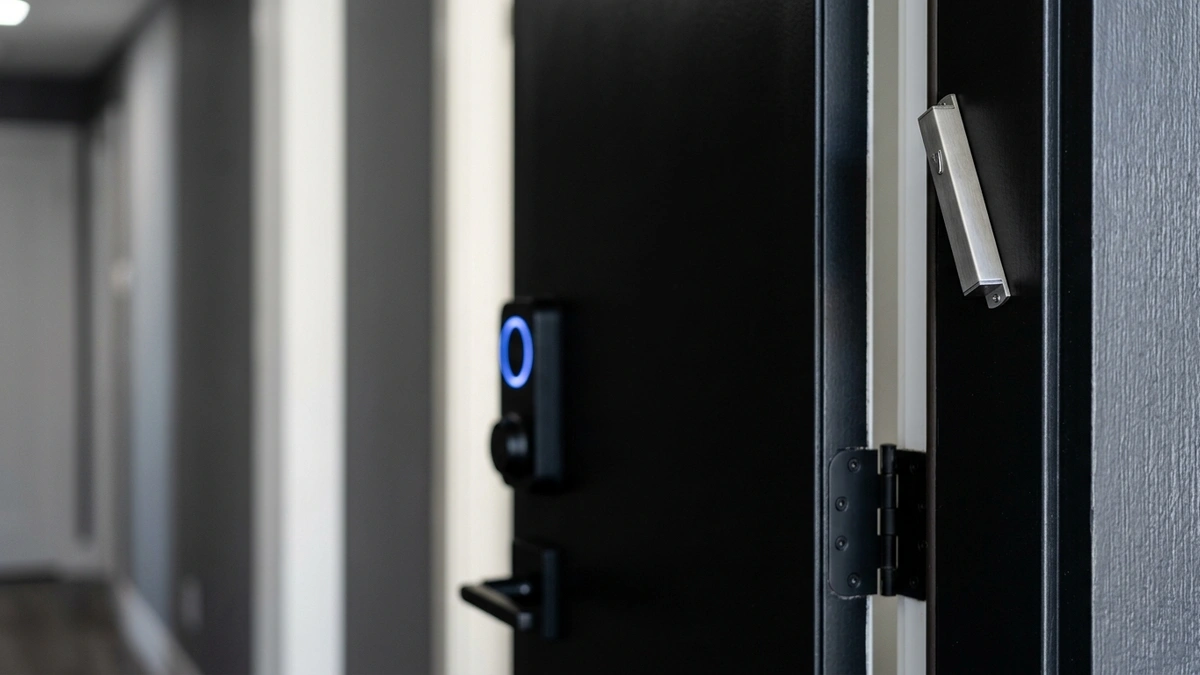
Smart home front doors, standard doors with electronic locks, keypads, or app-based entry mechanisms, are halachically straightforward. The door swings on hinges, has a frame with two posts and a lintel, and functions as a normal entrance. A mezuzah is required with a full bracha on the right side of the entry.
Automatic garage doors raise a separate question: is a garage considered a beit dirah (a dwelling space) obligated in mezuzah, or a mere storage area? If the garage is used only for storing vehicles and has no significant human use, some poskim treat it as entirely exempt from mezuzah, while others require a mezuzah without a bracha. If it contains a workspace, living area, or is regularly used by people in a meaningful way, the obligation may apply. This is a question worth asking your rav.
Pivot doors, large, centrally hinged modern doors common in contemporary design, do have a form of hinge, though it sits differently than a traditional door. Our discussion of pivot door mezuzah placement addresses how the heker tzir principle applies in those cases. Similarly, entrances with glass door mezuzah considerations follow the same structural framework, the material of the door does not affect the obligation: the structure of the doorway does. See also Do Magnets or Electronics Affect a Mezuzah? What You Need to Know.
For any automatic entrance, the practical steps are these: confirm that the opening has two doorposts and a lintel, confirm that the space beyond it qualifies as a room obligated in mezuzah (four by four amot in size and used for human habitation or activity), identify the right side of entry, and affix the mezuzah there. If the door slides and there is genuine uncertainty about which side is halachically "right," consult your rav. If you are also navigating an open concept mezuzah situation, where automatic doors open into large, partially open spaces, the obligation of each individual doorway is evaluated on its own.
One common error we see is the assumption that if a door opens automatically, it does not need a mezuzah because "it's not really a door in the traditional sense." This reasoning does not reflect the halacha. What matters is the structure of the entrance and whether it serves a genuine function of entry and exit for human use. A motion-sensor door at the front of a home is not less of a door because it opens without a hand.
A second error is placing the mezuzah on the frame of the motorized track or sensor housing rather than on the actual doorpost. The mezuzah must be affixed to the doorpost itself, the vertical structural post of the entrance, not to surrounding equipment. Questions about mezuzah wall material and proper surface affixation are also relevant here, since some automatic door frames are made of aluminum or other materials that require special consideration for how the mezuzah is mounted.
If your building has multiple automatic entrances in sequence, a lobby door followed by an inner corridor door, for example, how many mezuzahs you need is determined by counting each qualifying doorway individually. Each one with the proper tzurat ha'petach and functional purpose requires its own mezuzah. The poskim rule that an entrance merely blocked by furniture, but not permanently sealed, retains its obligation because the frame remains functional; certainly an entrance whose door is currently open or in motion retains its obligation.
For entrances in shared buildings, a lobby, a stairwell door, a common hallway, the obligation rests on the residents jointly, since a shared space is obligated in mezuzah (Shulchan Aruch, Yoreh De'ah 286:1), and in practice one resident or the building management typically affixes it on behalf of all. A mezuzah written according to any halachically valid scribal tradition (Ashkenazi, Sephardi, or Yemenite) is kosher for residents of all backgrounds, so the mezuzah placed in common areas does not need to match each resident's personal custom.
If you are unsure whether your automatic entrance qualifies, we are happy to assist you evaluate it. Reaching out to us or to your rav is the right step before affixing or omitting a mezuzah on any entrance that raises a genuine question.
The Deeper Point: The Entrance Is Still an Entrance
There is something worth noting here. The Torah says u'chtavtam al mezuzot beitecha u'vish'arecha, "and you shall write them on the doorposts of your house and on your gates." The word sha'ar (gate) and petach (entrance) both point to the same reality: the place through which you pass as you come and go. Automatic doors have not changed that reality. Every time you pass through an entrance, whether the door swings open by hand or by sensor, you are crossing a threshold that the Torah recognized as a meaningful moment. The mezuzah is there to remind us, at that moment of coming and going, of Hashem's presence and protection.
The mitzvah of mezuzah is not diminished by modern technology. If anything, the proliferation of new door types is an invitation to think more carefully about which entrances in our lives we are truly sanctifying. The removable wall mezuzah question, what to do when walls or doors are temporary, reflects the same underlying concern: is this entrance real enough to obligate a mezuzah? For automatic doors, in most cases, the answer is yes.
Key Takeaway
An automatic door mezuzah obligation is determined by the structure and function of the doorway, not by how the door opens. If the entrance has two doorposts and a lintel, is used for regular entry and exit, and leads to a room or space that qualifies for mezuzah, the obligation applies. Most automatic, sensor, electric, and smart doors meet these criteria and require a mezuzah; whether the bracha is recited depends on the type of door and the structure of the entrance. When there is genuine doubt, about the structure, the use of the space, or which side is halachically right, affix the mezuzah without a bracha and consult your rav. The type of door mechanism does not exempt an entrance from this mitzvah.
About Kosher Mezuzah
At Kosher Mezuzah, every scroll we carry is written by a qualified sofer (Torah scribe) and reviewed by a trained magiah (halachic mezuzah examiner). Our process endorsed by the Orthodox Union, every mezuzah is fully documented, including the name of the sofer, the name of the magiah, the date of writing, the materials used, and an image of your actual scroll. This level of traceability gives buyers the confidence that the mezuzah they are placing on their doorpost is genuinely kosher, not merely marketed as such.
We understand that questions about automatic doors, smart home entrances, and modern architecture are not always easy to navigate. The halacha was not written with sliding glass sensors in mind, and applying it correctly to new situations requires care. That is why we encourage every customer to consult with their rav about any entrance that raises a genuine question, and we are here to help with the practical side of ensuring the mezuzah itself is halachically sound.
If you have an automatic door in your home or building and are uncertain about the obligation or the correct placement, reach out to us directly and we will be glad to help you fulfill this mitzvah properly. May the mezuzah on your doorpost be a source of protection and blessing for all who enter and leave. Yishmor tzeitcha u'vo'echa me'atah v'ad olam, may Hashem guard your going out and your coming in, from now and forever.


.svg)
Bring a true Kosher Mezuzah into your home
Fulfill the mitzvah with confidence, beauty, and meaning.
Buy a Mezuzah