
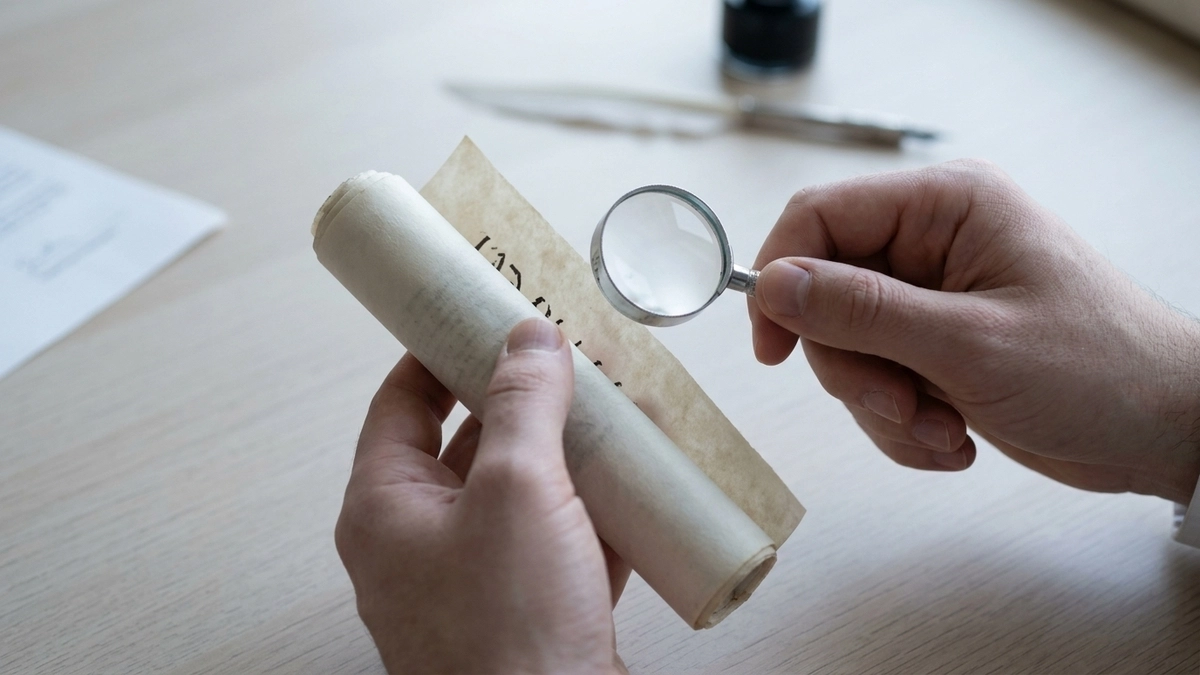
Handwritten Mezuzah Red Flags: How to Spot a Suspicious Scroll Before You Buy
When you purchase a mezuzah scroll, you are fulfilling a mitzvah of Oneness, a Torah obligation that requires a genuine handwritten scroll produced with yiras Shamayim (fear of Heaven) by a qualified sofer.
Understanding the handwritten mezuzah red flags that signal fraud, misrepresentation, or substandard work is not a matter of consumer caution alone. It is a halachic responsibility, because affixing a scroll that does not meet the detailed requirements of STaM does not fulfill the mitzvah. Recognizing these red flags ensures that every letter, spacing, and formation on your scroll upholds the sacred standards required for a kosher mezuzah.
Kosher Mezuzah is dedicated to ensuring the proper fulfillment of the mitzvah of mezuzah, and we have compiled this guide to help you recognize the warning signs before you affix a scroll to your doorpost, so that the mitzvah you perform is the mitzvah halacha commands.
Key Takeaways
- A handwritten mezuzah scroll is only halachically valid when written by a qualified sofer on kosher klaf with proper intent — many core conditions (such as correct text, order, single piece of parchment, proper letter formation, and writing lishmah) are necessary, and when they are missing the scroll is invalid (pasul).
- The biggest handwritten mezuzah red flag is a suspiciously low price, which is a strong warning sign. A genuine handwritten mezuzah requires significant time, skill, and high-quality materials—costs that cannot be cheaply replicated without compromising kashrut.
- Poor, blurry, overly uniform, or machine-like letter formation may indicate the scroll was printed or produced without proper care since STAM laws require each letter to be distinct.
- The absence of a recognized hechsher — such as OU endorsement — or a seller’s failure to provide an actual image of the scroll are serious handwritten mezuzah red flags that should prompt serious questions before purchasing.
- Never rely on a beautiful mezuzah case or a seller’s verbal assurance alone — always demand full written documentation of the scroll’s provenance and consult a qualified rav when any doubt remains.
The Halachic Ruling: A Mezuzah Must Be Written by a Qualified Sofer with Verified Intent
A handwritten mezuzah scroll is only kosher when it is written by a qualified sofer stam, a trained Torah scribe, who writes each letter with kavvanah (intention) for the sake of the mitzvah, on kosher klaf (parchment), with kosher die (ink), following the exacting laws codified in the Shulchan Aruch (Yoreh De’ah 274–288). Many of these conditions are required — especially correct text and order, single piece of parchment, proper letter formation, and writing lishmah — and when they are not met, the scroll is pasul and the mitzvah is not fulfilled.
The single controlling question of this article: what specific warning signs indicate that a mezuzah scroll being sold as handwritten may not meet halachic standards? Every section below is devoted to answering that question directly.
The obligation to affix a mezuzah on each doorpost that meets the halachic requirements is derived from the Torah itself: “And you shall write them on the doorposts of your house and upon your gates” (Devarim 6:9).
Rambam (Hilchot Tefillin, Mezuzah and Sefer Torah, chapter 5) rules that the mezuzah must be written for the sake of the mitzvah, on parchment from a kosher animal, in proper script, with black ink, and by someone writing with intent to sanctify the text for this purpose. Halachic sources — including Rambam (Hilchot Tefillin, Mezuzah and Sefer Torah, ch. 5) and Shulchan Aruch, Yoreh De’ah 274–288 — are clear that a mezuzah written without proper kavvanah lishmah, or on materials that halacha defines as invalid, is pasul. A mezuzah purchased without verifying its provenance is a scroll whose halachic status cannot be confirmed.
Chazal and the poskim emphasize that checking and verifying one’s mezuzos is not optional. According to the Gemara (Yoma 11a), a private mezuzah must be checked twice in a seven-year cycle for the homeowner, while public mezuzos are checked twice in fifty years. The Shulchan Aruch (Y.D. 291:1) codifies this. If a newly purchased scroll comes from an anonymous or unverifiable source, especially in today’s mass market, one generally should not rely on a presumption of kashrut. The burden of verification rests on the buyer, who must make sure to purchase from trustworthy, halachically reliable sources; simply not knowing the scroll’s provenance is not a responsible way to fulfill the halachic requirement.
What the Halacha Requires You to Know Before Buying
Before examining specific red flags, it is worth understanding what a properly sold handwritten mezuzah should include. The sofer’s name must be available and verifiable. The name of the magiah (trained checker) who reviewed the scroll must also be accessible. The date of writing and the materials used, specifically the type of klaf and die, should be disclosed upon request. Halachic guides warn that many people, even Torah-scholars, have affixed mezuzahs incorrectly, and urge buyers to rely on scribes and experts who are fluent in these laws. This caution applies with even greater force when purchasing a scroll from an unfamiliar vendor.
The Rambam wrote with striking clarity (Hilchot Tefillin, Mezuzah and Sefer Torah 6:13): “חייב אדם להיזהר במזוזה מפני שהיא חובת הכל תמיד” — “A person is obligated to be careful with the mezuzah because it is an obligation upon everyone at all times.” This instruction reflects the same principle the Tur and later sources apply to carelessness about mezuzah as a real failure of obligation. When a buyer does not ask basic questions about a scroll’s origin and receives no answers, that carelessness is actionable. Knowing what to ask, and recognizing when an answer is insufficient, is hence part of fulfilling the mitzvah properly.
At Kosher Mezuzah, we are dedicated to ensuring the proper fulfillment of the mitzvah of mezuzah, which is why each scroll we provide comes with verified sofer and magiah documentation, OU endorsement, and QR traceability. Whenever you are considering purchasing, you are welcome to reach out to us through our contact page so that a knowledgeable team member can assist you.
Recognizing Handwritten Mezuzah Red Flags in Practice
A major red flag is an unusually low price. A kosher, handwritten mezuzah scroll requires significant time and skill to produce. The labor of a qualified sofer, the cost of genuine materials, and the checking process all contribute to a minimum cost that cannot be substantially reduced without compromising quality. Scrolls selling significantly below the standard market rate, especially on online marketplaces, are frequently printed, photocopied, or written on invalid materials. In line with the broader principle of beautifying mitzvos — “This is my G‑d and I will beautify Him” (Shemos 15:2; Shabbat 133b) — genuine investment, not discount acquisition, is the natural posture toward a mitzvah of this weight.
Buying an inexpensive scroll from an unverified source creates a real risk that the mitzvah will not be fulfilled, because such scrolls are often printed, photocopied, or written on invalid materials. For more context on where these scrolls often appear and why the risk is real, see our article on purchasing a mezuzah scroll from an online marketplace.
Another red flag involves the physical appearance of the writing itself. Genuine STAM (Sefer Torah, Tefillin, and Mezuzos) script follows strict rules regarding the form of each letter. Each letter must be complete, properly formed, and clearly distinguishable from adjacent letters. If letters appear perfectly uniform, overly mechanical, or otherwise differ in inconsistency of ink flow from line to line, these are signs that the scroll may not have been written by hand at all, or may have been written hastily without proper attention to halachic standards. The Shulchan Aruch (Yoreh De’ah 288) rules that a scroll with such letter defects renders the scroll pasul. Our article on why clear letter formation in a mezuzah scroll matters outlines these standards in greater detail.
Limitations of Mezuzah Supply Chains and Verification
Even well-regarded retail Judaica stores, which operate with good intentions within the community, face structural limitations in providing complete halachic verification for every mezuzah they sell. Most retail stores purchase mezuzot that have been written and checked by others, often passing through multiple distributors before reaching the customer. As a result, detailed documentation about the sofer, the magiah, and the materials used may not always accompany each scroll at the point of sale.
This is not a reflection of the store’s integrity or expertise, but rather a reality of the current supply chain. For buyers who wish to ensure the halachic status of a mezuzah, it is advisable to request documentation from the store or consult a local rav who can inspect the scroll directly. Understanding these limitations helps buyers navigate the marketplace responsibly and make informed decisions about a mitzvah that depends entirely on the validity of the scroll itself.
Additional Practical Considerations
Beyond these primary red flags, buyers should also consider factors that, while not automatically invalidating a mezuzah, can affect the integrity of the mitzvah:
Verification and Documentation
- Verifiable sofer and magiah information: Knowing the names of the sofer and magiah is crucial for authenticity.
- Written certification or hechsher: Trusted rabbinic certification, such as from the Orthodox Union, ensures the scroll meets rigorous STaM standards. Lack of certification does not automatically make a scroll invalid but raises serious questions.
- Documentation over verbal claims: Sellers’ verbal assurances alone are insufficient; written proof linking the scroll to a recognized authority is essential.
Product Transparency
- Actual scroll images: Buyers should see a photograph of the actual klaf they are purchasing, not just decorative case images. QR codes linking to scroll-specific details (sofer, magiah, certification) represent the current standard of transparency.
- Script tradition clarity: Mezuzot follow Ashkenazic, Sefardi, or Arizal traditions. Buyers should confirm the scroll aligns with their community’s practice.
Retail and Marketplace Awareness
- Seller credibility alone is not enough: Even trusted Judaica stores cannot substitute for proper halachic verification.
- Structural reality of distribution: Scrolls often pass through distributors, so documentation may not be attached at the point of sale. Asking the store or consulting a rav can help verify halachic status.
- Market risks: Low-cost or online purchases from unverified sources carry a higher risk of defects, improper writing, or invalid materials.
The Orthodox Union, for example, is the most widely trusted kosher certification agency in the United States, and their standards for STAM extend deep into both the production process and sofer credentials. A scroll bearing no hechsher, or a hechsher from an unverifiable or unrecognizable organization, should prompt careful inquiry before purchase. In an age when documentation from our OU Endorsed process is easily available, there is no reason to settle for unverifiable verbal assurances.
To understand what OU endorsement means for a mezuzah scroll specifically, our frequently asked questions about kosher mezuzah OU standards provide clear answers.
Our article on what a QR code on your mezuzah actually reveals explains how this system works and why it matters for halachic verification.
When evaluating a mezuzah, you should also be alert to sellers who cannot identify the script tradition of the scroll. A Mezuzah written in Ashkenaz, Sefardi, or Arizal script follows distinct letter-formation traditions tied to specific communities and mesorah (tradition). A knowledgeable sofer and a reputable seller can identify the scroll’s tradition to your community’s practice. A seller who is indifferent to this distinction or who cannot answer the question is unlikely to be well-informed about the scroll’s halachic status.
Before final purchase, confirming these script traditions and what they mean for your home, see how Ashkenaz, Sefardi, and Arizal scripts differ from one another. If you are unsure how many scrolls your home requires, our practical guide to doorway obligations and mezuzah placement also provides essential context.
For buyers who want to deepen their background knowledge before making a purchase, our Mezuzah learning center offers a comprehensive foundation in the relevant halachos.
What Every Buyer Should Remember
The handwritten mezuzah red flags discussed above, such as suspiciously low prices, and poor or machine-like letter formation, are sufficient reasons for serious concern. None of them should be dismissed. When even one of these warning signs is present, the buyer’s responsibility is to ask more questions, seek rabbinic guidance, or choose a vendor who can provide complete documentation.
To ensure a mezuzah is halachically valid, buyers should focus on certification and oversight:
- Qualified Sofer Credentials: The sofer must be trained in the detailed laws of STaM, be G‑d-fearing, and have experience writing kosher mezuzot. Certification of the sofer’s training and expertise provides assurance that each letter is formed correctly and that the scroll was written lishmah (for the sake of the mitzvah).
- Independent Magiah (Checker): A qualified magiah should review the scroll after writing, confirming that all letters, spacing, and materials meet halachic standards. This additional layer ensures that any errors in formation or materials are caught before the mezuzah reaches the buyer.
- Rabbinic Certification or Hechsher: Reputable certification agencies, such as the Orthodox Union, review the entire production and checking process. A recognized hechsher confirms that the scroll has been written on kosher parchment, with proper ink, by a vetted sofer, and checked according to halachic requirements.
- Documentation and Traceability: Buyers should request written documentation that includes the sofer’s name, the magiah’s name, and the certifying rabbinic authority. In modern practice, QR codes linking to scroll-specific information—including photographs of the klaf and verification records—provide an additional level of transparency.
By prioritizing sofer credentials, magiah oversight, and recognized certification, buyers can significantly reduce the risk of affixing a mezuzah that does not fulfill the mitzvah. These steps transform concern into confidence, ensuring that every mezuzah placed on a doorpost meets the sacred standards required by halachah.
A qualified rav should always be consulted when there is genuine uncertainty about the kashrut of a specific scroll. If you are ready to fulfill the mitzvah confidently and with full documentation of your scroll’s provenance, we invite you to browse our full selection of certified, verified mezuzah scrolls, where every scroll comes with verified sofer and magiah information and meets the rigorous standards of OU endorsement.



.svg)
Bring a true Kosher Mezuzah into your home
Fulfill the mitzvah with confidence, beauty, and meaning.
Buy a Mezuzah