
How to Place a Mezuzah on a Deep Door Frame (Wide Doorpost Guide)
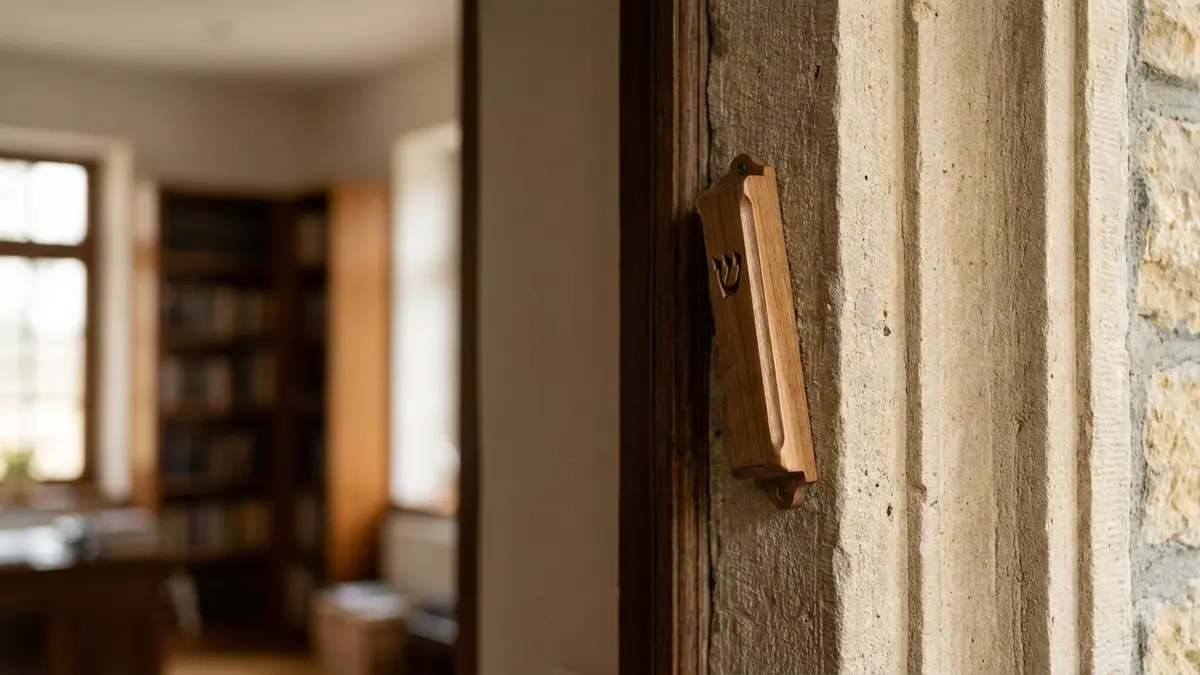
When placing a mezuzah on a deep door frame, the halachic ideal is to fix the mezuzah within the first tefach (handbreadth, approximately 8 centimeters or about 3 inches) of the doorpost, measuring from the outer edge of the doorway toward the interior of the home. This guidance applies whether the doorpost is a standard wood frame, a thick concrete or masonry wall, or a wide casing, though unusual constructions should be shown to a rav. If your wall is unusually deep and the mezuzah has been placed further than a handbreadth from the outer edge, it often needs to be repositioned, but a rav should be consulted to decide whether your current placement is invalid or can be left b’di’avad. If you are uncertain whether your current placement is within this measurement, we encourage you to contact us at Kosher Mezuzah and we will help you assess it.
The Halachic Basis: Why a Handbreadth Is the Limit
The source for this ruling begins in the Gemara in Maseches Menachos (32b), where Rabbi Yosef teaches that if one embeds a mezuzah a tefach deep into the doorpost, the mezuzah is invalid. The Shulchan Aruch (Yoreh De'ah 289:4) codifies this ruling explicitly: the mezuzah must be fixed on the doorpost of the entrance, and carving a recess a full handbreadth into the doorpost renders the placement invalid. The underlying principle is that the mezuzah must be situated in a place that is genuinely considered part of the doorpost of the entrance, not the interior of the wall itself.
The Rishonim discuss this requirement from several angles. Rashi and the Nimukei Yosef understand the Gemara as referring to a physical carved‑out hole in the doorpost and emphasize that the mezuzah should be placed upright in a dignified way. The Rambam rules that one may either nail the mezuzah to the face of the doorpost or carve a recess and insert it, but that setting it into a recess more than a tefach deep, like a bolt sunk into the doorway, is invalid.
Why does this handbreadth define the boundary? Several Poskim, including the Levush and the Bach (Siman 289), explain that beyond a handbreadth, the location is no longer considered the "doorpost of the entrance", the place where the gate closes and where entry is defined. It becomes simply interior wall. The verse instructs us to write the mezuzah "on the doorposts (Mezuzos) of your house" (Devarim 6:9), and if the placement is deep inside the wall's body, the physical connection to the entrance, and to the concept of the doorpost, is severed. This reflects that the mezuzah is meant to be present at the threshold, visibly marking the Jewish home as a place consecrated to Hashem.
A related question discussed among the poskim involves the case where the doorpost itself is wider than a handbreadth. The standard guidance is that l'chatchila (initially, in the optimal manner) the mezuzah should be placed within the handbreadth closest to the outer edge of the doorway, that is, the side facing the street or the hallway outside. If it was placed further in, the question of whether it is valid b'di'avad (after the fact) can depend on whether it is still under the lintel and clearly within a recognizable part of the doorway structure, something best evaluated with a rav. Some situations where the doorframe widens only for decorative purposes are handled differently than cases of true structural thickness, a point addressed further below.
Practical Application: Working With Thick Walls and Wide Frames
In practice, many homes today, especially those built with brick, concrete block, or heavy masonry, have door frames that are significantly wider than a standard 4 to 5 centimeter wooden doorstop. Walk up to your front door and measure the depth of the wall from the outside face to the inside face. If that depth exceeds 8 centimeters (one tefach), it does not mean you cannot affix a mezuzah, it means you must affix it carefully, placing the entire mezuzah within the first 8 centimeters from the outer edge.
Here is how to apply this in the most common scenarios:
When the entire mezuzah fits within the first handbreadth. This is the ideal case. Affix the mezuzah to the doorpost so that the mezuzah case does not cross beyond 8 centimeters from the outer face of the wall. This is valid both l'chatchila and b'di'avad. Questions about mezuzah placement in an apartment often involve exactly this kind of measurement challenge in older building stock.
When a metal or wood frame narrows the doorway in the middle. Contemporary poskim differ on this scenario, whether one should fix the mezuzah in the wider outer portion of the doorway or in the narrower inner frame that seems to function as the primary entrance. Many contemporary guides rule to place the mezuzah on the narrower section, which often serves as the functional entrance, even if this is more than 8 centimeters from the outer wall edge, because that frame is treated as the main tzuras hapesach (form of the doorway). Since details vary by construction, this should be confirmed with a rav.
When the widening is only decorative. If the doorway has a wide decorative casing or molding that does not represent the structural depth of the wall, in many cases the mezuzah should be placed at the beginning of the actual doorway, not at the outer edge of the decorative frame. This follows the general principle that the mezuzah belongs on the doorpost of the entrance, not on purely ornamental additions, though unusual designs should be checked with a rav.
When the mezuzah has already been placed too deep. The halacha is explicit that a mezuzah set into a carved recess more than a handbreadth deep is invalid and must be corrected. When a mezuzah in a deep door frame sits beyond the first tefach, a rav should be asked whether it is halachically comparable to that case and whether it must be removed and re‑fixed in a new position, and if so, with or without a new beracha. Questions related to height, such as when the upper third is physically inaccessible, involve similar logic about what constitutes an obligated, accessible location on the doorpost.
When weather or damage is a concern. If there is genuine risk of sun damage, rain, or vandalism, many contemporary poskim allow, in consultation with a rav, placing the mezuzah somewhat further inside the doorway, deeper than the ideal position, provided it remains under the lintel and is still clearly within the doorway space. This is a b'di'avad accommodation and should not be the default approach. A mezuzah case that protects the scroll can help balance preservation with proper placement in many situations.
If you are unsure how to measure correctly or whether your current placement meets these requirements, we are glad to assist you work through it.
Common Errors to Avoid
The most frequent mistake with a mezuzah on a deep door frame is placing the mezuzah case flush against the interior wall rather than at the outer edge of the doorway. This happens because many people intuitively affix the mezuzah where it is most easily accessible or visually prominent from inside the home, without realizing that the outer edge of the doorpost is where the placement must begin.
Another common error is using an oversized case that pushes the mezuzah up toward the lintel. Shulchan Aruch (YD 289:2) requires the mezuzah to be at least a tefach below the top of the doorway, so one should arrange things so that neither the scroll nor the visible case is pushed into that top handbreadth beneath the lintel, avoiding the question of a mezuzah placed too high.
Halachically, the mitzvah is on the klaf itself; the case is there to protect it. In borderline height questions (for example, a very long case near the lintel), a competent rav will look at where the actual scroll sits relative to the tefach below the lintel, not only at the decorative overhang of the case.
A subtle error involves doorways where the lintel is narrower than the doorposts. In such a case, the mezuzah must be fixed under the lintel. If the doorposts extend beyond the lintel, and it is impossible to fix the mezuzah under the lintel, it may be fixed on the doorpost provided it remains within a handbreadth of the lintel's edge. Ignoring this detail leaves the mezuzah technically outside the required zone. For similar edge-case questions involving the exact surface of an unusual doorpost, our article on Mezuzah on an extended doorpost addresses scenarios where the post itself is an extension of the wall.
A Word on Orientation and Angle
When placing a mezuzah in a deep or recessed frame, the question of whether to place it vertically or at a slant sometimes arises alongside the depth question. The Shulchan Aruch rules that the mezuzah should be placed vertically, while the Rama rules that it should be placed at a slant, diagonally with the top tilted inward. Both of these are valid minhagim (customs), and one should follow the practice of one's community or the guidance of one's rav. For those interested in understanding why the mezuzah is slanted, there is a meaningful halachic discussion behind this practice. When two rooms share a doorway and the dominant side of entry is unclear, reviewing the rules about which side to affix between two rooms will help complete the picture.
The more important point for a door frame is that the position along the depth of the doorpost, within the halachically acceptable zone (ideally the first handbreadth), takes priority over the angle question. A beautifully angled mezuzah that ends up in a placement many poskim regard as outside that zone may not fulfill the mitzvah. Get the depth right first, then address the angle according to your custom.
About Kosher Mezuzah
At Kosher Mezuzah, every mezuzah scroll we provide is written by a trained and G-d-fearing sofer (scribe) and reviewed by a trained magiah (examiner). Our process carries OU endorsement through the Orthodox Union's mezuzah supervision, and we provide full documentation of the sofer, the magiah, the materials used, and the date of writing. This level of traceability is not standard across the market, and it exists precisely because the mitzvah of mezuzah deserves no less. When you know who wrote your mezuzah and that it was properly checked, you can affix it with genuine confidence.
Proper placement and a kosher scroll go hand in hand. A perfectly positioned mezuzah with a pasul (invalid) scroll does not fulfill the mitzvah, and a kosher scroll placed incorrectly on the doorpost achieves the same unfortunate result. We encourage every homeowner and renter to have their mezuzos checked by a qualified sofer at least twice in seven years, more frequently in climates with significant heat or humidity, and to review their placements whenever construction, renovation, or a move creates new questions.
Halachic questions about specific doorways, unusual construction, and edge cases should always be directed to a competent rav. Our role is to support you with verified scrolls, reliable information, and genuine care for the fulfillment of this precious mitzvah. The mezuzah on your doorpost is a daily reminder that your home belongs to Hashem, and it deserves to be placed and maintained with that in mind.
Fulfill the Mitzvah With Confidence
If you have questions about the depth of your door frame, the placement of an existing mezuzah, or whether a current installation needs to be corrected, reach out to us directly at Kosher Mezuzah and we will be glad to help you through it.
May every mezuzah on your doorposts be a source of shmirah (protection), beracha, and zechus for your entire household. יְהִי רָצוֹן מִלִּפְנֵי אָבִינוּ שֶׁבַּשָּׁמַיִם שֶׁיִּשְׁמֹר אֶת בֵּיתְךָ לְעוֹלָם וָעֶד.


.svg)
Bring a true Kosher Mezuzah into your home
Fulfill the mitzvah with confidence, beauty, and meaning.
Buy a Mezuzah