

How Often Should You Check Your Mezuzah? The Halachic Answer Every Homeowner Needs
Mezuzah checking frequency is one of those halachic obligations that many people simply never think about, until something goes wrong. We assume the mezuzah on the doorpost is fine. It was kosher when we bought it, so it must still be kosher now. But parchment ages, ink cracks, and letters can fade or break in ways that invalidate the scroll entirely. The obligation to check our mezuzahs is real, it is rooted in the Gemara, and it is something every Torah-observant household should take seriously. This article will explain how often you are required to check, why the halacha demands it, and what practical steps you can take to make sure your home remains protected and the mitzvah properly fulfilled. For the full discussion, read Can You Reuse an Old Mezuzah Case? What to Check First.
Key Takeaways
- Halacha requires mezuzah checking frequency of twice every seven years (approximately once every 3.5 years) for private homes, with all doorways requiring individual inspection according to the Shulchan Aruch.
- Mezuzah checking should be performed by a qualified magiah who examines every letter and detail of the scroll, as a protective case alone does not prevent ink deterioration or invalidation over time.
- More frequent inspections are necessary if your mezuzah faces weather exposure, visible damage signs, or moisture—and families experiencing hardship should consult a rav about checking their mezuzahs promptly.
- An invalid mezuzah represents a continuous, active unfulfilled mitzvah obligation rather than a dormant problem, making timely detection and correction essential for proper fulfillment.
- Common errors include assuming covered mezuzahs need no inspection, checking only the front door while neglecting interior doorways, and relying on unqualified individuals instead of trained examiners.
- After inspection, a qualified sofer determines whether a mezuzah can be repaired or must be replaced entirely based on the nature and extent of the damage.
How Often Should You Check Your Mezuzah?
Mezuzah checking frequency is governed by a clear ruling in the Shulchan Aruch: a mezuzah in a private home must be inspected twice every seven years. That works out to roughly once every three and a half years. If you have not had your mezuzahs inspected in the past three to four years, halacha requires that you do so now. We encourage you to review our mezuzah inspection services and schedule a check with a qualified sofer (scribe) or magiah (halachic mezuzah examiner).
This ruling applies to every mezuzah in your home, not just the front door. Every doorway that requires a mezuzah must be checked on the same schedule. The obligation is not optional, and it does not disappear simply because the mezuzah looks fine from the outside.
What the Halachic Sources Actually Say
The source for this obligation is the Gemara in Yoma (11a), which states that a mezuzah belonging to an individual must be checked twice in seven years. The Shulchan Aruch codifies this ruling in Yoreh De'ah 291:1. Poskim discuss the status of a house owned by multiple partners; in practice, a family home follows the private-dwelling standard, and the lighter standard of a "public" mezuzah does not apply to it.
Halachic authorities note something important: even if a person checked several of his mezuzahs and found them all to be valid, he is still obligated to check the remaining ones. You cannot assume that because some passed inspection, all will pass. Each mezuzah must be examined individually.
Why a Public Mezuzah Is Checked Less Often
The Gemara distinguishes between a private mezuzah and a public one, such as a mezuzah on a shul, beit midrash, or communal building. A public mezuzah is only required to be checked twice in fifty years, which corresponds to a yovel (Jubilee) cycle. Rashi (Yoma 11a) explains that the rabbis were lenient here because one should not over-burden the public — were the requirement frequent, each individual would leave the task to others. This is a limited exception and does not apply to a home.
The Deeper Obligation: Every Moment Counts
The Minchat Chinuch (Mitzvah 423) makes a striking point: unlike some mitzvot that are performed once and completed, the mitzvah of mezuzah is ongoing. Every moment a Jewish home has an invalid mezuzah, or no mezuzah at all, there is a continuous omission of the mitzvah. This understanding makes checking not just a legal technicality, but an expression of our ongoing commitment to guarding the sanctity of our homes. An invalid mezuzah that goes undetected is not a dormant problem: it is an active one.
What Must Be Checked During an Inspection?
A qualified magiah does not simply glance at the scroll. A proper inspection means examining every letter of the mezuzah text (traditionally counted at 713 letters) to confirm that the tzurat ha'ot (correct form of each letter) is fully intact. The examiner checks for cracked or faded ink, letters that have merged, letters that have broken, and whether the sirtut (the halachically required scored lines guiding the writing) is present. He also confirms that the klaf (parchment) itself has not deteriorated in ways that affect the validity of the scroll.
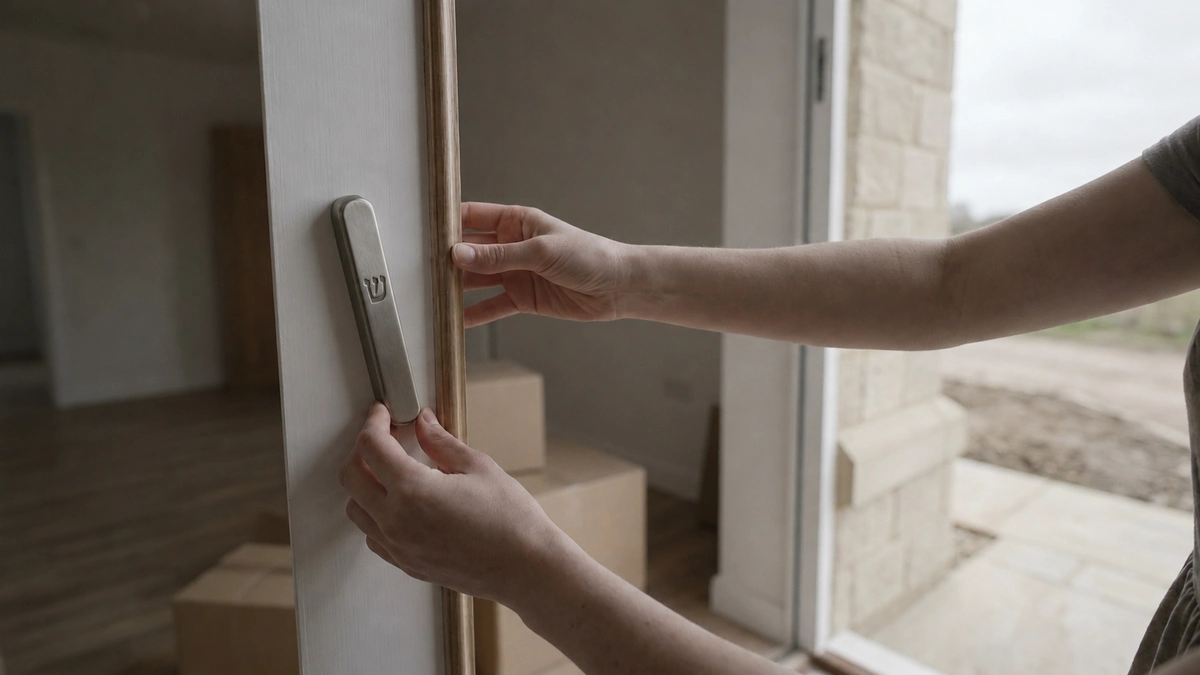
Signs of wear are not always visible without removing the scroll from its case. This is why opening a mezuzah case for inspection is not optional, it is part of the obligation itself.
When Are More Frequent Checks Required?
The twice-in-seven-years schedule is the baseline. But, poskim (halachic decisors) have identified circumstances that require more frequent inspection.
Weather and environment are major factors. A mezuzah placed in a covered indoor doorway is far less exposed than one affixed to an exterior gate, a seaside porch, or a doorway in a region with extreme humidity. Mezuzah weather damage can accelerate the deterioration of both klaf and dio (ink), sometimes making a mezuzah pasul (invalid) well before the three-and-a-half-year mark.
Signs of visible damage also require immediate attention. If you notice mezuzah damage signs, a cracked case, moisture, discoloration, or peeling on the scroll itself, do not wait for the regular inspection cycle. Have the scroll examined by a magiah without delay.
A family experiencing hardship is another situation that has long prompted poskim to recommend checking the mezuzahs. The Gemara (Shabbat 32b) warns of severe consequences for neglecting the mitzvah of mezuzah, and another Gemara (Bava Metzia 102a) records a tragic incident where a man suffered devastating personal loss after improperly removing a mezuzah from a home. While we do not make mechanistic claims about cause and effect, the tradition of checking mezuzahs during difficult times reflects the halacha's sensitivity to the connection between a kosher mezuzah and shmirat Hashem (Divine protection).This is not superstition, it is halachic awareness. You are encouraged to speak with a rav about mezuzah neglect halacha if your household has gone many years without an inspection.
After the Inspection: Repair or Replace?
Not every mezuzah that fails inspection must be replaced entirely. Sometimes a qualified sofer can repair specific letters that have cracked or faded, as long as the repair meets the halachic standards for correction. Other times, the damage is too extensive and a new mezuzah is required. If a replacement is needed, you can explore our OU Endorsed (OU STaM) mezuzah scrolls here — each one written by a named sofer and checked by a named magiah.The decision depends on the nature and extent of the invalidation, and it must be made by a qualified sofer or magiah, not by the homeowner alone. Understanding the difference between mezuzah repair vs. replacement can help you have a more informed conversation with your examiner.
Common Errors That Affect Proper Fulfillment
One of the most frequent mistakes we see is the assumption that a mezuzah in a protective case needs no inspection because "it's covered." A case protects the scroll from physical damage but does not prevent ink from naturally cracking or drying over time. The case must be opened and the scroll unrolled at every inspection, and having it examined by a qualified magiah is the reliable way to catch defects that an untrained eye would miss.
Another common error is checking only the front door and overlooking interior doorways. The halacha applies to every obligated doorway in the home. A thorough inspection covers all of them, from the bedroom doorways to the study. The OU's mezuzah endorsement program (OU STaM), which we work with closely at Kosher Mezuzah, emphasizes this completeness as part of what genuine halachic compliance requires.
A third mistake is relying on a non-expert to evaluate the scroll. Evaluating a scroll properly requires being fully versed in the complex laws of *tzurat ha'ot* (the precise forms of the letters) and proper spelling. Handing a scroll to a well-meaning friend who "knows a bit about sofrut" is not a substitute for a trained magiah.
Key Takeaway
The halacha requires that every mezuzah in a private home be checked twice every seven years, approximately once every three and a half years. This obligation applies to all obligated doorways, not only the front door. Environmental conditions or visible damage are reasons to check sooner, and checking during times of family difficulty is a long-standing practice. The inspection should be performed by a qualified magiah who examines every letter of the scroll. An invalid mezuzah that is not detected and corrected represents a continuous unfulfilled obligation, and addressing it promptly is both a halachic requirement and an act of care for one's home and family.
How Kosher Mezuzah Supports Proper Fulfillment
At Kosher Mezuzah, every scroll we provide is written by a named sofer and checked by a named magiah (halachic examiner). We provide full traceability, the sofer, the magiah, the date of writing, the materials used, and an image of your actual scroll, so that you can confirm the chain of kashrut from the sofer's quill to your doorpost. Our mezuzahs are endorsed through the OU's mezuzah program, and we take seriously the responsibility of ensuring that every household receives a scroll that is genuinely kosher.
We also recognize that owning a kosher mezuzah is only part of the obligation. The mitzvah must be maintained over time. Our FAQ on mezuzah checking frequency addresses many of the practical questions homeowners have about inspection, replacement, and what to expect from the process. If you have questions about the kashrut of a scroll you already own, we are here to help.
If you are not certain when your mezuzahs were last inspected, or if you have reason to believe they have been exposed to moisture, heat, or physical damage, please reach out to us directly. We can connect you with a qualified magiah and help ensure that your home's mezuzahs are fulfilling the mitzvah properly.
May your home be a bayit ne'eman b'Yisrael, a faithful Jewish home, and may the zechus (merit) of this mitzvah bring beracha and shmirah to all who dwell within it.


.svg)
Bring a true Kosher Mezuzah into your home
Fulfill the mitzvah with confidence, beauty, and meaning.
Buy a Mezuzah