

Mezuzah Scroll Guide: What It Says, What It Costs, and How to Know It's Kosher
The complete buyer's guide to the mezuzah scroll: contents, scripts, sizes, honest prices, and the checks that make it kosher.
What a Mezuzah Scroll Is, in Brief
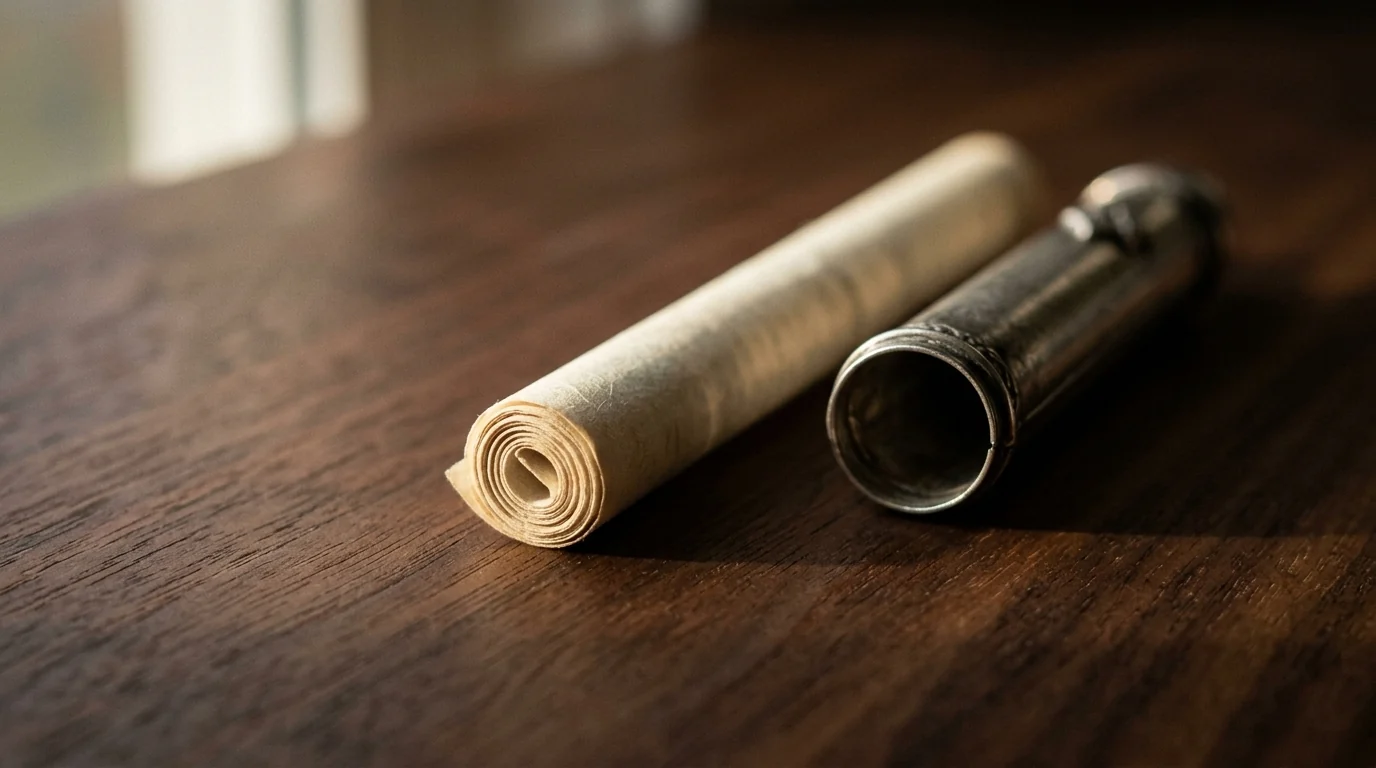
A mezuzah scroll is a small piece of parchment on which a trained scribe, a sofer, writes two passages from the Torah by hand: Shema Yisrael (Deuteronomy 6:4-9) and Vehaya Im Shamoa (Deuteronomy 11:13-21). Together they contain the commandment itself, "and you shall write them on the doorposts of your house and on your gates." The scroll, not the decorative case, is the mezuzah. To be kosher it must be handwritten with a quill and kosher ink on parchment from a kosher animal, on scored guide lines, with every letter correctly formed and in order. A printed or photocopied scroll does not fulfill the mitzvah. The scroll is rolled and placed in a case on the right doorpost as one enters, in the upper third, and is checked twice every seven years.
Key Takeaways
- The mezuzah scroll (klaf) is the mitzvah itself - the case is only there to protect it. A beautiful case with a printed or pasul scroll inside does not fulfill the mitzvah.
- Every kosher scroll contains the same two Torah passages: Shema (Devarim 6:4-9) and Vehaya Im Shamoa (Devarim 11:13-21), handwritten by a vetted sofer.
- A kosher handwritten scroll starts around $140; the difference in price reflects the sofer's time and the level of hiddur, not the materials.
- Printed scrolls, photocopies, and "decorative" scrolls are never kosher, no matter how authentic they look.
- Have your scrolls checked by a qualified examiner twice every seven years.
What exactly is a mezuzah scroll?
When people say "mezuzah," they usually picture the decorative case on the doorpost. But halachically, the mezuzah is the scroll inside - a piece of parchment called a klaf, made from the skin of a kosher species of animal, on which a trained scribe (a sofer STaM) has handwritten two passages from the Torah with kosher ink and a quill or reed pen.
The case can be silver, wood, glass, or plastic - it makes no halachic difference. The scroll is what fulfills the mitzvah. That is why buying a "mezuzah with scroll included" from a gift shop or marketplace needs real care: the case may be lovely while the scroll inside is printed, incomplete, or was never kosher to begin with. (We wrote more about that in our guide to why buying a mezuzah on Amazon can be risky.)
What does the mezuzah scroll say?
Every kosher mezuzah scroll in the world contains the same two paragraphs, written in order:
- Shema Yisrael (Devarim 6:4-9) - the declaration of Hashem's oneness, the command to love Him, to teach Torah to your children, and the source of the mitzvah itself: "and you shall write them on the doorposts of your house and on your gates."
- Vehaya Im Shamoa (Devarim 11:13-21) - the Torah's promise that keeping the mitzvos brings blessing, and the same instruction to place these words on our doorposts.
In English, the opening line reads: "Hear, O Israel, Hashem is our G-d, Hashem is One." The two passages together are the "words" the Torah commands us to write on our doorposts - so the scroll on your door is not a symbol of the commandment; it is the commandment, word for word.
On the back of the scroll, the sofer writes the Name Shakai (spelled shin-dalet-yud) - often explained as standing for "Shomer Dalsos Yisrael," Guardian of the doors of Israel. Many scrolls also carry an additional traditional inscription on the back. When the scroll is rolled and placed in a case with a window, the shin-dalet-yud is what shows through.
Why the scroll must be handwritten
The halacha for a mezuzah scroll follows the same standards as a Torah scroll. To be kosher, it must be:
- Handwritten by a G-d-fearing, trained sofer - never printed, stamped, or photocopied
- Written on klaf (parchment) from a kosher species of animal
- Written on ruled parchment (sirtut) - a mezuzah written without scored guide-lines is pasul
- Written with kosher ink and a quill or reed pen (kulmus), with the sofer's proper intent (kavanah) for the sanctity of the mezuzah and of Hashem's Names
- Complete and in order - every letter properly formed, no letter missing, cracked, or touching another, and the passages written in the order they appear in the Torah
One flawed letter can render the entire scroll pasul (invalid) - and a missing letter cannot be added later: because the passages must be written in order, such a scroll is beyond repair. This is why serious sellers have every scroll computer-checked and then examined again by trained human examiners (maggihim) before it ships - and why a suspiciously cheap "kosher scroll" usually is not. Our full checklist is in the Kosher Mezuzah FAQ. For a related question, see Do You Have to Kiss the Mezuzah? What the Halacha Actually Says.
A word about the person behind the scroll: a sofer STaM trains for years in the laws of the letters before writing scrolls for others, and reputable programs certify that competence. The same discipline that qualifies a sofer to write a mezuzah also governs Sifrei Torah and tefillin - it is one profession trained on one body of law, which is why the sofer's name and credentials are worth asking for wherever you buy.
Ashkenaz, Sefardi, or Arizal - which script?
Jewish communities follow long-established scribal traditions for the shape of the letters (the ksav). The text is identical; the letterforms differ:
- Ashkenaz (Beis Yosef) - the script used by most Ashkenazi communities
- Sefardi (Vellish) - the script of Sephardic communities
- Arizal - followed by many Chassidic communities
Each person should follow their own community's tradition. All three are accepted scripts, and according to most poskim a scroll written in another tradition's script is still kosher - so if you already own one, ask your Rav rather than assuming it has to be replaced. If you are not sure which tradition applies to your family, that is also a question for your Rav - and see our full comparison: What's the difference between Ashkenaz, Sefardi, and Arizal mezuzahs?
What sizes do mezuzah scrolls come in?
Scrolls are measured by the height of the parchment. The most common household sizes are 12 cm (about 4.7") and 15 cm (about 5.9"). Two practical points:
- Your scroll must fit your case - a 12 cm scroll needs a case with at least that interior height. Buy the scroll first, then the case.
- Halacha sets no minimum size - a small scroll written correctly is fully kosher. But very small scrolls are harder to write: every letter still needs perfect form in a fraction of the space, which is why tiny scrolls from reputable sofrim often cost more, and why very cheap tiny scrolls deserve extra suspicion.
For matching scrolls to doorways and cases, see our mezuzah size guide.
How much does a kosher mezuzah scroll cost?
A genuinely kosher, handwritten scroll from a vetted sofer starts at about $140. Here is our current pricing, as a real-world reference:
| Scroll | Script | Sizes | Price from |
|---|---|---|---|
| Sefardi scroll | Sefardi | 12 cm / 15 cm | $140 |
| Ashkenaz scroll | Beis Yosef | 12 cm / 15 cm | $150 |
| Arizal scroll | Arizal | 12 cm / 15 cm | $140 |
Why the range? The price of a scroll is almost entirely the sofer's skilled time - roughly 2-4 focused hours of writing for a single scroll, before the examination chain even begins: a computer scan, then a trained magiah reviewing every letter, word, and spacing. The materials carry real cost too: klaf prepared to halachic standards and traditionally made ink (dio). A standard kosher scroll takes hours of exacting handwork; a mehudar scroll - written and checked beyond the minimum halachic requirements - takes considerably longer, which is what you pay for. (More in: What "mehudar" actually means.)
Be careful at the extremes: a $25 "kosher scroll" is essentially always printed or written so quickly that its kashrus is doubtful. There is no halachic shortcut that makes a hand-written-to-standard scroll that cheap.
Can I write my own mezuzah scroll?
Practically speaking, no. Writing STaM (Sifrei Torah, Tefillin, Mezuzos) is a trained profession: the sofer must know the detailed laws of every letter's form and write with the required intent. Certification is not itself a halachic requirement - it is how you know a sofer actually meets those standards. A scroll written by an untrained hand - however sincere - will almost certainly be pasul. If the idea of writing appeals to you, some sofrim will let a buyer watch a scroll being finished; that is the kosher version of the experience.
Putting the scroll in the case and on your door
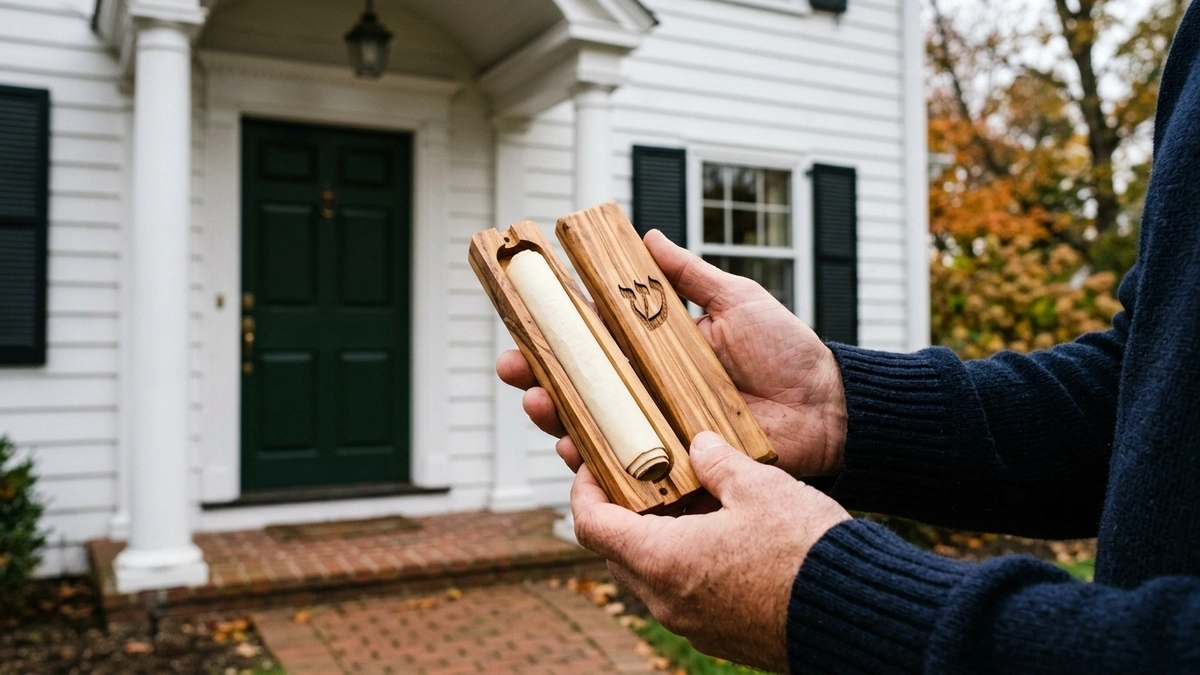
The scroll is rolled closed - from the end of the text toward the beginning - wrapped, and placed in the case with the top of the writing up, so that the shin-dalet-yud shows through the case window. Then the case is fixed to the right side of the doorway as you enter - on the left it is pasul - at the bottom of the top third of the doorpost. Ashkenazi custom is to slant it, top toward the inside; Sephardic custom, following the Shulchan Aruch, is to affix it straight upright. Follow your family's practice, and ask your Rav if you are unsure. Full walkthrough with photos: common mezuzah placement mistakes - and if you are wondering which doorways in your home need one, see how many doorways need a mezuzah.
What about the case?
The case is the scroll's shield - against weather, touch, and time - and beyond that it is a matter of taste, not halacha. Two practical notes: pick a case tall enough for your scroll (a 12 cm scroll needs a 12 cm-interior case), and if you like the look of a window case, that is what the Shakai on the back of the scroll is positioned to show through. Our scrolls ship with a choice of no case, classic white, or clear acrylic. For a deeper comparison of materials, see glass vs wood vs metal cases and the case size guide.
Keeping the scroll kosher: checking
Parchment and ink live in the real world - humidity, sun, and time can crack letters and invalidate a scroll silently. Halacha requires mezuzos to be examined by a qualified examiner twice every seven years. Scrolls on exterior doors or in humid rooms deserve closer attention. If a check finds a problem, ask the examiner what your options are - a scroll that is beyond repair is set aside with respect (geniza) and replaced. See our FAQ for what happens to a pasul scroll.
Where to buy a kosher mezuzah scroll
Wherever you buy, insist on three things: (1) a named, vetted sofer behind the scroll, (2) independent checking - computer plus human examiner, and (3) real oversight of the seller. Every scroll we sell is handwritten in Eretz Yisrael by vetted sofrim, computer-checked and examined before shipping, and sold under the Orthodox Union's STaM program - the OU lists us on its own mezuzah page among the vendors selling OU Endorsed Mezuzahs. Each scroll ships with a QR-verified record of the sofer who wrote it and the inspection it passed.
Shop kosher mezuzah scrolls - Sefardi, Ashkenaz (Beis Yosef), and Arizal, from $140.


.svg)
Bring a true Kosher Mezuzah into your home
Fulfill the mitzvah with confidence, beauty, and meaning.
Buy a Mezuzah